


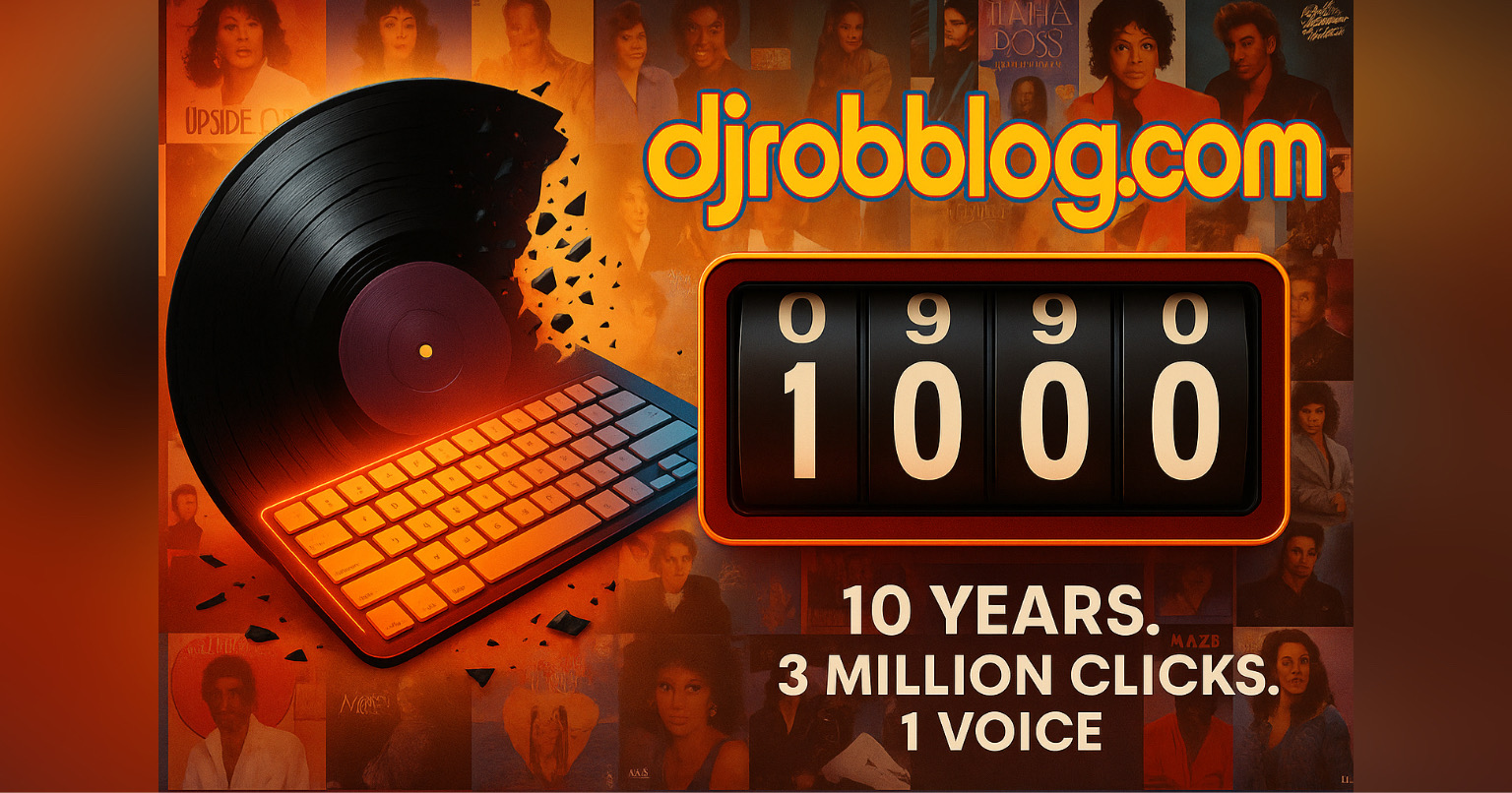
(July 19, 2025) — When I published my very first blog post in January 2015, which contemplated the state of Black musicians as they were not represented in the top ten of the Hot 100 for the first time in nearly 28 years, I had no idea what I was starting. I just wanted to write about music — the songs, the charts, the artists, and the emotions they stirred.
Now, 1,000 posts and more than 3 million clicks later, I’ve learned more than I ever imagined — not just about music, but about the world, about culture, and even about myself (and some of you)!
So as I celebrate this milestone, I wanted to pause, reflect, and share a few things I’ve learned on this ride, along with my appreciation to the thousands of people who’ve clicked my articles three million times since Day 1.

⸻
🎵 1. Music Is Still a Universal Language — And Always Will Be
No matter how much the industry evolves, how fragmented the platforms become, or how quickly trends shift, music remains one of the few constants that unites us all. Whether it’s a chart-topping pop anthem, a TikTok snippet, or an overlooked deep cut from the past, music has the power to connect people across race, gender, generation, geography — even (sometimes annoyingly) ideology.
This blog has allowed me to see just how deeply music resonates with people. I’ve received comments from readers in countries I’ve never visited, thanking me for highlighting an artist they love or revisiting a song they thought they’d forgotten. I’ve developed pen pals — even phone pals — in places as far away as Slovakia. That’s the magic of it: music transcends. And that’ll never change.
⸻
📻 2. Crossover Isn’t Always a Compliment — And Social Media Proved That
Being a member of several music discussion groups on Facebook has been eye-opening. One thing I’ve noticed? Crossover success— especially into pop territory — isn’t always celebrated in hindsight. Often, the artists who crossed over most visibly in the ‘70s, ‘80s, or ‘90s are now viewed with suspicion or even side-eyed as “sellouts.” Or they’re relegated back to their original genres — almost as if they hadn’t crossed over at all.
I’ve seen artists get pigeonholed as “R&B” even when their music clearly cuts across genres. Conversely, some have been stripped of their cultural credit simply because their biggest hits happened to chart on the pop side too. This same type of scrutiny doesn’t always apply to non-Black musicians. A former rap artist like Post Malone being accepted by the country music community in the same year Beyonce made a genre-smashing entry but was roundly rejected is probably the most visible example of this. It’s a sad reminder that genre classification isn’t just about sound — it’s about race, identity, and cultural ownership. And sometimes, it’s about what people feel has been taken away from them, not just what’s been shared.
⸻
📈 3. Streaming Changed Everything—Especially the Billboard Charts
The rise of streaming has turned the music world upside down — and I’ve tried to give readers a front-row seat for all of it. Once upon a time, Billboard charts reflected what people bought or what radio played. Now, it’s about what people click. And with that change came a shift in chart dynamics: fewer songs cycle in and out each week, and blockbuster album releases can flood the Hot 100 with dozens of tracks at once — unheard of in the 20th century.
In the pre-streaming era, a song reaching the Top 10 felt like climbing a mountain. Now, it sometimes feels like a side effect of fanbase-driven streams. You almost have to have a huge built-in following on platforms like Spotify or Apple Music to even stand a chance at having a hit. I don’t say that to knock it — it’s just different. But I do miss the days of faster turnover, of songs fighting their way up week by week. Back then, longevity was earned over time — not dumped on the charts in bulk.
⸻
🎯 4. Genres May Be Blurring, But Culture Still Matters
A turning point came in 2012 when Billboard decided to change the methodology for its genre charts — specifically R&B/Hip-Hop and Country. The change meant these charts would mirror the Hot 100 by using the same all-genre consumption data: streaming, downloads, and airplay, regardless of who was doing the consuming.
The result? The cultural essence of these charts began to fade. Songs that once would have been propped up by the core R&B or country audience were now competing with crossover behemoths. The genre charts no longer told (and still don’t tell) the story of those communities. They tell the story of everyone — and, in doing so, no one in particular.
What was lost in that shift wasn’t just chart clarity — it was cultural identity. And even in a world where genres are “dying,” the culture behind them still lives and still deserves to be recognized.
⸻
🎤 5. From Rock to Rap: A Cultural Shift with Complex Consequences
As hip-hop has risen to become the dominant force in music, its takeover hasn’t been without resistance — from rock traditionalists mourning their genre’s decline to members of the Black community wrestling with what hip-hop now represents.
What started as a powerful storytelling tool — amplifying life in the margins — has too often become a platform for braggadocio and posturing. The cautionary tales of early hip-hop have, in most cases, evolved into glamorized portrayals of violence and excess. Tragically, what’s performed for the mic too often becomes reality in the streets, with real-life consequences for the very communities that created the music.
Still, numbers don’t lie: R&B/hip-hop, now tracked jointly, has been the most consumed genre in America for eight years straight. It’s today’s cultural engine — just as rock once was — shaping everything from fashion to language to the Billboard charts themselves.
⸻
🪦 6. The Artists We’ve Loved and Lost Will Always Be With Us
From the very first memorial I wrote — about Natalie Cole following her 2015 passing — to the most recent (Connie Francis), and the more than 100 artists in between, researching and writing about these legends has introduced me to even more of their music than I knew existed. It was thrilling to discover — or rediscover in some cases — long lost gems or some historic anecdotes about these artists that I — and maybe you — never knew previously. People sometimes chided me as a chaser of the undertaker, but it’s never been an obsession with morbidity. It’s always been an appreciation for the roles these artists played in creating the complex musical tapestry we get to enjoy long after they’re gone, and a respect for their achievements along the way.
🗳️ 7. Politics Suck — But They’re a Necessary Evil that Often Plays Out In Music
Political protest isn’t new. Even in music, it’s been part of rock and roll since before the days of Nixon or the Vietnam War. But, to someone like me, it seemed that the protests back then rallied around what was generally believed to be the common good (anti-war, anti-racism, anti-oppression, pro-women). Today, the loudest voices seem to be on the extreme ends of political ideologies that reflect how polarized we’ve become.
Also, big-name artists are chided for inserting themselves into politics (read Bruce Springsteen, Taylor Swift, Beyoncé), while others (like Kid Rock and Ted Nugent) are mocked for their well-known political views. Meanwhile, the cancellation of an artist for making offensive (racially insensitive) remarks is as chastised as the comments that led to the cancellation. The rise of Morgan Wallen as this decade’s biggest male artist is the surest proof.
But Wallen — like Springsteen, Beyoncé and Swift — is protected by the First Amendment and that still matters, unless and until the executive branch of our government decides to insert itself in the conversation — as both the judge and enforcer — of what should and should not be protected as free speech.
⸻
🎵 8. Concerts Still Matter
In this age of streaming, where many artists are paid as low as thousandths of a cent per click of their songs, it’s still important to support them in other ways, including their concert tours. Although I’m no longer a fan of huge crowds, I’ve attended more than a hundred concerts since 2015 — mostly before the pandemic — and documented them all here. The best among them were Stevie Wonder (3 times), Jeff Lynne’s Electric Light Orchestra (twice), Marilyn McCoo & Billy Davis, Jr., and the British band Squeeze (surprisingly!). Still on the bucket list: Jeffrey Osborne, Ron & Ernie Isley as the Isley Brothers, Charlie Wilson, Pat Benatar & Neil Giraldo, and Rod Stewart.
⸻
✍🏾 9. Blogging Isn’t What It Used to Be — But I’m Still Here
When I started djrobblog.com, blogs were a thing. People read longform content. They clicked, commented, and shared. In 2018, this site peaked at nearly a million hits — and it felt like the sky was the limit.
Then came the pandemic. Then came TikTok, Instagram Reels, and short-form everything. People stopped reading as much. And like so many others, my blog’s clicks slowed. Attention spans shrank. Algorithms changed. SEO (search engine optimization) started to matter more than soul.
But even through that shift, one thing hasn’t changed: my gratitude. For every person who still clicks. Who still reads all the way to the end. Who shares a post or leaves a comment. You’re the reason I keep doing this.
This started as a hobby, became a (non-paying) business, and evolved into a full-blown passion project. And as long as I have the ability to write and the love of music in my heart, I have no plans to stop. (Weirdly, the clicks have gone up again in 2025, which is trending to see a year-over-year increase over 2024’s readership — and I’m NOT complaining.)
⸻
🙏🏽 10. Thank You—for Everything
To those who’ve been riding with me since blog post Number One — or even if you just hopped on this week — thank you from the bottom of my heart. You’ve helped me create something lasting. Something personal. Something joyful!
Here’s to the next 1,000!
And with my original sign-off: Thanks for all the love and support of DJROBBLOG!
DJRob

DJRob (he/him) is a freelance music blogger from the East Coast who covers R&B, hip-hop, disco, pop, rock and country genres – plus lots of music news and current stuff! You can follow him on Bluesky at @djrobblog.bsky.social, X (formerly Twitter) at @djrobblog, on Facebook or on Meta’s Threads.
You can also register for free here (or by selecting the menu bars above) to receive notifications of future articles.
Related Reading: The Blog’s Very First Article (January 2015)
Congrats, Rob! I’m a reader — I can’t get into TikTok or all that video short stuff — and I really appreciate your thoughtful writing. Here’s to many more posts!
Thanks so much! And please continue… there’s much more to come.