


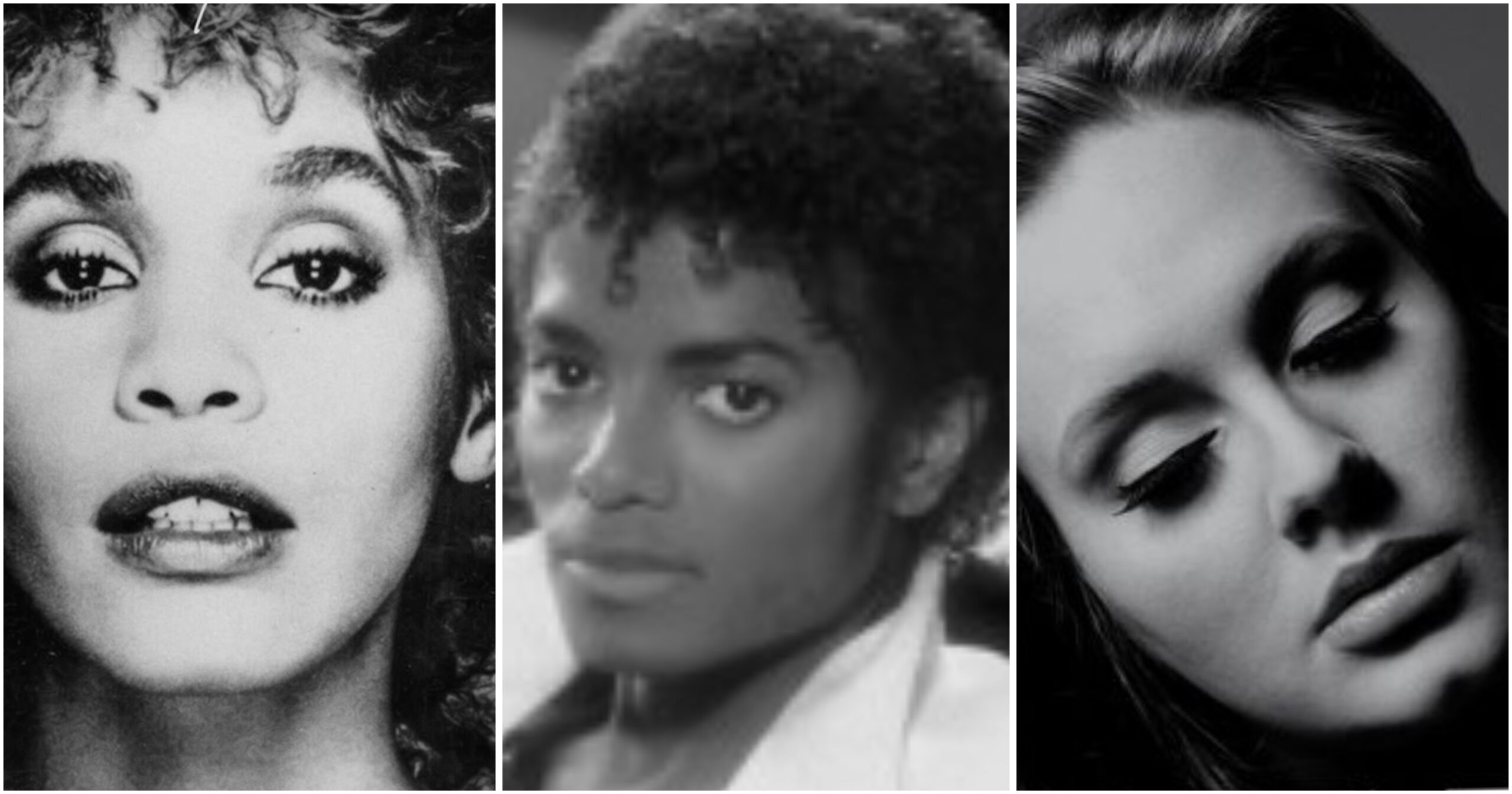
How one music icon’s victory march and another’s untimely demise led to the two most-viewed Grammy ceremonies ever.
(January 26, 2026) – It’s awards season again, and the 2026 Grammy Awards are upon us. This year’s ceremony airs Sunday (Feb. 1) on CBS from Los Angeles — and if recent trends hold, viewership will be modest at best, far removed from the era when the Grammys were true appointment television.
This year’s show will be further handicapped by the absence of a Taylor Swift or Beyoncé nomination to raise the buzz level. (Note: Taylor’s The Life of a Showgirl album will be eligible for the 2027 awards.)
Even with Beyoncé and Taylor Swift competing for Album of the Year last season — with Bey’s Cowboy Carter winning — the show’s ratings remained far below historic peaks. The annual event billed as Music’s Greatest Night has seen record low ratings this decade — just around 9 million each in 2021 and 2022 — an 83 percent decline from the record 51.7 million who watched in 1984.
Several factors could be blamed for the decline, not the least of which was the COVID-19 pandemic, which forced both the 2021 and ’22 shows to be postponed from their original late January dates to March and April, respectively. The 2021 ceremony was also a virtual experience, which caused it to lose some of its “live-action” appeal.
The early ‘20s were also marred by controversy as a former Recording Academy chief executive, Deborah Dugan, filed a complaint with the Equal Employment Opportunity Commission alleging gender discrimination and sexual harassment within the Academy’s executive ranks. Now under new leadership and a more diverse group of voters, it didn’t help that the 2025 ceremony, which saw a dip in viewership after a rebound the year before, was impacted by the historic wildfires in Los Angeles, the Grammys’ permanent home for much of its existence.
And then there’s the growing political divide and the anti-Hollywood sentiment of some right-leaning conservatives, especially as recognized musicians have become more vocal about their often-progressive stances and candidate endorsements, and with the show’s hosts sometimes using the Grammy stage as a liberal platform. With the number of alternative programming options television viewers have today compared to the pre-streaming, major network-dominated era of the 20th century, people can protest with their TV remotes more now than ever.
But perhaps the musicians themselves have had the most impact. A growing list of high-profile artists have expressed their disdain for the once-sacred Grammys, with some vowing to never again attend the event or submit their music to the Recording Academy for consideration after repeated snubs or perceived black listings (Drake, The Weeknd, Nicki Minaj, and Morgan Wallen being the most prominent recent examples).
Despite all the above, viewership has improved in recent years — 16.9M (2024) and 15.4M (2025) – although still nowhere near the salad days of the 1980s. That decade saw five of the six highest-rated Grammys with 1984’s show leading the way, followed by 2012 (39.9M), 1985 (37.1M), 1988 (32.8M), 1983 (30.9M), and 1986 (30.4M). Those six programs remain the only ones to draw more than 30 million viewers in the show’s live telecast history (since 1971). The 2012 show – like the 1984 one in its time – garnered more than 10 million more viewers than any other show during the 21st century.
So why were the 1984 and 2012 ceremonies so highly watched? The answers were defined by triumph — and tragedy.

First the triumph…

In 1984, Michael Jackson’s Thriller wasn’t just popular — it was a cultural force. The album had just become the world’s best-selling record and went on to win a record eight Grammys that night while still dominating the Billboard charts. The soft-spoken and media-shy King of Pop wasn’t scheduled to perform or present any trophies that night, but everyone knew he’d have a front-row seat and betting odds would place him at the acceptance podium at least once during the telecast.
On top of that, he was only a few months removed from having released what was arguably the most iconic short film ever — the “Thriller” video — so Jackson’s presence, even if only seen during brief audience panning scenes, was a guaranteed ratings winner. In an age without Internet or streaming, the TV networks held a captive audience, and the 1984 Grammys were, in short, Jackson’s victory march and must-see TV for anyone following pop culture at the time.
Following that year’s ceremony, Grammy viewership returned to more earthly numbers, dipping below 30 million viewers in 1989 and never seeing that plateau again until 2012. That was when the unthinkable happened.
The tragedy…

On the eve of the 2012 ceremony, Whitney Houston, who was in L.A. for that year’s event and was scheduled to attend Clive Davis’ pre-Grammy party that weekend, was found dead in a bathtub at the Beverly Hilton Hotel in Beverly Hills. Her death was attributed to accidental drowning complicated by heart disease and cocaine use. Houston, whose alleged addiction battles were well documented, had instantly become a tragic figure — one whose demise became one of the most-tweeted breaking-news events in Twitter history at the time. Every major network broke into normal programming to cover her death. Her back catalog of albums surged in sales and downloads (streaming wasn’t quite a thing yet). More pertinently, the timing of her death sent Grammy producers into a frenzy to come up with a suitable tribute to the fallen icon.
Houston’s legion of diehard fans — and non-fans alike — were sure to tune into the show to see how they’d honor “The Voice.” Hosts and presenters took turns acknowledging Whitney’s impact on music over the prior three decades, but it was Jennifer Hudson’s stirring performance of “I Will Always Love You” that brought down the house. In the end, the 2012 ceremony pulled in 39.9 million viewers, 50% more than the prior year (26.6M) and more than any other year besides ‘84.
While Whitney’s tragedy was the biggest factor in the 2012 viewership spike, a triumph also characterized that year’s event: Adele’s chart topping album 21. Like Thriller before it, 21 had been the year’s biggest LP and was on its way to becoming the first album to top Billboard’s year-end chart two years in a row since Thriller itself. Both remain the only albums to achieve that feat. And like Thriller, 21 dominated the Grammy proceedings, winning all six of the awards for which it was nominated, making it the second-biggest award winner in the show’s history behind Thriller. In the years since, it’s a small coincidence that 21 and Thriller were named by Billboard as the two greatest charting non-soundtrack albums of all time.

But even Adele might concede that people were not viewing the 2012 show in record numbers to watch her make repeated trips to the podium. Whitney’s loss had been sudden and impactful. The world knew that a once-in-a-lifetime artist of her caliber could only be properly honored by the industry that made her famous, even on such short notice. And, as sad as it is to note, it will probably take a tragedy of equal proportions to generate the kind of viewer numbers that the 2012 show garnered.
Because even with all their greatness, the triumphs of Taylor, Beyoncé — or this year’s Grammy darlings Kendrick Lamar and Bad Bunny — simply can’t generate the monocultural moment that Thriller commanded 42 years ago.
Unless Bad Bunny announces beforehand that he plans to wear a dress to the ceremony — then all bets are off.
DJRob
DJRob (he/him) is a freelance music blogger from the East Coast who covers R&B, hip-hop, disco, pop, rock and country genres – plus lots of music news and current stuff! You can follow him on Bluesky at @djrobblog.bsky.social, X (formerly Twitter) at @djrobblog, on Facebook or on Meta’s Threads.
You can also register for free by selecting the menu bars above to receive notifications of future articles.