


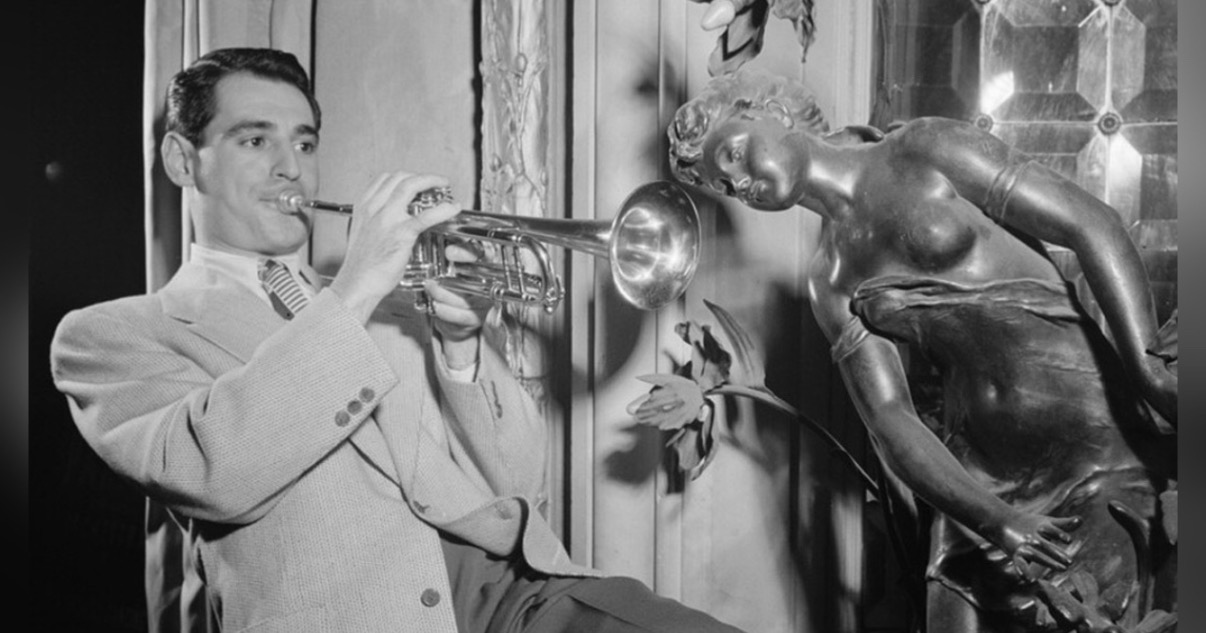
Ray Anthony is the Earliest-Surviving Link to a Billboard No. 1 Record
(September 7, 2026) – Eighty-five years ago, a teenage trumpeter played on just the fourth record ever to reach No. 1 on Billboard’s national pop chart.
He’s still here.

His name is Ray Anthony. He’s 104 years old, a World War II veteran, former member of Glenn Miller’s legendary orchestra, and – as best as DJROBBLOG can determine – the living musician whose connection to a Billboard No. 1 record reaches further back than anyone else’s.
The record was Glenn Miller and His Orchestra’s “Song of the Volga Boatmen,” which reached No. 1 in March 1941 – less than eight months after Billboard published its first national record chart.
According to Wikipedia, “Song of the Volga Boatmen” is a “well-known traditional Russian” song published in a book of folk songs in 1866 by Mily Balakiev, a Russian composer, pianist, and conductor. The instrumental was adapted in a jazz arrangement by composer Bill Finegan for Glenn Miller’s Orchestra in 1941. Miller’s band included trumpeter Ray Anthony, who at 104 years old and to the best of this blogger’s knowledge, is the last surviving member of the orchestra and the only musician alive who performed on one of Billboard’s first four No. 1 hits.
“Song of the Volga Boatmen” was a chart anomaly for its time, managing to squeeze in a lone week at No. 1 after its three predecessors each managed two to three months at the top. Those three songs – “I’ll Never Smile Again” by Tommy Dorsey and His Orchestra w/ Frank Sinatra and the Pied Pipers (on vocals), “Only Forever” by Bing Crosby w/ John Scott Trotter and His Orchestra, and “Frenesi” by Artie Shaw and His Orchestra – have no known survivors who performed on the original recordings, making “Song of the Volga Boatmen” the earliest known such record.

“I’ll Never Smile Again” was the first No. 1 pop song in Billboard. The important people associated with the recording are all deceased, including Dorsey, Sinatra, and the four Pied Pipers. Members of Dorsey’s orchestra associated with the recording in early 1940 are also deceased.
The Oscar-nominated song “Only Forever” (from Crosby’s 1940 film Rhythm on the River) is the least airtight of the first three No. 1s because its surviving discographic documentation isn’t as complete. Crosby died in 1977 and Trotter in 1975. But several sources list the instrumental personnel for the song’s recording session as “unknown.” So, it’s not been proven that all of them are deceased. However, given that these would have been professional studio/orchestra musicians recording 86 years ago, there is also no documented evidence of any living participants in the song’s recording session.
As for “Frenesi,” which was recorded in March 1940, the personnel are unusually well documented and include nearly three dozen musicians, none of whom survive today.
Which leaves the earliest Billboard pop chart chronology looking like this:
| # | First Reached No. 1 | Record (main artist and title) | Living Participant (2026) |
| 1 | July 27, 1940 | Tommy Dorsey – “I’ll Never Smile Again” | None found |
| 2 | Oct. 19, 1940 | Bing Crosby – “Only Forever” | None known* |
| 3 | Dec. 21, 1940 | Artie Shaw – “Frenesi” | None found |
| 4 | Mar. 15, 1941 | Glenn Miller – “Song of the Volga Boatmen” | Ray Anthony |
*Complete instrumental personnel are not firmly documented.
Anthony, born on January 20, 1922, was just 18 years old when Billboard inaugurated its national pop chart in July 1940 and still only 18 when “Song of the Volga Boatmen” was recorded on January 17, 1941; he turned 19 three days later and was still 19 when it hit No. 1. This means that Anthony provides a living link spanning essentially the entire history of Billboard’s national singles charts as he was already recording with Glenn Miller when Billboard launched it in 1940 and he’s still alive 86 years later.
The irony in the historical link between Miller and Anthony goes far beyond their chart connection. Anthony left Miller’s band shortly after “Volga Boatmen” topped the chart. Miller eventually disbanded that version of his orchestra, entered the U.S. Army, and disappeared aboard a military aircraft over the English Channel in December 1944. He was declared deceased a year and a day later in December 1945, though his body and the plane’s wreckage were never recovered.
Anthony, on the other hand, served in the U.S. Navy during World War II, then established his own orchestra after the war to become a successful bandleader in his own right. Now, at 104 years of age, Anthony represents two rapidly disappearing pieces of American history: the WWII generation and the first generation of musicians whose records Billboard ever ranked.
There’s something poignant in the Miller/Anthony story: two musicians leave what was arguably America’s most popular band, both men serve during WWII, but their lives take radically different trajectories. Miller became one of WWII’s enduring mysteries; Anthony survived the war and lived to witness all the pop chart’s changes over the past eight decades.
Speaking of those variations, the main singles chart as it is known today – the Hot 100 – wasn’t inaugurated until August 4, 1958, and has a different list of surviving performers on its earliest No. 1 hits. The chart’s third No. 1 single, “Little Star” by the Elegants, featured surviving group member and songwriter Vito Picone on lead vocals. Just three months later, “To Know Him Is to Love Him” – the chart’s seventh No. 1 single by the Teddy Bears – featured surviving member Carol Connors on lead vocals. If only counting individually credited artists, then Frankie Avalon takes this unique honor as his “Venus” topped the chart in March 1959 – the Hot 100’s eleventh No. 1 hit.
In an interesting connection to Ray Anthony and Glenn Miller, Vito Picone, 85, was born just five days after “Song of the Volga Boatmen” topped the chart.
And anyone wondering where the legendary Pat Boone fits into all of this, the 92-year-old holds the distinction of being the earliest individually credited artist on a No. 1 song who is still alive today. His 1955 remake of Fats Domino’s “Ain’t That a Shame” topped Billboard’s “Most Played in Jukeboxes” chart, which was one of Billboard’s pre-Hot 100 national pop charts. Boone still records to this day, including a 2024 country single, “My Stupid Tattoo,” which poked fun at regrettable body ink.
Anthony, as a member of Miller’s band, would again reach No. 1 on the pop chart later in 1941 with “Chattanooga Choo Choo,” an arguably much more familiar song to future generations than “Song of the Volga Boatmen.” That would make him a surviving musician on the two earliest No. 1 recordings known to this writer.

But it’s that first one that gives Anthony his extraordinary place in Billboard history. When “Song of the Volga Boatmen” reached No. 1 in March 1941, Billboard’s national pop chart was less than eight months old, Anthony was 19, America had not yet entered World War II, and rock-and-roll – not to mention Elvis, Motown, the Beatles, disco, MTV, hip-hop, compact discs and streaming – all lay somewhere in the future.
Eighty-five years and countless changes to the music business later, that teenage trumpeter has outlived nearly everyone and everything from that era – including by eight decades the bandleader whose name appeared on the record.
Ray Anthony was there near the beginning.
Remarkably, he’s still here.
(Think he’s heard the current record-breaking No. 1 “Choosin’ Texas” by Ella Langley?)
DJRob
DJRob (he/him) is a freelance music blogger from the East Coast who covers R&B, hip-hop, disco, pop, rock and country genres – plus lots of music news and current stuff! You can follow him on Bluesky at @djrobblog.bsky.social, X (formerly Twitter) at @djrobblog, on Facebook or on Meta’s Threads.
You can also register for free by selecting the menu bars above to receive notifications of future articles.