


(July 25, 2025) – The top five albums of 1978, according to Billboard, were these blockbusters: 1) Saturday Night Fever Soundtrack – Bee Gees & Various Artists, 2) Grease Soundtrack – John Travolta, Olivia Newton-John & Cast, 3) Fleetwood Mac’s Rumours (still big from 1977); 4) The Stranger by Billy Joel; and 5) Aja by Steely Dan. Few could argue against the merits of those albums – each a monster classic still discussed among the greatest albums of all time, and deservedly so.
But the sixth most successful album that year? It belonged to the late Chuck Mangione, the jazz multi-instrumentalist who passed away July 22 in his hometown of Rochester, N.Y., at age 84. He reportedly died in his sleep.
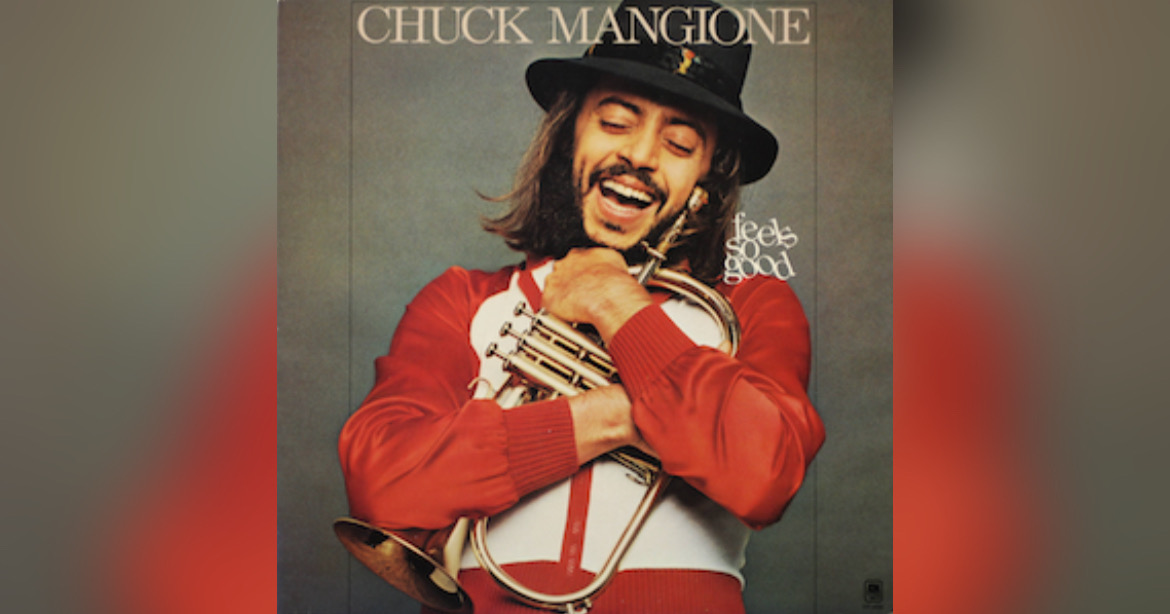
The album Feels So Good, released in 1977 on A&M Records (co-founded by fellow jazz-pop trailblazer Herb Alpert) – contained one transcendent single that said everything without uttering a word: the title track.

The pop radio edit of “Feels So Good” — with a run time of 3:31 — offered an easy way in for mainstream pop fans unfamiliar with jazz fusion. In contrast, the full 9:43 album version was a journey — a daunting one for anyone with the musical attention span of, well, your average pop music fan. Yet, it was only the third-longest song on a six-track LP that still managed to clock in at nearly 42 minutes — because all but one of the six songs were at least six-and-a-half minutes in length.
On the album, “Feels So Good” began with Mangione’s stirring flugelhorn solo of the main melody easing listeners in slowly — 1:35 of patient buildup before the rhythm guitar finally joined. By the 1:45 mark, the familiar riff that kicks off the single version is heard, meaning that the task of whittling down the remaining eight minutes of this masterpiece would be the Herculean one — a feat Mangione later described as “major surgery.” What to cut? What to preserve? It’s the same conundrum that kept Stevie Wonder’s “Isn’t She Lovely” from single release and off the charts a year earlier, although in that case, the artist didn’t want any of his song edited out, and Motown never released a single to stores.
But A&M and Mangione’s gamble paid off. “Feels So Good” debuted modestly at No. 87 in February 1978, while the Bee Gees’ “Stayin’ Alive” sat at No. 1 and their “Night Fever” was hot on its heels. Week by week, Mangione’s instrumental rose through the disco (and pop-rock) fog, breaking into the top 40 in March, and reaching No. 4 on June 10, at which point it was the longest-charting song in the Hot 100’s top 40, behind only two remaining Saturday Night Fever cuts (“Night Fever” and Yvonne Elliman’s “If I Can’t Have You,” which were nearing their end).
The success of “Feels So Good” was made even more remarkable by what it wasn’t: disco, rock, or vocal-driven. Aside from a couple of “Close Encounters of the Third Kind” themes, Mangione’s hit was the only instrumental to crack the top 40 in 1978 (and the only one, without exception, to reach the top ten) — instrumentals being a vanishing art form in mainstream pop music even then.
While instrumentals were no longer in vogue, the jazz-fusion skids had been greased somewhat by the time “Feels So Good” hit the market. Guitarist and budding pop and soul crossover star George Benson had seen major Hot 100 success with songs like “This Masquerade” and “On Broadway,” and top charting albums like Breezin’ and Weekend In L.A. Other musicians like Quincy Jones, the Crusaders, Herbie Hancock, Spyro Gyra, Stanley Clarke, and George Duke also saw similar crossover success around that time.
The A&M label itself would enjoy some of this success with co-founder and boss Alpert who hit No. 1 the following year with his horn-filled classic, “Rise,” itself boosted by a popular soap opera sync in 1979.
“Feels So Good” needed no such tie-in — it rose to the top on its own merits, an organic chart climb at a time it was least expected. Its success not only endeared pop fans but made Mangione the top Jazz Chart artist in a year where the aforementioned jazz-fusion greats were enjoying their own momentum.
Indeed, the shortened radio version had satisfied casual pop fans. But for those who wanted more, the album gave them nearly ten minutes of horn-led bliss. The LP slowly climbed the Billboard 200 for months, eventually doing better than the single and peaking at No. 2. The album that held it back? Naturally, Saturday Night Fever — a fitting metaphor for just how hot the music scene was in ’78, and how the jazz-fusion legend nearly overcame the then-biggest selling album of all to get that elusive No. 1.
Chuck Mangione never again reached the top five of the pop charts, but he never needed to. “Feels So Good” became the biggest part of his legacy — an instrumental anthem that defied genre, era, and expectation. It made listeners feel something without uttering a word, and in doing so, it carved out a permanent place in music history. It even gave Mangione an afterlife, inspiring a future role as himself in the animated series King of the Hill. But in a ‘70s decade of flash and fury, Chuck gave us something smooth, warm, and enduring. And even now, nearly half a century later, it still feels so good.

R.I.P. Chuck Mangione (1940-2025)
DJRob
DJRob (he/him) is a freelance music blogger from the East Coast who covers R&B, hip-hop, disco, pop, rock and country genres – plus lots of music news and current stuff! You can follow him on Bluesky at @djrobblog.bsky.social, X (formerly Twitter) at @djrobblog, on Facebook or on Meta’s Threads.
You can also register for free (select the menu bars above) to receive notifications of future articles.