


(December 12, 2025) – Billboard has rewritten the rules of the Hot 100 so many times over the past six-plus decades that it’s almost expected. Whether the chart was using retail store reports, SoundScan data, digital downloads, or the stream-everything era we now live in, methodology changes have always reshaped chart history—sometimes subtly, sometimes dramatically.
But few rule changes were as conveniently timed—or as consequential—as the one that occurred in late November 1969, a tweak that propelled one of the Beatles’ most beloved singles to No. 1 when, by every indication the previous week, neither side of that record was going to make it.
And yes, I report this as a lifelong Beatles fan. You can love the Fab Four and still acknowledge that the charts occasionally bent in their favor… just as they do for today’s artists whom old-school fans love to discredit as apples and oranges in a system that more rapidly pads their stats.
Let’s “Come Together” with “Something”

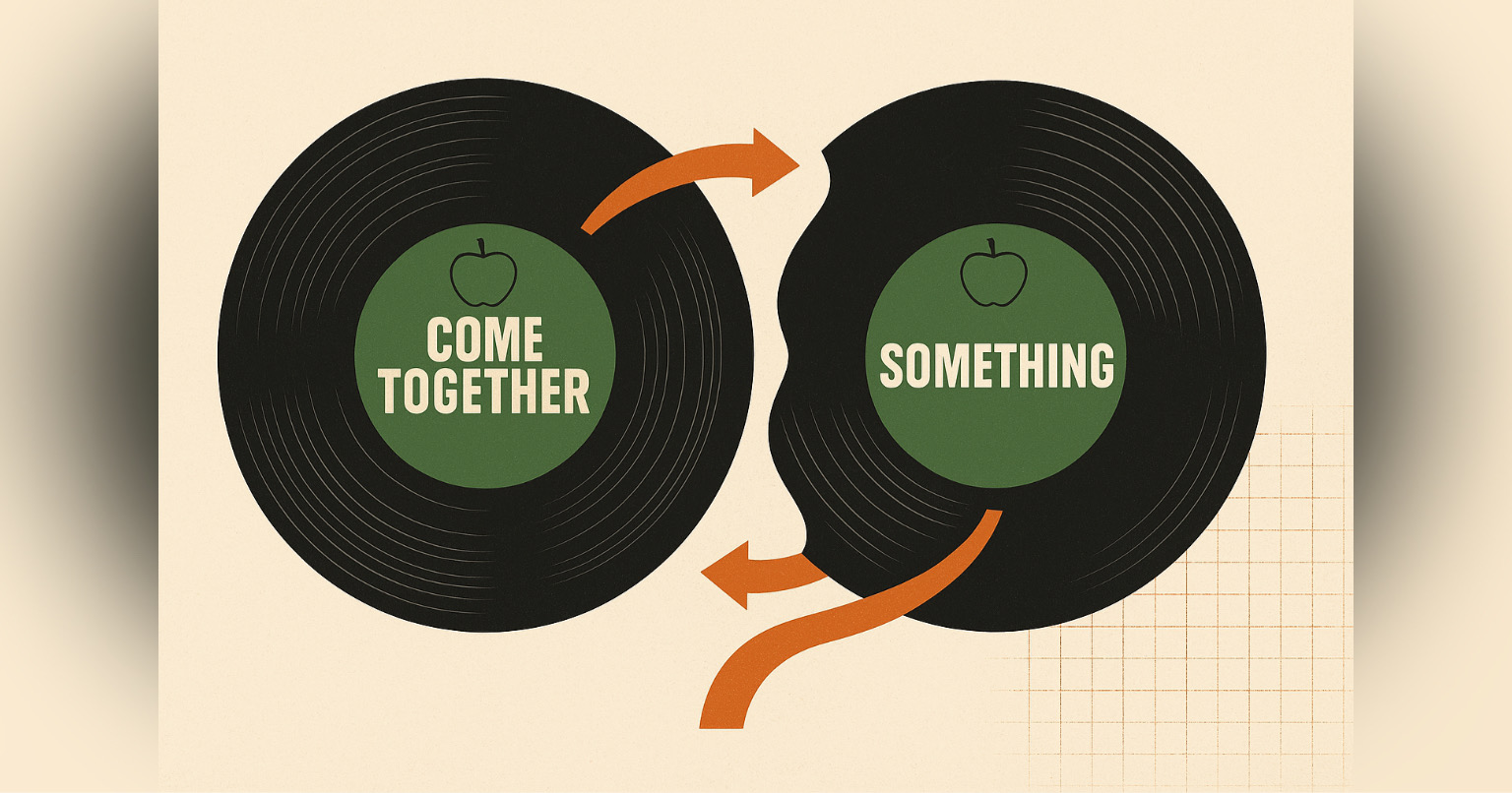
The single in question was the double-A-sided “Come Together”/“Something,” a vinyl 45 issued from Abbey Road in the fall of 1969. Don’t get it twisted: “Come Together” and “Something” are both masterpieces. The former was John Lennon’s attempt at creating a campaign song for countercultural California gubernatorial candidate Timothy Leary who at the time advocated for the use of mind-altering drugs like LSD and psychedelic mushrooms. The latter was George Harrison’s love song that has been considered one of the greatest of all time. It was also George’s first No. 1 composition as a Beatle. Lennon’s bit of “funky” “gobbledygook” and Harrison’s wistful ballad opened Abbey Road and formed the two sides of the album’s lone single release.

Quick primer for younger readers: Back in the vinyl era, most 45 RPM singles had two songs — one on the A-side and one on the B-side — and both could be played on radio and earn chart points. That meant an act could score “two-sided hits,” with each side sometimes charting separately, a scenario that simply doesn’t exist in the digital, track-based streaming era.
Back in the 1960s, this helped the Beatles and other artists whose singles often charted both sides individually, thus padding their hit totals. In the case of “Come Together”/“Something,” it was probably the greatest two-sided hit the Beatles had, out-charting classic double-sided 45s like “Penny Lane”/“Strawberry Fields Forever,” “We Can Work It Out”/“Day Tripper,” and “I Feel Fine”/“She’s a Woman,” all of which sent both sides of the same 45 into the top ten separately.
Beatles: 1 + 1 + 1 is 3; Billboard: 7 + 3 is 1
For six weeks following their single release in October 1969, “Come Together” and “Something” charted separately on the Hot 100, as Billboard’s rules dictated—meaning each side had to stand on its own merits and airplay. Sales points were often assigned to the side getting the most response in a particular market, based on reports from dealers across the country.
Then in the issue dated Nov. 22, Billboard made the following announcement:
“To more accurately reflect the proper position a single record with a two-sided hit on the Hot 100 chart. and all other singles charts. Billboard will list the single record rather than the two sides at a different position. The new system will be effective with the Nov. 29 issue. Billboard will ask dealers for information on the single and not an individual side. The information will put the record in proper position relative to the sale of other singles records, as opposed to the splitting of the points for two titles on the single record.
“Examples of the two-sided hit in the current issue, on the Hot 100 chart, are: Apple’s “Something” and “Come Together” by the Beatles, in positions 3 and 7, respectively. Fantasy’s “Fortunate Son” and “Down on the Corner” by the Creedence Clearwater Revival, in positions 14 and 21, respectively, and Columbia’s “See Ruby Fall” and “Blistered” by Johnny Cash, in positions 75 and 100, respectively.”
In fact, that week the picture seemed clear, neither Beatles tune was heading for the top:
“Something” was holding at No. 3 after losing its bullet.
“Come Together” had slipped from No. 2, where it had apparently peaked, to No. 7.
Meanwhile, R. B. Greaves’ “Take a Letter Maria” surged from No. 10 to No. 2, leaping over both Beatles tunes and seemingly positioned to grab the top spot from The 5th Dimension’s “Wedding Bell Blues.” By conventional chart logic—bullet behavior and overall momentum—neither Beatles track was poised to go all the way.
Related: 1969 was the year with the most No. 2-peaking singles… Here’s the list
Then with the Nov. 29 issue, the newly combined Beatles single leapfrogged everything and ranked No. 1, giving the Fab Four their 18th of eventually 20 chart toppers. Notably, their 20th was also a double-sided hit: “The Long and Winding Road”/“For You Blue” (although that B-side — another Harrison composition — rarely gets mentioned as his second No. 1 contribution to the group).
The Asterisk That Never Gets Discussed
Now, does all of this mean the Beatles didn’t deserve their chart success? Absolutely not. Their influence is unmatched, their catalog historic, and their cultural footprint still reverberates through everything from TikTok covers to AI recreations.
But this event does raise an eyebrow—because ‘60s music fans today love arguing that modern artists’ accomplishments don’t “count.”
You’ve heard it before:
• “Mariah only goes No. 1 because of streaming or a rule that allows old Christmas hits to return every year.
• “Taylor just benefits from her built-in fanbase and digital manipulation.”
• “Drake took advantage of playlist culture.”
• “The charts today don’t matter.”
Yet in 1969, a mid-run Billboard rule change—one whose timing rewarded the Beatles greatly—reshaped history. A week after its lone frame at the top, the “Come Together”/“Something” single fell to No. 3, but not before helping secure what would ultimately become one of the group’s most important legacies: their 20 No. 1 hits.
Remove that one controversial week — or make the change a week later — and the Beatles’ total might well sit at 19, a mark Mariah Carey matched with “All I Want for Christmas Is You” six years ago (the song sits at No. 1 for its 19th non-consecutive week as of this writing).
Imagine the fan debates today if the Beatles and Mariah were tied. Imagine the think pieces. Imagine the holiday-season trolling.
But the rule change happened, the record stands, and the Beatles’ count remains 20.
What It Says About Chart Debates Today
The takeaway isn’t that the Beatles “cheated.” They didn’t. Billboard made the shift, and the industry played by the new rules—as always.
The takeaway is that every era has its quirks:
• The Beatles benefitted from the combining of two-sided singles (twice, it turns out).
• The Bee Gees and RSO Records benefitted from some “savvy” marketing in 1978.
• Mariah benefitted from the 1990s retail boom and heavily discounted singles (when others weren’t releasing them).
• Drake benefitted from the streaming era’s strategic playlist placements.
• Taylor benefits from a huge built-in fanbase and multiple variations of the same album.
Does this mean they’re illegitimate? Well, they’re definitely part of a living, evolving market and chart system that has changed dozens of times, often benefiting the artists who are contemporary at the time.
The Beatles didn’t need help to be legends. But this one moment in 1969 is a fascinating reminder that even the most sacred chart accomplishments can have asterisks—and that comparing eras will always require context and nuance.
So the next time someone discredits Mariah, Taylor, Drake, or the modern chart landscape, remember:
If Billboard hadn’t changed its rules when it did, the Fab Four’s crown jewel No. 1 tally might look very different.
And that’s not disrespect—it’s perspective.
DJRob
DJRob (he/him) is a freelance music blogger from the East Coast who covers R&B, hip-hop, disco, pop, rock and country genres – plus lots of music news and current stuff! You can follow him on Bluesky at @djrobblog.bsky.social, X (formerly Twitter) at @djrobblog, on Facebook or on Meta’s Threads.
You can also register for free by selecting the menu bars above to receive notifications of future articles.
Excellent piece!
Thank you!