


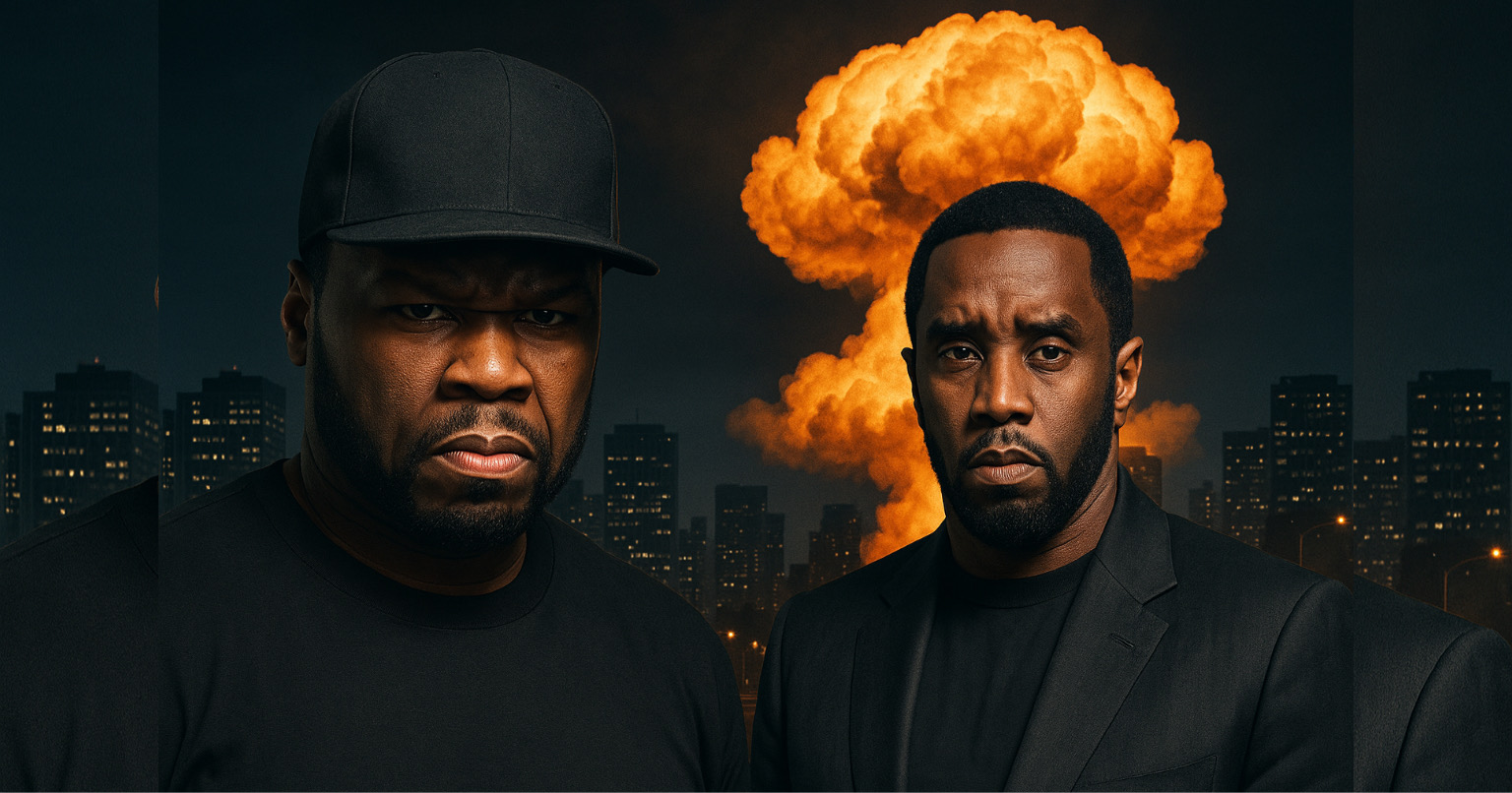
DJROBBLOG’s Take on 50 Cent’s Diddy Documentary: Explosive Claims, Unanswered Questions, and a Hip-Hop Reckoning
(December 4, 2025) – You’d be forgiven if you’ve forgotten or never knew what caused the beef between two of rap’s greatest entertainment moguls in Curtis “50 Cent” Jackson and Sean “Diddy” Combs, because for the past two years it’s been all 50, with the Get Rich or Die Tryin’ rapper maybe delivering the final blow — the long-promised Diddy documentary — from which it will surely be difficult for the Bad Boy founder to recover.
The real question isn’t whether 50 delivered a fatal blow about a predicament Diddy is heard describing as “eight nuclear bombs straight to the head”—but whether viewers will see this as justice, vengeance, or opportunistic storytelling.
For a refresher, their long-running beef apparently started nearly 20 years ago when 50 Cent released a diss track called “The Bomb,” which insinuated that Diddy had a role (“Puffy know who hit that nigga”) in the 1997 murder of The Notorious B.I.G. It’s an allegation that resurfaces in the new documentary.
With Sean Combs: The Reckoning, the “Candy Shop” rapper has seemingly delivered the goods on the former Bad Boy kingpin, or is that “kink-pin”? Never has one rapper’s takedown of another been so thorough, so complete… and so one-sided. With The Reckoning, Fiddy-vs.-Diddy makes the Kendrick-v-Drake drama of 2024 look like child’s play. The question that remains, however, is how much of what’s shown and said will viewers believe? Is this just another Hollywood takedown of a once-successful Black man who became too big for his own good? Are these unbalanced accounts taken strictly from those who Diddy screwed over (no pun intended) and are now exacting their revenge? Or is it simply 50’s personal vendetta against Diddy finally coming to the small screen?
Or better yet: is any or all of what’s alleged true? Where people fall on the belief spectrum will largely depend on their fandom of Diddy (and to a lesser extent, 50) and/or their trust of the legal system’s handling of Black celebrities in general.
The divide may even be generational. You’ve got boomers whose disdain for hip-hop is palpable, Gen Xers who fueled and fondly remember Bad Boy’s rise, Millenials who grew up on “Making the Band,” and Gen Z who likely only see Diddy through scandal and memes, many courtesy of 50 Cent.

50 Cent Pulls Out Most of the Stops
50 — as trolling as he may be at times — has made it his singular goal to ruin this particular nemesis. After all, this is a rapper who’s trolled Diddy at nearly every turn during his current demise. He mocked Diddy following his homes being raided in 2024. He relished in social media each new allegation being levied by accusers. He appealed to Donald Trump — Narcissist-in-Chief — not to grant a presidential pardon by reminding 47 of the negative things Diddy said about him in the run up to the 2020 election. So, if you’re looking for balance, look elsewhere. This is 50’s production; he’s holding the proverbial mic.
The irony is that Combs — the controlling Svengali of ‘90s hip-hop — is himself reduced to legal recourse, with a cease-and-desist order and threats to sue the documentary’s creators and Netflix for a portrayal they’ve labeled an inaccurate “hit piece.” Even footage that Diddy himself once owned — that of him being self-recorded days before his final arrest in September 2024 — makes him look desperate and helpless when placed in 50’s hands (illicitly acquired according to Diddy’s legal team).
As executive producer on the Netflix documentary that chronicles Diddy’s early ‘90s rise and recent downfall, 50 and his team of producers went straight to the sources and the people who were once in Bad Boy Entertainment’s inner circle. The most damaging ones are the interviews with former Bad Boy employees Kirk Burrowes — cofounder-turned-cautionary tale — and Mark Curry. The September 2024 footage Diddy recorded is never-before-seen accounts of him strategizing with his family and legal team about the fate he surely saw coming. Netflix claims the tapes were obtained legally — after Diddy’s arrest — and, as of Wednesday (Dec. 3), had not honored the cease-and-desist order from Combs’ lawyers.
Puffy’s Beginnings and Quick Rise
But the four-part series should also be remembered for the insights we never saw previously, or had forgotten about. There was Puffy’s rise from intern to A&R guy to VP of the late Andre Harrell’s Uptown Records. At the time, the label was viewed as the gateway to early ‘90s hip-hop and R&B, with acts like Heavy D & the Boys, Jodeci, Mary J. Blige, and Al B. Sure releasing hit after hit.
There was his firing from Uptown in 1993 when he began to challenge Harrell, taking with him the Notorious B.I.G. and birthing Bad Boy Entertainment. The backing of Bad Boy by Arista’s Clive Davis with $10 million up front set Bad Boy on its way to late ‘90s dominance of both R&B/Hip-Hop and pop charts.
There were his relationships with his mother, Janice Combs, who raised Sean after his father was murdered in the 1970s; and the mother of three of his children, the late Kim Porter, both of which were cast as being violent at times. Simultaneously poignant and chilling was the producers’ use of Nat King Cole’s “Nature Boy” to soundtrack the development (and grooming?) of Porter during her evolving relationship with Diddy.
There were accounts from childhood best friend and future Bad Boy cofounder Kirk Burrowes, who was perhaps the most compelling and important source of the whole story. After all, it was Burrowes who’d been given a 25% share of Bad Boy Entertainment (Janice Combs was given the other 75%, as her son didn’t initially want his name attached to the label given the legal troubles he was already facing following a celebrity basketball tournament he’d sponsored — and oversold — resulting in a stampede and the deaths of nine people in 1991.
Sean Combs — barely 22 at the time — was already business savvy.
From Puffy to Puff Daddy to P. Diddy to Diddy — Sean Combs was a Complex Man
That savvy, however, is portrayed throughout the film as ruthless, evil, and even deadly. He’s at times described as often not paying his artists or producers, with many of them (Curry, 112, Total, the Lox, Carl Thomas) now languishing in obscurity. Burrowes, who’s since faced homelessness, recounts how Diddy — with baseball bat in hand — forced him to relinquish his 25% ownership of Bad Boy when the boss’s finances were tight.
Diddy was a marketing genius who, to the public and the most diehard of fans, was Bad Boy’s good guy who always came out on top. He was even the seeming peace keeper in rap’s East-vs.-West civil war of the mid-1990s. Where Pac and Death Row chief Marion “Suge” Knight were vilified by the media, Puff was exalted, as ‘80s hip-hop group EPMD’s Erick Sermon accurately recalls. Yet, behind the scenes, Combs is depicted as always maneuvering, always remembering those who slighted him, and always seeking more power — disguised in his mind as “making history.”
Behind all of this was a man who, as a child, was “goofy as hell” and couldn’t defend himself while being picked on — as Burrowes tells it. Diddy also suffered beatings as a kid from Janice — some of which Burrowes allegedly witnessed — and the aspiring hip-hop mogul even allegedly “laid hands” on his mom after she confronted him about his career choice following the basketball tournament massacre.
Diddy and the Connection to Pac & Biggie
That massacre was only the tip of the iceberg for what lay ahead. At various turns in the series, Combs is directly or indirectly tied — allegedly, of course — to the deaths or shootings of several people in and outside of his close-knit circle, the most notable of them being Tupac Shakur and, more shockingly, his own artist Christopher “The Notorious B.I.G.” Wallace.
As details unfold, some of which have been well documented, Diddy’s “friendship” with two factions of the notorious Crips gang is depicted as being at the root of Pac’s fatal shooting in September 1996. Former Crip Keefe D, himself facing charges of being in the vehicle involved in 2Pac’s murder, is shown recalling the $1 million dollar “hit” on the slain rapper’s and Suge Knight’s lives, for which only half payment was rendered when Knight survived.
Even more disturbing, however, is how Combs — known at the time as Puff Daddy — allegedly “escorts” Biggie to his own death by forcing him to remain in Los Angeles against his will following the 1997 Soul Train Awards, and by attending (and performing at) a party the following night in “enemy territory.” To those observing, it was seen as Puff’s defiant act of sticking it to the West, specifically Death Row, just six months after their own chief breadwinner — 2Pac — had been murdered.
Still sadder was the allegation that Biggie’s massive funeral — the televised Brooklyn parade attended by thousands and fit for a king — wasn’t paid for by Diddy or Bad Boy Records, but by Biggie’s estate, according to Burrowes. This was despite Wallace having died while “on the job.”
The Sexual Misconduct Allegations
But it’s the post-Biggie phase of Diddy’s trajectory that serves as this documentary’s main premise. Realizing that the ‘90s method of marketing hip-hop as he knew it was becoming passe (and that none of the other artists on his Bad Boy roster, including himself, could bring Biggie-like numbers), Combs had expanded his brand into fashion (Sean John), spirits (Cîroc vodka), and reality competition TV (MTV’s “Making the Band”).
It was then that many of the intimate and romantic relationships that are at the core of his sexual misconduct allegations were formed.
There’s former girlfriend Cassie Ventura who declined to be interviewed for the series but of whom footage is aplenty, including past interviews and, expectedly, the infamous video of her being kicked and beaten by Diddy at a Florida hotel following one of the alleged “freak-offs.” Cassie’s initial civil lawsuit in 2023 was what cracked open the floodgates that brought Diddy to where he is today.
There’s the “gigolo” Clayton Howard who participated in Diddy’s cuckold fantasies with Ventura, detailing the sex acts he performed on her for thousands of dollars a pop, while Combs — either out of view or masked — narrated.
There was Danity Kane member Aubrey O’Day, whose alleged assault is revealed to be the account of a witness, not the drugged-up singer herself who can’t recall and, frankly “doesn’t want to know” if she was raped.
There’s former Diddy-Dirty Money group member Kalenna Harper whose dubious recollection of the events surrounding the alleged Diddy assault of fellow member Dawn Richard are among the few moments casting doubt on the legitimacy of these claims, particularly given her recorded conversations and later formal statement in support of Diddy.
There’s music producer Rodney “Lil Rod” Jones, whose musical talents landed him the job to oversee Diddy’s last project – The Love Album: Off the Grid (touted as R&B “music you can fuck to”). Rod described how the recording sessions on Diddy’s yacht devolved into sex-filled parties where he’d awaken from a drug-induced haze with, alternately, strange women or Diddy himself in his bed. Rod, who claims he was never paid for his work on The Love Album, is one of the many people who’ve accused Diddy of sexual harassment or assault.
And finally there’s the remarkable testimony of Capricorn Clark, the former Diddy assistant who tied him to the bombing of rapper Kid Cudi’s car after it was discovered that Cassie and Cudi were having an affair. It was Clark’s testimony at Diddy’s 2025 trial that jurors apparently found least credible — particularly of her own “kidnapping” by Diddy — as we learn through interviews with two of those jurors, both of whom deny being star struck (despite one of them sounding very much so).
In all there are more than 100 sexual misconduct cases filed against Diddy with 77 of those still pending.
The Broader Reckoning
Make no mistake, nothing about this documentary is intended to make Diddy look good, and nothing did. While obligatory disclaimers appear in the form of white-font captions against a solid black screen and provide key transitions from one part of the series to the next, 50 Cent’s message is clear: Diddy is irredeemably evil and that won’t likely change.
But there are broader “reckonings” here than Diddy’s. Some of it lies in the bigger picture of Black male celebrities being exalted to the top of their industries (see Michael Jackson, R. Kelly, Mike Tyson, James Brown, Bill Cosby) only to be knocked down when issues that were, in some cases, hidden in plain sight come to light.
Some of it lies in the realization some 30 years later that the whole East-v-West rap civil war was never that. It was always just Bad Boy-vs-Death Row, as Sermon put it, with both labels’ main foot soldiers — Pac and Biggie — paying the ultimate price.
It’s the recognition by many of us fans of Bad Boy’s ‘90s output — this blogger included — that nothing is really as it seems, especially if one person, in this case Diddy, is allowed to control all the narratives. The benefit of critical thinking in one’s 50s begs the question: why didn’t artists like The Lox, 112, Mase, Total, Carl Thomas, and Faith Evans continue to thrive under Bad Boy’s powerful influence and leadership in the industry? Why was it that the owner of the label, one with no classic musical training who “couldn’t tell a “C” note from an “F” one” and “couldn’t sing or rap,” wound up with the most successful career of all his artists?
It also begs why some of those artists weren’t also interviewed for the documentary and whether viewers got a complete picture of the events depicted given the executive producer’s well-documented beef with his subject. A documentary this explosive almost screams for the voices that aren’t there.
Then there are the voices that were silenced forever — those of 2Pac and Biggie — and whether Diddy will ultimately face charges for deaths that happened nearly 30 years ago.
But most important is the reality that alleged sexual assault victims were finally given a voice and, if any or all of these portrayals of Diddy are true — or seen as such not by fans, but by the people before whom the former mogul’s fate still lies in dozens of civil lawsuits — it’s likely that Diddy will never recover from this Reckoning.
And that, after all, was 50 Cent’s main goal.
DJRob
DJRob (he/him) is a freelance music blogger from the East Coast who covers R&B, hip-hop, disco, pop, rock and country genres – plus lots of music news and current stuff! You can follow him on Bluesky at @djrobblog.bsky.social, X (formerly Twitter) at @djrobblog, on Facebook or on Meta’s Threads.
You can also register for free here (or select the menu bars above) to receive notifications of future articles.