


July 27, 2025). Before Soul Train became a nationally syndicated cultural phenomenon, it was just a modest local program in Chicago — the brainchild of radio announcer Don Cornelius, who launched the show in August 1970 on WCIU-TV. It wasn’t long before Cornelius, whose vision for a “Black American Bandstand” was starting to pick up steam, moved the Train to Los Angeles.
By October 1971, Soul Train had entered national syndication and never looked back, ultimately becoming the longest-running first-run, nationally syndicated TV show in American history — lasting 35 years before its last original episode aired in 2006. Reruns aired for two more years under the banner The Best of Soul Train, before the beloved program left the airwaves for good in 2008.
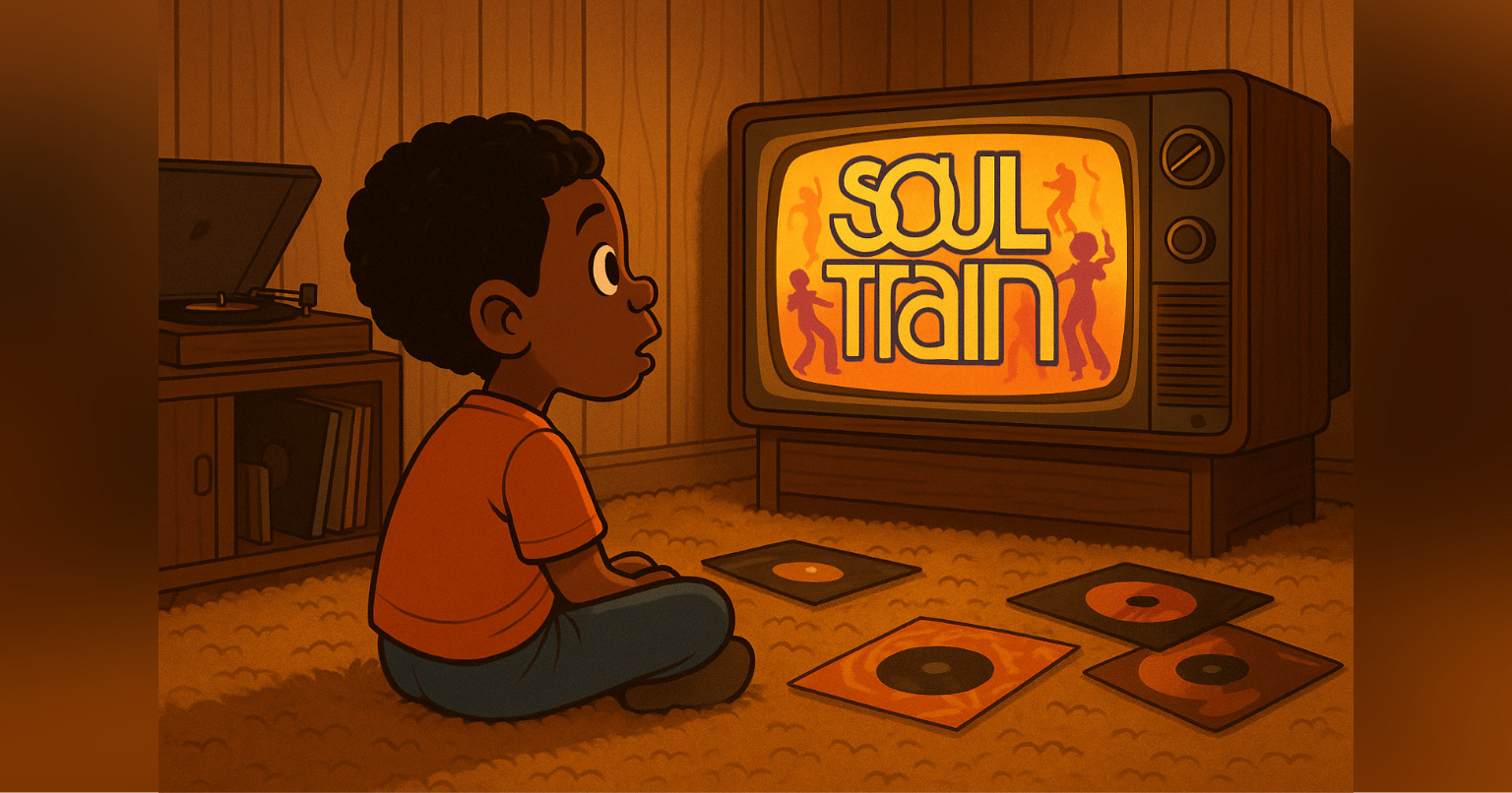
I climbed aboard Soul Train for the first time in 1974, when my family returned to the States after being stationed in Germany for the show’s first three years. Saturday afternoons in our household quickly became synonymous with the funk, the fashion, the fun — and the ‘fros — of Soul Train. Who could forget those ads from regular sponsor Johnson Products, the Chicago-based, Black-owned company whose “Afro Sheen and Afro Sheen Cosmetics” were as much a part of the show’s DNA as the infamous Soul Train Line that became the penultimate segment of every episode? I spent the next several years trying to grow my ‘fro as big as those Soul Train Dancers I had been emulating, until the 1980s ushered in a new crop of shorter, curlier and, dare I say, wetter hairstyles.
Among my earliest and most vivid memories of the show, though, were the now-iconic 1975 and ‘76 episodes featuring, respectively, British rock superstars Elton John and David Bowie — not exactly soul stalwarts, but striking figures who left an indelible mark on the Train’s tracks nonetheless. Elton’s performances of “Philadelphia Freedom” and “Bennie & the Jets” — both modest crossover hits on the Soul chart — were electric, and you could tell he genuinely enjoyed being there.
Of course, I’d later learn that other white artists — Dennis Coffey (in 1972) and Gino Vannelli (in early ’75) — were the first non-Black acts to appear on the show, proving that the Train, while Black-centered, was open to some good ol’ blue-eyed soul as well.
In the years that followed — especially in the 1980s — the show embraced many more pop acts with crossover appeal, sometimes head-scratchingly so. Don “All She Wants To Do Is Dance” Henley (of the Eagles) headlined a 1985 episode that also featured as the secondary performer a then-relatively unknown Whitney Houston in her only appearance on the show. A year earlier, the newly installed music video segment featured Huey Lewis & the News’ “The Heart of Rock and Roll,” a moment that would’ve felt more at home on American Bandstand than on the “hippest trip in America.”
Still, Soul Train never completely lost its soul. Despite occasional detours into mainstream pop, the show arguably did more for Black music — and particularly soul and R&B — than any other institution outside of Motown. In 1972, the show’s first full year in national syndication, Black artists dominated the Billboard Hot 100 like never before, occupying up to eight of the top ten spots at various points that year and accounting for 11 of the year’s 22 No. 1 hits — a record share in the chart’s pre-SoundScan era (1958-1991). Artists like Al Green, the Spinners, Harold Melvin & the Blue Notes, the Chi-Lites, Eddie Kendricks, Gladys Knight & the Pips, and Barry White —the latter whose Train appearances with Love Unlimited Orchestra exposed Black orchestral soul to a much wider audience — all gained invaluable exposure from the Train’s platform, with the Hot 100 success to prove it.
After Don Cornelius stepped down in 1993, the show carried on with guest hosts before settling into a rotation of permanent ones, including actor Shemar Moore. But no host ever matched Cornelius’ gravitas, vision, or iconic baritone. And no other show ever gave Black music and Black culture such a long, uninterrupted stage on American television.
Below, as part of DJROBBLOG’s tribute to the show that helped define Black culture and entertained generations, we’ve compiled the more than 60 artists who appeared most frequently on Soul Train. Nowhere else will you find a more accurate, thoroughly researched accounting of the musicians who rode the Train the most. You’ll see which acts top the list and their unique connections to the show, along with the most represented of the famous entertainment families, plus the non-Black act who appeared the most, with nine appearances that spanned 25 of the show’s 35 years.
Of the hundreds of artists who appeared on the show, the below acts graced that stage at least five times. So hop aboard as we rewind the tracks and pay tribute to the most frequent Soul Train riders of all time…the Soul Train Hall of Fame!
Rank: Artist (# of episodes) – A short vignette follows (for the top 24 artists only).
1st: Whispers (20)

Led by twins Walter and Wallace “Scotty” Scott, the Whispers made an incredible 20 appearances beginning Valentine’s Day 1972 and ending 26 years to the week in February 1998. That number jumps to 21 if you include a 1993 episode where the twin brothers appeared without the rest of the group. The Whispers’ rank is not surprising when you consider their unique tie to the show. They recorded for Dick Griffey & Don Cornelius’ short lived Soul Train Records in the mid seventies before moving to Griffey’s SOLAR label after he and Cornelius discontinued the show’s namesake label. The Whispers continued to be among Cornelius’ favorites, and they even recorded two theme songs for the show — one in 1980 (“Up On Soul Train”) and another in 1993 (the twins with Naughty By Nature and Chanté Moore, both of whom also appear on this list).
Tied-2nd: O’Jays (12)

It’s no secret that the iconic trio from Canton, Ohio whose major success came by way of their Philly Soul connection to Kenny Gamble & Leon Huff, were favorites of Cornelius. Their first show in September 1972 included their iconic performance of breakthrough hit “Back Stabbers,” while their twelfth and final one happened 19 years later in 1991. Co-lead singer Eddie LeVert made two additional appearances, both with late son Gerald (1992 and ‘96).
Tied-2nd: Barry White (12)

Also on Cornelius’ list of favorites was the late maestro himself, Barry White, whose first four appearances came by way of his famous Love Unlimited Orchestra, which he conducted. Barry’s baritone/bass voice was so iconic that even the deep-voiced Cornelius conceded in allowing White to cohost an episode in 1982. He also made an appearance with former wife Glodean — famous for her freakishly long fingernails — in 1981.
4th: Temptations (11)

The Motown act with the most appearances were the Temptations whose eleven top the Four Tops and Eddie Kendricks — each with nine. Those tallies notably include some shows that were taped while these acts were with other labels, but their greatest legacies will forever be tied to Motown. Altogether, the Temptations and late former lead singers Kendricks, David Ruffin, and Dennis Edwards made a combined 26 appearances when counting solo performances.
Tied-5th: Atlantic Starr (10)

Atlantic Starr’s ten appearances spanned 16 years (1978-94) and a revolving door of six different female lead vocalists: Sharon Bryant, Barbara Weathers, Porsche Martin, Rachel Oliver, Crystal Blake, and Aisha Tanner. Soul Train also chronicled the band’s evolution from consistent R&B hitmakers in the late 1970s to a formidable pop ballad crossover act in the ‘80s and early ‘90s.
Tied-5th: Lakeside (10)

Lakeside was another act who benefited from their connection to Dick Griffey’s SOLAR Records. Griffey served as talent coordinator for Soul Train and had a personal interest in seeing acts like The Whispers, Shalamar, and the boys from Dayton, Ohio, gracing the show’s stage. Their biggest success came in 1980’s “Fantastic Voyage,” which they performed in a November episode that year, though they would continue to make appearances until 1990.
Tied-5th: Billy Preston (10)

The man whose career was launched by his ties to the Beatles parlayed his success into ten Soul Train appearances, where he performed big hits like “Outta Space,” “Nothing from Nothing,” and his duet with Syreeta Wright, “With You I’m Born Again,” in April 1979 — a full year before it became his last top ten pop hit in 1980. Ironically, Preston’s “Space Race” became bumper music for Soul Train rival show American Bandstand shortly after its release in 1973.
Tied-8th: Dramatics (9)

The Dramatics out of Detroit saw their biggest success in the early 1970s with “Whatcha See is Whatcha Get” and “In the Rain,” both million sellers, and a bold remake of Billy Paul’s iconic “Me & Mrs. Jones,” which was an R&B chart hit in ‘75. They performed all three on Soul Train, with appearances that spanned from 1973-86 and encompassed the group’s breakup and reunion in the ‘80s.
Tied-8th: Four Tops (9)

Just as the Four Tops were known for their loyalty and longevity in the business, their nine Soul Train appearances mark the most for any group whose membership remained intact for the entire ride. The Whispers’ five classic members appeared more times than the Tops, but they also made appearances without Leaveil Degree (who joined after the Whispers’ first shows in 1972) and Marcus Hutson (who left before the group’s final performances in the ‘90s).
Tied-8th: Gap Band (9)

Tulsa’s favorite sons The Gap Band’s nine appearances spanned three different decades (‘70s, ‘80s and ‘90s) and included them performing all their iconic hits like “Burn Rubber,” “Early in the Morning,” and “I Don’t Believe You Wanna Get Up and Dance (Oops Upside Your Head).” When counting Charlie Wilson’s three solo appearances, including during the show’s final season in 2006, the former lead singer places among the five acts whose Soul Train run spanned the longest time (27 years in his case). The Isley Brothers lead that category with seven appearances from 1972-2003 (31 years).
Tied-8th: Al Green (9)

The Train made a stop in Memphis to pick up the soulful Al Green in 1972, and never looked back. Green was one of several artists who eschewed lip-syncing for actual live performances on the show (Aretha Franklin, Luther Vandross, and Elton John were among the others). By the time of his last performance in 1986, Green had been ordained as a pastor for years and recorded several gospel albums.
Tied-8th: Eddie Kendricks (9)

Not only was Eddie Kendricks the former Temptation with the most appearances on Soul Train, but he was also the Motown artist with the most solo appearances. Many of those came while he was still recording solo for Motown’s Tamla label, where he scored major hits like “Keep on Truckin’,” “Boogie Down,” and “Shoeshine Boy,” all of which he performed on the show. Eddie was one of the few artists to make three appearances in the same season (1973-74). The below video is from that same season, where two Soul Train dancers did the short-lived Scramble Board while Kendricks’ “Boogie Down” plays.
Tied-8th: Patti LaBelle (9)

The blog is taking special exception here to count Patti LaBelle’s solo appearances along with her three stints as leader of the group LaBelle since that trio bore the singer’s name. Otherwise, Patti would be relegated to the below list of artists with just six appearances. Of note, ex-LaBelle member Nona Hendryx was a three-time solo guest during the 1980s.
Tied-8th: Teena Marie (9)

The Ivory Queen of Soul — as she was known — was also, not surprisingly, the white artist who appeared on Soul Train the most with 9 episodes. That’s four more than former mentor and lover Rick James (and includes her debut joint appearance with the King of Punk Funk). Marie’s appearances spanned four distinct decades and nearly 25 years from 1979-2004. She died Christmas Day 2006.
Tied-8th: Brian McKnight (9)

Beleaguered crooner Brian McKnight made the most appearances of any artist whose first show occurred during the 1990s. The balladeer’s nine appearances spanned from 1993-2005. I’ll let Google be your companion on why he is considered beleaguered.
Tied-8th: Shalamar (9)

Shalamar existed as a studio outfit (and made two appearances) before former Soul Train dancers Jody Watley and Jeffrey Daniel were famously commissioned by music promoter Dick Griffey to join the group in 1978. Howard Hewitt joined in 1979 and the rest, as they say, was history. Counting the solo ones by those three members along with the group’s nine, and Shalamar accounts for 23 total Soul Train appearances.
Tied-8th: Bobby Womack (9)

The late Bobby Womack (and his brothers, collectively The Valentinos) had a sordid romantic history with the women in their lives (Google it!), but there was no denying the gravely voiced singer’s favor with R&B radio and Soul Train — especially after the public forgave him for marrying Sam Cooke’s widow within months of his murder in the ‘60s. Among his performances was his solo remake of The Valentinos’ “Looking for a Love” and the iconic soul smash, “If You Think You’re Lonely Now.”
Tied-17th: Commodores (8)

The Commodores out of Tuskegee were a tale of two halves — four appearances with Lionel Richie and four appearances without. And Lionel’s 1982 solo visit wasn’t the only one by an ex-Commodore. The band’s lead guitarist Thomas McCleary also rode the train solo in 1985 following his first (of two) solo albums. Check out the band in their funkier early days performing their first top 40 pop hit (with Lionel playing some wicked synthesizer riffs) below.
Tied-17th: Freddie Jackson (8)

The name Jackson was synonymous with soul excellence in the 1980s and early 90s. Between 1983 and 1993 alone, Michael, Janet and unrelated Freddie accumulated 30 No. 1 singles on the Billboard Hot R&B/Hip-Hop chart — 10 apiece. But Freddie was the Jackson with the most Soul Train visits, nabbing eight between 1986 and 2004, to Janet’s four and Michael’s zero (solo).
Tied-17th: Chaka Khan (8)

Like Patti LaBelle above, the newly minted Rock and Roll Hall of Famer Chaka Khan is being credited in both solo and group roles since her band Rufus was often listed with Chaka’s name in a featured billing. Counted separately, Chaka made five appearances with Rufus and three solo. The band also made one appearance in 1981 after Chaka left (before she returned temporarily in ‘83).
Tied-17th: The Moments/ Ray, Goodman & Brown (8)

A group under a different name is still the same group. That’s what the members of the Moments were banking on when they were forced to axe that name and go with their surnames on post-1979 releases due to contractual disputes. In doing so, they achieved their biggest pop crossover (“Special Lady”) in 1980 and performed it on Soul Train.
Tied-17th: Chanté Moore (8)

It’s hard to believe but Chanté Moore is second only to Teena Marie for the most solo appearances among female solo singers with eight. And all of hers occurred between 1992-2003, which were Soul Train’s leaner years. Incidentally, the female with the most appearances — counting group and solo turns — was Jody Watley, who made seven shows with former group Shalamar and six solos.
Tied-17th: New Edition (8)

Soul Train released an album in 1973 on the Adam VIII label titled Soul Train Hall of Fame, featuring songs by artists who’d performed on the show (and some who hadn’t). But if there were a real Soul Train Hall of Fame, it would no doubt include New Edition, the quintet/sextet that performed eight shows between 1984 and 2004. What would qualify them for the Hall of Fame were those performances plus appearances by spinoff entity Bell Biv Devoe and solo visits by Bobby Brown, Ralph Tresvant, Ricky Bell, Johnny Gill, and even a cameo by Michael Bivens.
Tied-17th: Smokey Robinson (8)

The former Motown executive’s name is in headlines for unsavory reasons in 2025, but Smokey Robinson and Don Cornelius forged a friendship in the 1970s that led to eight appearances between 1973 and 1988, including two tribute episodes devoted entirely to the crooner with the smooth tenor voice. Speaking of tributes, the English band ABC appeared on Soul Train in 1987 to perform their big pop hit “When Smokey Sings,” which incidentally never made the soul chart.
Tied-25th: Regina Belle (7)

Tied-25th: Deborah Cox (7)

Tied-25th: Gladys Knight/Pips (7)

Tied-25th: Isley Brothers (7)

Tied-25th: Kool & the Gang (7)

Tied-25th: LL Cool J (7)

Tied-25th: Curtis Mayfield (7)

Tied-25th: Harold Melvin & the Blue Notes (7)

Tied-25th: Stephanie Mills (7)

Tied-25th: Mint Condition (7)

Tied-25th: Lou Rawls (7)

Tied-25th: Sylvers (7)

Tied-25th: Bill Withers (7)

Those are the first 25 positions (37 total acts), and here are the next 25…
The following 14 acts each appeared 6 times: Eric Benét, Chico DeBarge, Howard Hewitt (solo), Jermaine Jackson (solo), Gerald LeVert (solo), L.T.D., Cheryl Lynn, Jeffrey Osborne (solo), David Ruffin (solo), Rufus, Sister Sledge, Snoop Dogg, Sounds of Blackness, Jody Watley (solo).
The following 11 musicians each appeared 5 times: El DeBarge (solo), Jermaine Dupri, Rick James, Kenny Lattimore, LeVert, Naughty By Nature, Nelly, Billy Paul, Pointer Sisters, Staple Singers/Mavis Staples, Keith Sweat
Other interesting notes:
The King and Queen of Soul, ironically, don’t appear among the above 60 artists: James Brown and Aretha Franklin each made only three Soul Train appearances during the show’s epic run.
While Teena Marie is the white artist with the most Soul Train appearances with nine, the first white act to appear was Dennis Coffey (“Scorpio”) during the show’s first season in January 1972.
LL Cool J tops all rappers with seven appearances, but Jermaine Dupri — who was more a producer than a performer — is the artist who collaborated with the most different acts (5) onstage. His five appearances saw him billed with Mr. Black, Da Brat, Slick Rick, Lil Bow Wow, and Lil Kim.
As for the family acts, the following families had the most total appearances spread among their membership (mostly siblings):

- Jackson family — 19 appearances, including six by Jermaine, four by the Jackson 5/Jacksons, four by Rebbie, three by Janet, and one each by LaToya and Marlon. Michael never made a solo appearance on the show.
- DeBarge family — 18 appearances, including six by Chico, five by El, four by the group DeBarge, two by the group Switch (featuring Bobby and Tommy DeBarge), and one by Bunny.
- Sylvers family — 10 appearances, including seven by the Sylvers as a group, two by Foster, and one by Edmund.
Did you know? Musical artists weren’t the only staples of Soul Train. Comedians, actors, athletes, and professional dancers made special appearances on the iconic show, especially under Cornelius’ run during the early days. Fred Williamson, Brock Peters, Bill Russell, Jim Brown, Cicely Tyson, Richard Pryor, Pam Grier, and Lola Folana were among the many non-musical celebrities who showed up during the show’s first four seasons. And famous choreographer Michael Peters made a 1979 appearance three years before he choreographed and appeared in Michael Jackson’s iconic video “Beat It.”

In the end, Soul Train was more than a showcase — it was a measuring stick for relevance in Black music and culture. The more often an artist appeared, the more deeply embedded they became in the era’s musical DNA. These repeat riders weren’t just performers; they were familiar faces who helped define the show’s identity year after year. Whether they came with chart-topping hits, label connections, or just undeniable stage presence, their frequent invitations reflected both their popularity and Soul Train’s ability to stay plugged into the sound of the times. Looking back, it’s clear: if American Bandstand mirrored the mainstream, Soul Train mirrored the moment — and the artists who rode it most helped steer the culture along the way.
This has been DJROBBLOG’s tribute to the artists who made Soul Train the timeless institution it was — week after week, year after year, decade after decade. And as Don Cornelius would say, as always in parting… we wish you love, peace, and Soul!
DJRob
DJRob (he/him) is a freelance music blogger from the East Coast who covers R&B, hip-hop, disco, pop, rock and country genres – plus lots of music news and current stuff! You can follow him on Bluesky at @djrobblog.bsky.social, X (formerly Twitter) at @djrobblog, on Facebook or on Meta’s Threads.
You can also register for free (select the menu bars above) to receive notifications of future articles.