


What Would You Put in America’s Musical Time Capsule?
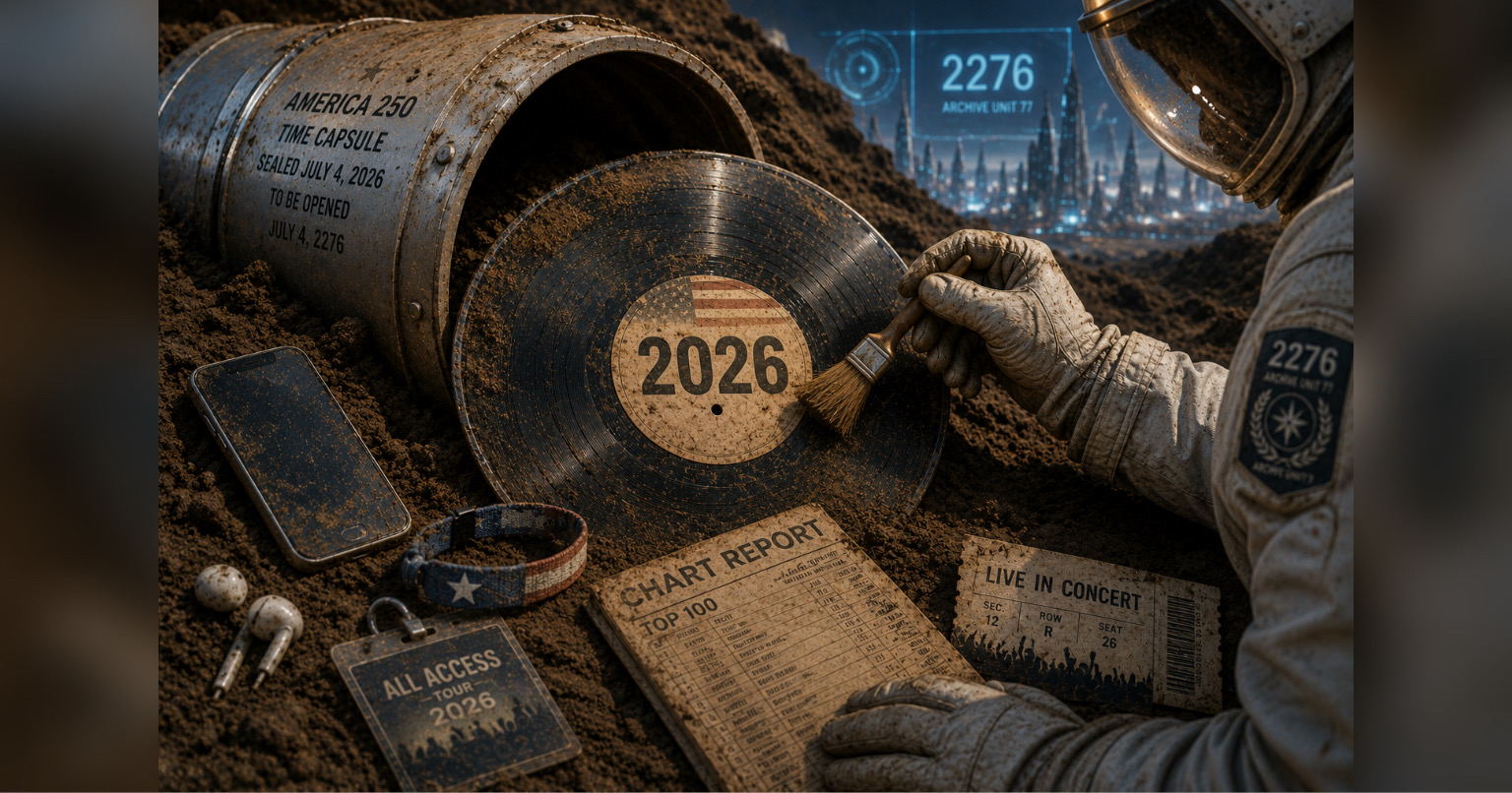
(July 8, 2026) – What if America’s official 250-year time capsule had included not just letters, sports memorabilia and an iPhone — but music? What music exhibits would best explain America in 2026 to people living in 2276?
As mandated by Congress in 2016 as part of the official America250 initiative, America’s Time Capsule was buried on July 4, 2026, at Independence National Historical Park, where it is to remain sealed until July 4, 2276 – the nation’s 500th birthday. Containing artifacts from all 50 states, plus letters to future Americans, professional sports memorabilia, an iPhone representing 21st century technology, and items from all three branches of federal government, it will remain buried about 10 feet below ground in a sealed, weather-resistant, stainless-steel container for the next 250 years.
The people who eventually open it in 2276 will be as far removed from us as we are from 1776 today. Yet, while people living in 1776 certainly didn’t have the communication options that we do now, can you imagine if they’d done the same for us, describing how they entertained themselves with music and dance? What role did songs play in rallying support for independence from British rule? Did enslaved Blacks introduce African rhythms to a developing country that influenced music as we hear it 250 years later?
DJROBBLOG thought it would be interesting to do just that for 2276… or at least imagine it (I’d be astonished if someone were able to access this blog 250 years from now!). I’ve come up with a list of six contenders for great music artifacts — or exhibits — representing where we are socially, culturally, politically, and even technically as a nation today. If I could package these and place them in a vault, never to be opened until 2276, these are the songs/albums/artists that I believe best tell the story of 2026 America, musically speaking.
Of course, this list is subjective, and I encourage readers to provide their own suggestions in “Your Thoughts” below, along with any accompanying messages they believe future Americans might want to hear in 2276.
Here are the blog’s music artifacts from 2026 to readers 250 years from now:
Exhibit No. 1: America’s Multilingual Identity and Globalization

“Swim” by BTS and “DTMF” by Bad Bunny.
If there were two acts whose popularity in 2026 reflected the globalization of popular music and America’s role in it – and the accompanying cultural debates – they were BTS and Bad Bunny. The South Korean BTS’ members were mostly in their 30s when their latest No. 1 single, “Swim,” topped the American charts in early 2026. Having just ended a four-year hiatus to complete obligatory military duty in their home country, they were still considered K-Pop’s biggest ambassadors as well as the most popular “boy band” in the world.
Meanwhile, Puerto Rican American superstar Bad Bunny – arguably the most popular musician in the world today – intersected the worlds of entertainment and politics when he was invited to perform at the 2026 Super Bowl (SB LX) halftime show. As a critic of sitting U.S. President Donald Trump, Bad Bunny’s performance, which included Spanish-language versions of his hits, highlighted the cultural divisions of the era as well as the increasing bilingual identity of the country’s citizens. His signature song, “DtMF,” – an initialism for “Debí Tirar Más Fotos,” or “I should have taken more photos,” – reached No. 1 on the charts in February 2026 and was a perfect encapsulation of Latino culture and the desire to document life’s precious moments on film.
Exhibit No. 2: America’s Conflicted Relationship with Cancel Culture

I’m the Problem, album by Morgan Wallen; and “It Depends,” single by Chris Brown.
Country superstar Morgan Wallen and R&B icon Chris Brown represent two different manifestations of the same cultural phenomenon: the limits of “cancel culture” in the face of enormous commercial success. Now the phrase “cancel culture” may not be a thing in 2276, but people should know what the term implies.
Brown’s career survived repeated legal controversies beginning with his assault of pop superstar and ex-girlfriend Rihanna in 2009 and extending well beyond it. Yet in 2026, he co-headlined a highly successful concert bill with fellow R&B/pop crossover legend Usher and is still recognized as one of the most important R&B figures of the 21st century.
Wallen rebounded after the 2021 video in which he used a racial slur yet went on to become country music’s dominant commercial force for years afterward. More than anyone, his popularity reflected the disconnect that existed between media narratives and consumer behavior. It also represented the dominance of streaming, which allowed albums to remain chart fixtures for years rather than months. As of July 2026, his last three albums have alternately occupied space in the top ten of the Billboard 200 for all but eight weeks since January 2021. Two of those – Dangerous: The Double Album and One Thing at a Time – hold the record for most weeks spent in the top ten among non-soundtrack albums since the weekly chart began 70 years ago. Don’t know if that record will be standing in 2276, but if so, they should know that it happened in the buildup to the semiquincentennial!
Exhibit No. 3: Ageism vs. the Fleeting Nature of Fame

Confessions II, album by Madonna; and Bitch, album by Lizzo.
With an album that sounded like it might be more suited for soundtracking a late-night romp at a bathhouse than grooving on a dance floor, a 67-year-old Madonna was able to top various Billboard charts – including a projected crowning of the Billboard 200 – with her first studio set in seven years. What’s more, if Confessions II tops the Billboard 200 – we won’t know until after this is published – it will become her tenth No. 1 LP and make her the first woman to score a No. 1 album in the 1980s, ‘90s, 2000s, ‘10s and ‘20s.
The notion that Madonna was still creating chart-toppers in 2026 was one thing. The fact that critics were calling it her best music in at least two decades was another. But Madonna’s inclusion here is more a testimony to her status as one of popular music’s most enduring legends than it is about the quality of her latest music. In an entertainment industry long criticized for treating women over 40 as commercially expendable, Madonna’s return to the top of the charts at age 67 suggested that longevity itself could be a cultural statement.
It sharply contrasted the fact that a more current superstar – Lizzo – who is 30 years Madonna’s junior and has more recent radio hits – failed just a few weeks earlier to even make the Billboard 200 with her latest set, titled Bitch.
Taken together, Madonna and Lizzo illustrated two very different truths about American popular music in 2026. One showed that an artist could remain culturally and commercially relevant into a fifth decade of recording. The other demonstrated how quickly momentum could evaporate in the streaming era, where social-media omnipresence and cultural conversation no longer guaranteed that listeners would show up when a new album arrived. Together, they revealed just how unpredictable stardom had become.
Exhibit No. 4: An American Institution and the Dominance of Country-Pop

The Life of a Showgirl, album by Taylor Swift; and “Choosin’ Texas” by Ella Langley.
No one has embodied the commercialization of celebrity more during this decade than pop music institution Taylor Swift. In a now-20-year career, the new Mrs. Travis Kelce (after marrying the famous NFL star at an unprecedented ceremony at Madison Square Garden on the eve of our semiquincentennial) has achieved more commercial success than any other entertainer this century. Earlier in the 2020s, she became the first woman to achieve billionaire status strictly on musical earnings. A combination of savvy marketing and a loyal fan base has made her one of the world’s most beloved and most polarizing figures – one who even found herself at odds with the sitting U.S. president. In short, she’s become an American institution, often drawing comparisons with Elvis, Michael Jackson and Madonna.
As a recent manifestation of her unwavering success, the aptly titled The Life of a Showgirl began 2026 at No. 1 and saw two of its singles top the Hot 100. Swift achieved a third Hot 100 No. 1 in June with “I Knew It, I Knew You,” from the Toy Story 5 motion picture.
Yet, while Swift’s third Hot 100 triumph of 2026 marked a return to country music and the top of that genre’s singles chart, an upstart artist named Ella Langley was dominating the year on both the Hot 100 and Hot Country Songs with her blockbuster hit, “Choosin’ Texas.” In addition to setting records for most moves in and out of the No. 1 position (six) during a single Hot 100 chart run, Langley’s smash also dominated Country Songs like no other hit by a female artist. Except for the two weeks that Taylor’s Toy Story hit reigned, “Choosin’ Texas” has remained at No. 1 country since December 2025, for a combined 30 weeks and counting. This also means that no male acts have topped Hot Country Songs so far in 2026 – a first for any year through early July in what historically has been a male-dominated industry.
Btw, I’d include a vinyl copy of Taylor’s album to reflect how viable that medium remained in 2026 following a nearly two-decade-long resurgence in sales.
Exhibit No. 5: Hip-Hop Culture at a Crossroads

Iceman, album by Drake; “Not Like Us” and GNX, single and album by Kendrick Lamar
While it is debatable whether Drake and Kendrick Lamar are more representative of 2026 hip-hop than any other rappers, hip-hop is too culturally significant to mainstream America to be absent from a musical time capsule. Even if it wasn’t dominating the Hot 100 the way it did in the late 2010s, it remained one of the defining forces in American culture. Never was that more true than in the seismic shift that occurred with the rivalry between Canadian rapper Drake and his Compton, CA-based former collaborator Kendrick Lamar.
On the surface, Drake represented hip-hop capitalism and its still-thriving commercial empire. Kendrick, on the other hand, rose to prominence as its artistic conscience. The bright line dividing the two was blurred significantly when Kendrick and Drake entered a historic diss-song feud in 2024 that saw Lamar emerging victorious with the scathing “Not Like Us,” a career-shifting No. 1 tune that won all five of its Grammy nominations in 2025, including for Record and Song of the Year. Aside from its personal attacks about Drake’s cultural identity and alleged pedophilia, the song’s production and cadence struck a nerve with mainstream America – returning to No. 1 more than eight months after its initial reign, thanks to a record-breaking Super Bowl halftime show performance by Kendrick, largely seen as his victory lap.
Still, a down-but-not-out Drake mounted a remarkable commercial comeback in 2026, returning with not one or two albums, but three simultaneous releases that saw him historically capture the top three spots on the Billboard 200 and simultaneously place 42 songs – a record – on the Hot 100. His return killed the notion that a rap beef could end the chart reign of a figure as ubiquitous and ingrained in the culture as Drake had been for nearly two decades. Yet it reminded folks that one of the foundations of hip-hop – the rap beef – was as important to hip-hop in 2026 as it had been for decades.
But if Drake and Kendrick Lamar represented two competing visions of hip-hop in the 2020s, Exhibit No. 6 contains two deceased music legends whose resurgent 2026 popularity recalled their similar yet distinct concepts of pop stardom from an earlier era.
Exhibit No. 6: When Legends Refused to Fade

Thriller, album by Michael Jackson; and “Purple Rain,” single by Prince.
These two late pop and R&B icons from the 20th century returned to the charts in 2026 with blockbuster recordings that found new life more than 40 years after their original chart dominance. In Prince’s case, his signature rock ballad “Purple Rain” — the title track to his quasi-autobiographical film and album — returned in January 2026 thanks to a synch with the final episode of the popular Netflix TV series Stranger Things. Originally released in 1984 when it peaked at No. 2, “Purple Rain” has since seen two returns to the chart – first in 2016 following Prince’s untimely death due to a drug overdose, and again in 2026.
But that didn’t come close to the renaissance that Michael Jackson created with the Thriller album and several hit singles from it and his other LPs. Arguably one of the greatest entertainers of all time, Jackson’s return was propelled by a historic but controversial biopic in which he was portrayed by his nephew Jaafar Jackson. The movie, simply titled Michael, grossed nearly $1B worldwide, making it the highest grossing film of its kind. What’s more, the 43-year-old Thriller – already the biggest-selling album of all time globally – has remained in the top ten of the Billboard 200 for the past two months, its longest duration since 1984.
Both Prince and Michael – whose comparisons to one another both in life and in death were inescapable – represented two different kinds of genius that popular music may never see again. The fact that their careers saw resurgences in 2026 – more than a decade after each man’s untimely death – was testimony to that fact and younger fans’ increasing demand for music from legacy artists. This was especially true for Michael, with thousands of viral videoclips of people reenacting his iconic dance steps to songs like “Beat It” and “Billie Jean,” both of which also saw new life on the Hot 100 in 2026.
For more than four decades, music fans have debated whether Michael Jackson or Prince was more talented. Ironically, their remarkable chart resurgences in 2026 suggested that the question itself may have missed the point. Their paths back to the charts were different, but each demonstrated a kind of immortality few artists ever attain.
If any recordings from this imagined musical time capsule are still being played when America’s official time capsule is finally opened in 2276, don’t be surprised if they’re by Michael Jackson or Prince.
Well, actually you won’t be around to be surprised, but… you get the point.
If you had room for just one more exhibit in America’s Musical Museum of 2026, what would it be — and what would you want Americans in 2276 to learn from it?
DJRob
DJRob (he/him) is a freelance music blogger from the East Coast who covers R&B, hip-hop, disco, pop, rock and country genres – plus lots of music news and current stuff! You can follow him on Bluesky at @djrobblog.bsky.social, X (formerly Twitter) at @djrobblog, on Facebook or on Meta’s Threads.
You can also register for free by selecting the menu bars above to receive notifications of future articles.