


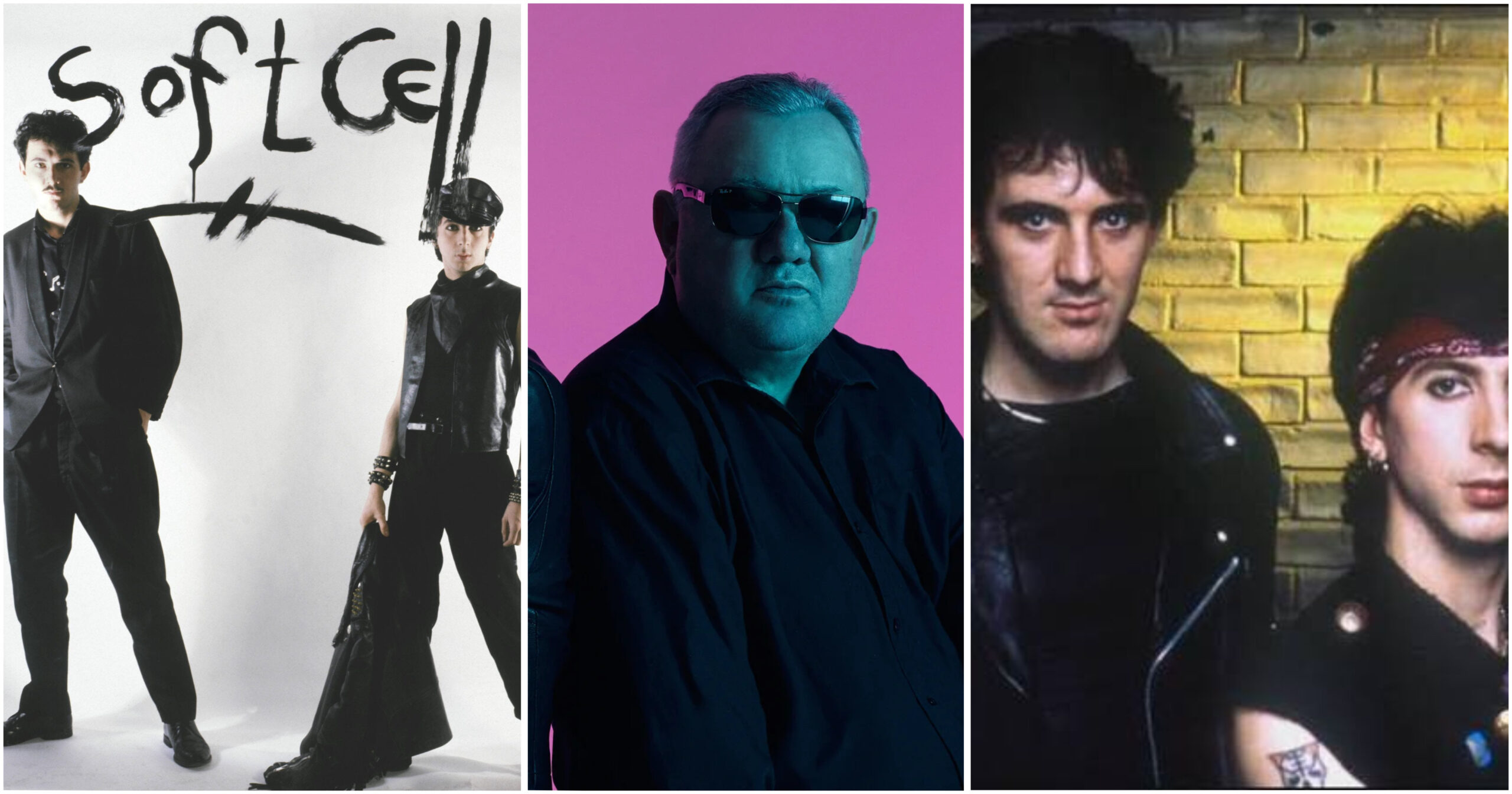
A tribute to Soft Cell’s Dave Ball, whose 1982 classic “Tainted Love” broke chart records—then lost them to technology’s evolution.
(October 24, 2025) – The haunting, pulse-like synth melody that defined 1982’s “Tainted Love” was the creation of Soft Cell’s keyboardist Dave Ball, who passed away Wednesday (Oct. 22) at his London home. He was 66.
Ball, one-half of the British duo alongside vocalist Marc Almond, helped turn an obscure 1964 soul track into an international new-wave anthem. Their version of “Tainted Love,” paired with a cover of the Supremes’ No. 1 pop hit “Where Did Our Love Go,” became a global dance-floor staple and one of the most enduring singles of the early 1980s. Few realized at the time that the song itself was a cover of Gloria Jones’ original, which had failed to chart nearly two decades earlier.

Ball later lamented that choosing to blend two preexisting hits rather than pairing “Tainted Love” with an original Soft Cell composition cost the duo a significant publishing payday—a decision that underscored the future ironies of a “tainted” love affair between the song’s artistry and its place in history.
The Record That Wouldn’t Die
When “Tainted Love”—a song about the painful dismantling of a bad relationship—hit the U.S. in early 1982, it seemed destined for a modest chart run. It debuted low at No. 90 on the Billboard Hot 100 that January, inched upward to No. 64, then slipped all the way to No. 100 for two weeks before making an improbable rebound. By late spring it was in the Top 40; by July, it peaked at No. 8. And then it simply refused to leave.
The single clung to the bottom rungs of the Hot 100 for months—its final five chart weeks frozen at No. 97—before finally exiting that November after 43 total weeks, surpassing Paul Davis’ “I Go Crazy” as the longest-charting single in Hot 100 history at the time.
Technology Giveth, Technology Taketh Away
But like many chart records, its reign didn’t last. In 1991, Billboard adopted new digital monitoring technology (then Nielsen SoundScan and Broadcast Data Systems; now Luminate), ushering in a new era of accuracy that allowed songs to stay on the charts much longer. “Tainted Love”’s record was soon eclipsed by a flood of newer hits—each benefiting from the very kind of technology that didn’t exist when Ball’s tech-heavy synthesizer first pulsed across American airwaves and dance floors.
Even its status as Britain’s biggest-selling single of 1981 was later revised, when improved sales data crowned Human League’s “Don’t You Want Me” instead. Ironically, both synth-driven classics—each signifying the dawn of a second British music invasion in America—were reshaped by data-driven corrections in their homeland decades after their release.
The Ultimate Irony: A Rule That Freezes Time
Now, in yet another twist of chart fate, Ball’s death comes in the same week Billboard announced a new longevity rule for the Hot 100: any song below No. 5 after 78 weeks will be automatically removed. That means the current all-time record holder, Teddy Swims’ “Lose Control” (112 weeks), is effectively untouchable.
In other words, this time technology—and new criteria—have ensured that the old adage—records were made to be broken—may no longer apply, a cruel twist to the rules that “Tainted Love” played by for decades.
Legacy in a Digital Age
“Tainted Love”—one of technology’s greatest hits—will forever remain a product of the analog age—a record whose climb, peak, and slow fade told a story of old chart math, persistence, and timing. In the era before streaming algorithms and chart recalibrations, Dave Ball’s synth line pulsed like a heartbeat—mechanical yet deeply human, just like the song’s woeful lyrics about that pending breakup.
Perhaps that’s the song’s greatest legacy: proof that even in an age defined by data and machines, emotions can either be manufactured or real—but often heartfelt and always remembered.
Rest in peace, David Ball (May 3, 1959 – October 22, 2025).

DJRob
DJRob (he/him) is a freelance music blogger from the East Coast who covers R&B, hip-hop, disco, pop, rock and country genres – plus lots of music news and current stuff! You can follow him on Bluesky at @djrobblog.bsky.social, X (formerly Twitter) at @djrobblog, on Facebook or on Meta’s Threads.
You can also register for free here (or select the menu bars above) to receive notifications of future articles.