


Fourteen Years Later, It’s Time for Billboard to Fix Its Genre Charts
(October 20, 2026) – The 2026 Billboard chart year — which runs from mid-October to mid-October — is officially in the books. And with its conclusion, the clear lead contender for the No. 1 hit of 2026 is Ella Langley’s “Choosin’ Texas,” a song that smashed records for No. 1 longevity on both the Hot 100 and Hot Country Songs charts.
On the former, the song notched 24 non-consecutive weeks at the top and is gunning to return for a 25th frame next week after sitting at No. 2 the past few weeks behind Taylor Swift’s latest single “Patient Zero.”
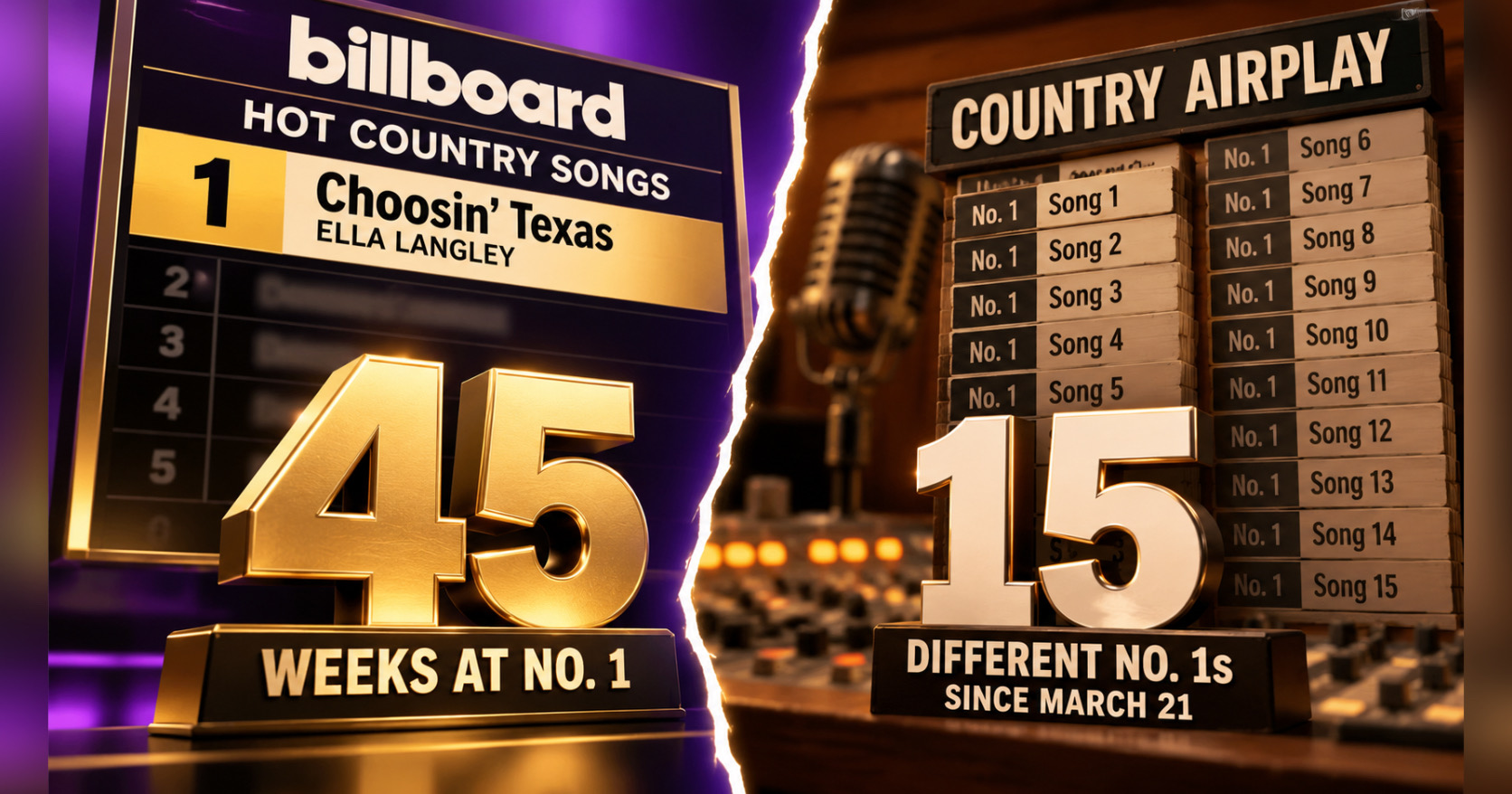
On country music’s flagship Hot Country Songs, “Choosin’ Texas” has spent an incredible 45 (and counting) of the past 47 weeks at No. 1 — interrupted only by Swift’s “I Knew It I Knew You” for two weeks in June.
It’s the latter accomplishment that makes the best argument yet for why Billboard’s genre song charts are severely flawed in this blogger’s opinion… and now have been for 14 years. Beginning exactly 14 years ago with the charts dated October 20, 2012, Billboard converted all its major genre song charts to a formula that replicates the all-encompassing Hot 100. That is, they each use the same all-inclusive, multi-format radio panel as the Hot 100, along with the same streaming and sales data.
In other words, a song’s placement on Hot Country Songs is not only determined by how much airplay it receives on country radio, but on pop, adult contemporary, rock, alternative, R&B/Hip-Hop, and Latin radio stations as well.
Since the October 2012 change to this all-inclusive methodology, songs rank in the same order on their respective genre charts as they do on the Hot 100, without exception and regardless of their activity within their own formats. The flagship genre charts have essentially become a subset of the Hot 100, with Billboard’s chart department even having to decide in less obvious cases when a song is eligible for one of the genre charts, particularly if it has not yet developed significant airplay at a particular format.
This all-genres-count approach means that “Choosin’ Texas,” which has been a multi-radio format smash for the better part of a year, still sits at No. 1 on Hot Country Songs, matching its performance as the highest-ranking country tune on the Hot 100. This is despite many of the format’s own radio stations having moved on from Langley’s juggernaut half a year ago.

Country Radio Moved Past “Choosin’ Texas” Months Ago
In fact, “Choosin’ Texas,” which topped the genre-specific Country Airplay list for three weeks in February/March, hasn’t been on that chart since June when it fell below the threshold to be removed to recurrent status. Langley’s even had two other No. 1 airplay songs since then — “Be Her” in June and “I Can’t Love You Anymore,” a duet with Morgan Wallen, in August — plus several other hits at country radio since “Choosin’ Texas” ran its course.
More tellingly, country radio has crowned 15 different No. 1 songs since “Choosin’ Texas” last reigned supreme on the Country Airplay chart dated March 21. Yet none of those 15 have even whiffed No. 1 on Hot Country Songs. Several have reached No. 2 there, but only by virtue of having been the second-highest ranked country song on the Hot 100 during the corresponding period… behind “Texas,” of course, and based on their own crossover success.
The current No. 1 at country radio, Lauren Alaina’s “All My Exes” featuring Chase Matthew, ranks a distant No. 14 on the October 24-dated Hot Country Songs chart. Its chances of topping that tally may depend less on its success at country radio than on whether it can generate enough streaming, sales and crossover airplay to overtake Langley’s enduring blockbuster… a task that has proven elusive for anyone not named Taylor Swift since last December.
How We Got to Two Different Charts
To be clear, there’s nothing inherently wrong with a country song enjoying crossover success, or with Billboard measuring that success. Indeed, “Choosin’ Texas” deserves every accolade its extraordinary popularity has earned. But when a chart bearing the name Hot Country Songs continues to crown a song that country radio abandoned months earlier — while 15 other songs have taken turns atop the format’s airplay chart — it’s fair to question whether the multi-metric chart is still telling us much about what’s actually happening within country music.
Before the October 2012 methodology overhaul, Hot Country Songs was fundamentally a country-radio airplay chart, with physical single sales no longer a factor and streaming not yet incorporated. This drew a lot of criticism within the industry, as radio and radio alone was driving how the charts behaved on a weekly basis. When Billboard introduced its new multimetric methodology, the former radio-only rankings continued under the Country Airplay name. The same was essentially true of the principal Hot R&B/Hip-Hop Songs chart with respect to its radio-format methodology.
With the advent of downloads and streaming, Billboard appropriately added those consumption metrics to all their flagship charts and retained or established separate format-specific airplay charts. But for reasons that are not exactly clear, Billboard’s chart managers decided in 2012 that a multi-format airplay component should apply to each genre, essentially diluting the input from a specific genre’s radio stations.
Consequently, we now have two different ways of identifying a country No. 1, and the current situation illustrates just how far apart those two measurements can drift.
Langley’s 45 weeks at No. 1 on Hot Country Songs are undeniably remarkable. But comparing that figure with country-chart records established when country radio airplay was the sole determinant risks treating fundamentally different achievements as equivalent.
So What Should Change?
This blogger has long lobbied for a change that limits the airplay component of the genre charts to their specific format’s radio input. Thus, Hot Country Songs should continue including streaming and sales, but the chart’s radio points should only be those from country stations. The same should apply to Hot R&B/Hip-Hop Songs, Hot Rock Songs, etc. This would create greater opportunity for more movement at the top of these charts while also reflecting more accurately what a given format’s core audience is vibing to.
Changing this years ago might have prevented the embarrassment of previous examples like Macklemore and Ryan Lewis’ “Thrift Shop” being No. 1 on Hot R&B/Hip-Hop Songs for 14 weeks (and ranking No. 1 on that chart for the year) or Lil Nas X’s “Old Town Road,” which Billboard famously removed from Hot Country Songs at the beginning of its chart run, spending 20 weeks at No. 1 R&B/Hip-Hop – both based on their success at multiple formats. The current No. 1 on that chart – Bruno Mars’ “I Just Might” – is now in its 32nd record-breaking week at No. 1, even though it peaked at R&B/Hip-Hop Airplay (at No. 10) way back in March and hasn’t been on the corresponding 50-position radio list since May.

None of this is suggesting that a change would end Langley’s reign at Hot Country Songs or Mars’ dominance of Hot R&B/Hip-Hop Songs. If their streaming and sales numbers remain overwhelmingly superior, they could still dominate their respective genre charts under the blog’s proposed formula. The argument is that the resulting ranking would be a more meaningful measure of their success within those formats, not a reflection of how those songs are being received across the board.
The bottom line: the solution to this problem doesn’t require returning to the old days when radio airplay alone determined the genre rankings. It requires something far simpler: making the radio component of each genre chart reflect the genre it’s supposed to represent.
After 14 years, it’s time Billboard’s genre charts became more than filtered versions of the Hot 100.
DJRob
DJRob (he/him) is a freelance music blogger from the East Coast who covers R&B, hip-hop, disco, pop, rock and country genres – plus lots of music news and current stuff! You can follow him on Bluesky at @djrobblog.bsky.social, X (formerly Twitter) at @djrobblog, on Facebook or on Meta’s Threads.
You can also register for free by selecting the menu bars above to receive notifications of future articles. Also, please feel free to share this article on your social media feeds.