


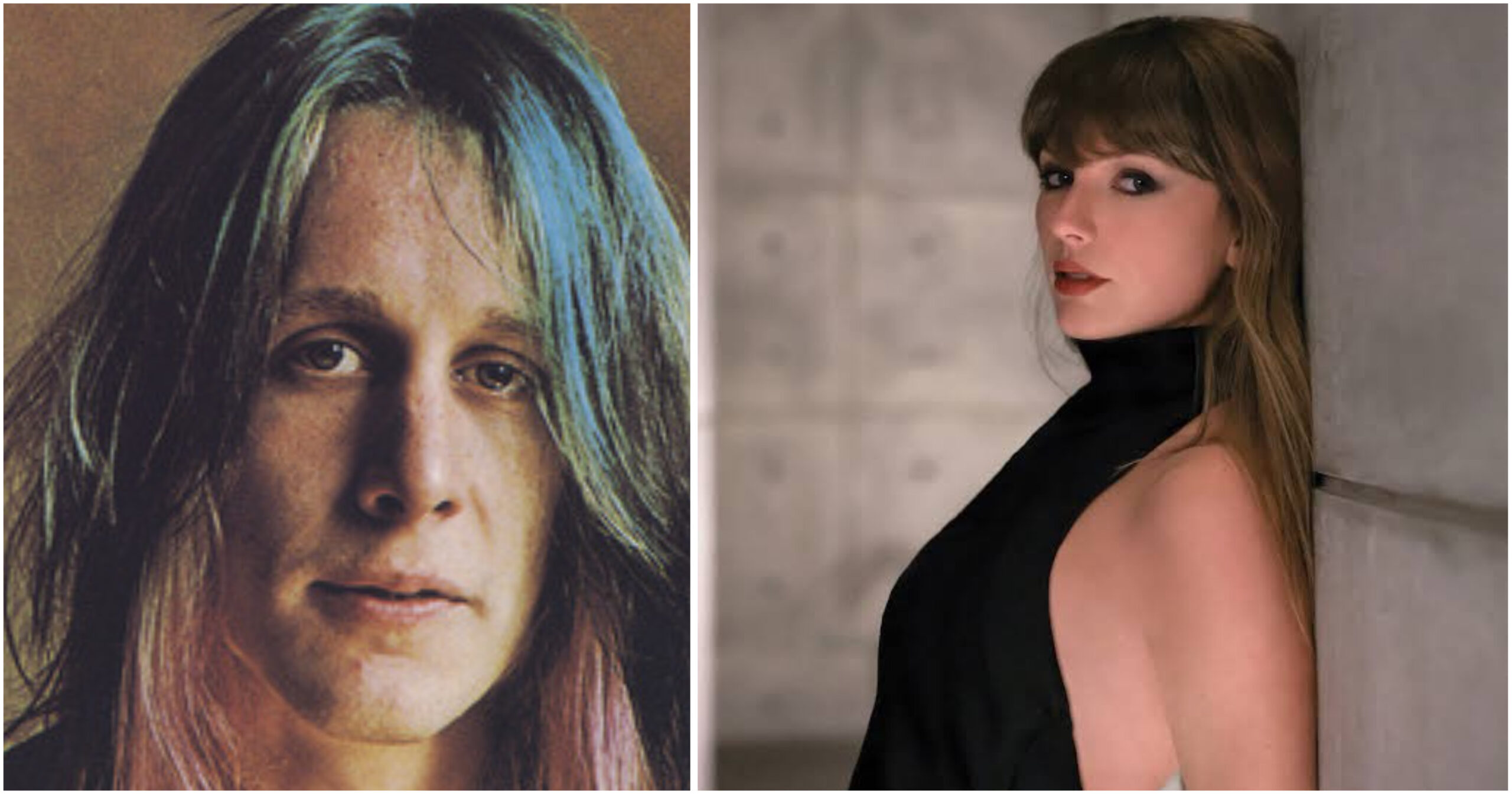
(September 27, 2026) – There’s nothing like a 78-year-old rock legend—one whose own hitmaking heyday was more than half a century ago—to rile up Swifties with one of the most scathing takes yet on their queen’s music and talent.
But that’s what “Hello, It’s Me” singer Todd Rundgren managed this weekend in a Vulture interview where he made the argument that Taylor Swift has “ruined music.” Among his many quotables were that Swift is the “apotheosis of mediocrity” and “doesn’t do anything particularly great except grow hair.”
Of course, before googling “apotheosis,” many Swifties probably had the same question: “Who is Todd Rundgren” before defending Swift’s continued hitmaking and dominance of all things pop culture.
And while the “growing hair” crack is certainly the most overtly gendered of his insults, the more interesting question arises from the argument surrounding them… specifically, Rundgren’s theory that boys have diverted their disposable income from music to video games, leaving the record industry to discover that girls had allowances too. As a result, he opines, the industry increasingly catered to young female consumers, producing the environment where stars like Swift, Lady Gaga (who, by comparison, he argued was a “real musician,” btw) and Ariana Grande have thrived.
Whatever Swift critics think about her music – and there is a subjective argument to be made about the limitations of her voice, the common three- or four-chord structures of (most of) her melodies, and the degree to which her cultural footprint exceeds her musical innovation – narrowing such comments to her music is not inherently sexist. But Rundgren didn’t stop there. He’s effectively explaining the dominance of Taylor and female pop stars in general as being the result of the industry discovering girls as consumers after boys went elsewhere.
But that assertion ignores the fact that women have made enormous strides in music since the mid-1980s when Madonna, Whitney Houston, Janet Jackson, and others began topping the charts with unprecedented regularity. Women hardly needed the PlayStation era to become dominant stars. In fact, the rise of Beatlemania itself should probably end the women-as-new consumers argument before Rundgren even reaches Atari or Intellivision. No doubt female record-buyers and concertgoers had a lot to do with the Fab Four’s musical takeover – and that of other musical heartthrobs – in the 1960s and beyond. In short, young women and girls have been enormously consequential music consumers for generations.
Perhaps where Rundgren’s argument accidentally demonstrates Taylor Swift’s significance (while trying to dismiss it) is on the charts today, where women have never been more dominant. Whereas young female fans in the 1960s and ’70s had fewer women artists—particularly singer/songwriters—telling their stories at the top of the charts, today’s fans have no such shortage. Swift has both benefited from and become one of the most powerful forces in that transformation.
Last year, women in lead roles accounted for a record 39 weeks at the top of the Hot 100. So far in 2026, they’ve topped the chart in 31 of the year’s 39 weeks. The last time a male artist was at No. 1 was on the June 6 chart when Drake’s ironically titled “Janice STFU” was at the top. Women are currently on a 16-week No. 1 streak with no apparent end in sight.
Ella Langley’s “Choosin’ Texas” has been No. 1 for 13 consecutive weeks (23 weeks total) and is looking to add a 24th when the new charts are released Monday (Sept. 28). After that, Swift is widely expected to challenge for No. 1 – at least temporarily – with her new single “Patient Zero,” the video of which premiered on Sunday’s MTV VMAs (Sept. 27) on CBS and one of four new songs on the just-released Encore edition of 2025’s The Life of a Showgirl. Then it’s possible that Langley returns to the top – as she has six other times this year.
Either way, with just 13 weeks remaining in 2026, it appears we’re in for a potential all-female finish with Langley, Swift, and later Mariah Carey (or Brenda Lee) set to make their annual holiday returns to the top. If all of that happens, without an intervening No. 1 by a male act, women would earn their greatest calendar-year share of weeks at No. 1 on the Hot 100 in the chart’s 68-year history with 44, shattering last year’s record.
Put another way: if women finish 2026 with 44 weeks at No. 1, their combined total for 2025 and 2026 alone—83 weeks—would nearly equal the 95 weeks female-led acts spent at No. 1 during the entire 1960s.
| Decade | Total Weeks at No. 1 for Female Acts | Best Year |
| 2020s | 165 | 2025 (39) |
| 2010s | 202 | 2011 (37) |
| 2000s | 214 | 2001 (35) |
| 1990s | 251 | 1999 (34) |
| 1980s | 159 | 1981 (28) |
| 1970s | 128 | 1977 (22) |
| 1960s | 95 | 1963 (23) |
| 1950s* | 0 | 0 (*Hot 100 started on 8/4/58) |
The above table is for data through the Sept. 26, 2026, chart and includes all females in lead roles (including male-female duets) and acts where females are named as leaders of a group (Joan Jett & the Blackhearts, Ruby & the Romantics, etc.). It excludes co-ed acts like the Staple Singers and the Fifth Dimension, as well as acts with women limited to “featured” roles (like Eminem featuring Rihanna). The 1990s – with dominant performances by acts like Mariah Carey, Janet Jackson, Madonna, Whitney Houston, TLC, Toni Braxton, and Celine Dion – were the best showing for female artists with 251 weeks – nearly half of the decade – at the top of the Hot 100.
And the table reveals that the decade-by-decade progression isn’t linear:
95 → 128 → 159 → 251 → 214 → 202 → 165 and counting.
The 1990s remain the extraordinary high-water mark, so this isn’t simply “women become progressively more dominant every decade.” Instead, 2025–26 represents an extraordinary resurgence after two decades below the ’90s peak. Women owned only 12 No. 1 weeks in 2024, and there were three years during the 2010s (2018, 2017, and 2015) with even fewer weeks having females at the top.
With three full years remaining in this decade – plus 13 weeks remaining in the year – the 2020s could easily surpass the 1990s’ showing by women, thanks in large part to Swift’s dominance. The 36-year-old has had at least one No. 1 every year this decade, with “Patient Zero” potentially being her fourth topper this year alone – moving her into another rare category in chart history (only six other acts – the Beatles, Supremes, Jackson 5, George Michael, Usher, and Rihanna – have scored four No. 1s in the same calendar year).
Taylor’s four new songs have been the source of much criticism since their Friday (Sept. 25) release with some arguing that she’s sacrificing quality for quantity and should take “a couple years off.” Others still, including some Swifties online, have theorized that Swift is getting these songs out of the way while putting pressure on herself to deliver a masterpiece for album No. 13 – her favorite number.
Whatever her strategy, there’s likely no world in which she slows down now. She still has some pretty big achievements in her sights. Only one other artist in chart history has had a No. 1 single in every year of a decade: Mariah Carey during the 1990s. A two-year hiatus would essentially eliminate the very chart-savvy Swift’s chances of tying that feat. And there’s still that other Carey mark Taylor is striving to achieve – her 19 No. 1s on the Hot 100, just one shy of the Beatles’ record.
Both targets are now in Swift’s crosshairs, and it’s possible that she matches and surpasses the Beatles’ mark this decade before she turns 40.
Say what you will about this generation’s biggest pop star, her multi-generational impact on pop music is undeniable. Even Rundgren’s own description – that Swift became a role model for one generation of young women, and now those women and their daughters attend her concerts together – speaks to her generational durability. That endurance is what keeps her in the equation every year.
Except now the wealth is being shared among many women at the top of the charts. And now with Swift, Carey and Langley conceivably taking it from here, three women from very different generations and career stages are poised to make chart history. With their recent domination of the Hot 100, it’s hard to believe that there were years during the 1960s when no solo women topped the charts and as recently as 1976 when just one woman – Diana Ross – topped the charts.
Todd Rundgren’s points about Taylor’s music could be defensible. But suggesting that a shift in consumer purchasing power to women somehow ruined music or encouraged mediocrity in the music biz is a stretch.
Instead, it may have helped change who holds power in it.
DJRob
DJRob (he/him) is a freelance music blogger from the East Coast who covers R&B, hip-hop, disco, pop, rock and country genres – plus lots of music news and current stuff! You can follow him on Bluesky at @djrobblog.bsky.social, X (formerly Twitter) at @djrobblog, on Facebook or on Meta’s Threads.
You can also register for free by selecting the menu bars above to receive notifications of future articles. Also, please feel free to share this article on your social media feeds.