


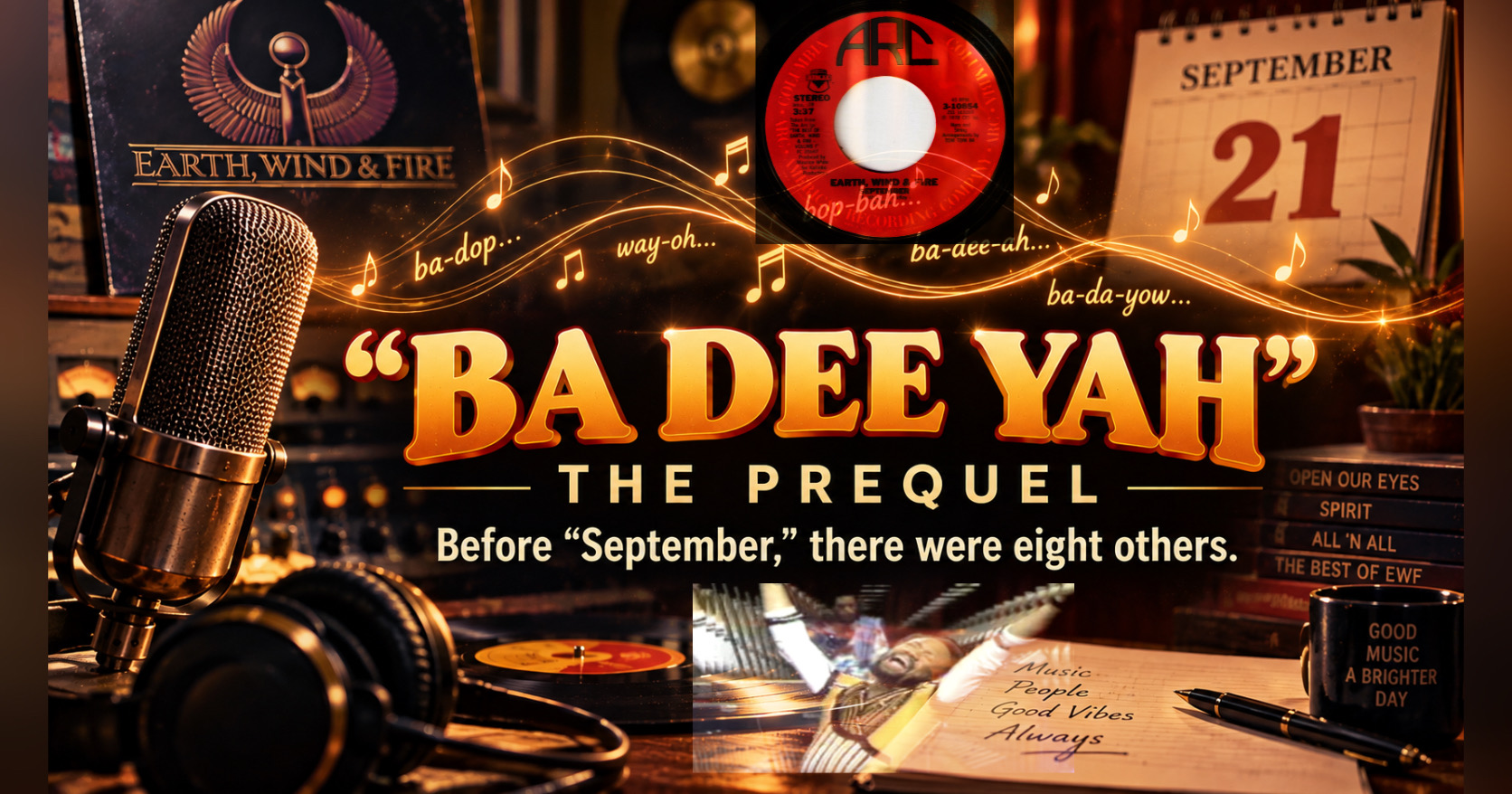
Before “September,” There Were Eight Others
(September 21, 2026) – Many people are familiar with Earth, Wind & Fire’s “September” – the ubiquitous 1978 track from their first greatest hits collection that has become synonymous with today’s date (Sept. 21) and one of the most beloved songs of the 20th century. Part of what’s resonated with so many fans nearly a half century after its release – besides the nostalgic lyrics of a September-to-December romance – is that famous “Ba-dee-yah” scat that Philip Bailey sings during the choruses.
Many EWF fans know, however, that “September” wasn’t the first time Maurice White, Philip Bailey & the rest of the Elements of the Universe incorporated variations of that famous chant in their music. In fact, DJROBBLOG found eight earlier instances in which Bailey’s falsetto led some variation of the lyric filler, often serving as its own musical instrument on album interludes and other “instrumental” tracks. Of course, I’d burst with all the euphoria that “ba-dee-yah” brings if I didn’t share them with you, so check ‘em out below, along with an audio clip accompanying each entry.
“Caribou” – from Open Our Eyes (1974).
This song introduced the familiar scat “Ba-dop-op-op-ba-dey-ee-oh” and variations of it comprise the song’s entire lyric. Of course, Open Our Eyes was the album that put EWF on the mainstream map with the group’s first top 40 single, “Mighty Mighty,” and the follow-up ballad “Devotion.” “Mighty Mighty” and “Kalimba Story” also reached the top ten on the soul chart. But it was the album’s penultimate track, the jazz-flavored “Caribou” — named for the famed studio ranch in the Rocky Mountains of Colorado where the album was recorded (similar to Elton John’s so-named Caribou album from the same year) — that introduced EWF fans to the famous improvised phrasing that would become the group’s signature vocal device on future albums and singles.
“Sun Goddess” by Ramsey Lewis feat. Earth, Wind & Fire – from Sun Goddess (1974).
This classic track didn’t appear on an EWF album originally; it instead was a song from Ramsey Lewis’ 1974 album of the same name. While it is officially considered an “instrumental” by the jazz legend, it did feature guest vocals by EWF’s Philip Bailey, whose entire lyrical contribution consisted of “Way-oh, way-oh, bob way-oh, way-oh-oh. Bop-ba-dop-ba-ba-ba-ba-di-ayy-oh.” Not “Ba Dee Yah” exactly, but you could see where things were headed when this song reached the top 20 on the soul chart and barely missed the pop top 40 (No. 44 Hot 100 peak) in the spring of 1975. It was included on EWF’s live Gratitude album later that year.
“Getaway” – from Spirit (1976).
Earth, Wind & Fire’s 1975 album That’s the Way of the World album oddly missed the “ba-dee-yah” train, but the signature phrase returned with 1976’s Spirit. The first single released from that ’76 masterpiece was the band’s third No. 1 soul single (and third million-selling hit as well). Its first nine seconds feature the vocalists scatting a variation of their famous phrasing in rapid fashion. It goes something like this: “Da-da-dup, ba-da-da-da-la-ba-dee-yow. Ba-da-da-da-la-ba-dee-yow-la-la-la, la-la-la, la-dum-da-dow!” It’s the only time in nearly four minutes we hear it, but it clearly announces the song’s arrival and was quickly becoming an EWF trademark by this point in their storied repertoire.
Related: 30 Songs for September — A Song Dedicated to Each Day of the Month
“Love’s Holiday” – from All ‘N All (1977).
This love ballad is considered one of those “babymakers” of the 1970s. The song blends emotional vulnerability with passionate desire and begins with Bailey’s falsetto leading a chorus of “Bop bah-ow, ba-de-ah-ow, bop-bah-ow!” before segueing into Maurice White’s famous “Would you mind?” intro. White’s focus on consent underscores the mutual respect and agreement that this song embodies, and it carries the verses for the next minute and a half before Philip kicks in again at the 1:58 mark with “bup-ba-bah, bup-ba-bah, bup-ba-bah, bup-ba-bah-bah-bah, bup-bah-bah.” Then the song is all Maurice again as he takes it to the finish. As crass as it may sound, some Gen-Xers may want to ask their parents if “would you mind” had anything to do with why they’re here today.
“Beijo (Interlude)” – from All ‘N All (1977).
Aside from “September,” this tune — aka “Brazilian Rhythm” — might be the most famous “ba-dee-yah” song in an EWF catalog full of them. In fact, “September” can probably trace its direct lineage to this track which includes a full-on chorus of “ba-dee-yahs” repeated in succession throughout its short 1:20 minutes. From beginning to end, this song – billed as an “instrumental” – highlights the joyful “ba-dee-yah” sound that some considered a space filler, others considered a trademark that, at this point, was nearly as essential to the EWF sound as the Phenix Horns had become. It’s probable that few fans can name this track by title on command, but they likely know it when they hear it…and can sing its “ba-dee-yahs” just the same.
“Runnin’” – from All ‘N All (1977).
Many critics and EWF fans consider All ‘N All the group’s best album. Might that have anything to do with the fact that they’d found multiple ways of incorporating our favorite phrase into their lyrics? Whether it be ballads, up-tempo funk jams, or jazzy album interludes, some variation of their trademark was present. Of course, the track “Runnin’” – like several others – was billed as an instrumental, with the only lyrics being a version of Bailey’s famous scatting. And what the interlude “Beijo” lacked in duration, “Runnin’” certainly made up for with its nearly six minutes of Philip singing “bop-bop-bayee-ah, bop-bop-baya-baya-bah, ba-ba-do-be-daya…” and later “ba-ba-da-boo-wee, ba-ba-da-ba-da-ba-doo-way.” And, true to form, we hear our first actual “ba-dee-yah” at the 1:30 mark, because, well, why not?
“Be Ever Wonderful” – from All ‘N All (1977).
The second of the two classic ballads on the iconic All ‘N Allalbum was “Be Ever Wonderful” – the album’s final track, which urged listeners to embrace their authentic self, resist societal pressures to conform, and celebrate their individuality. Certainly, EWF had done just that by 1977, with four of All ‘N All’s songs containing the famous scat. This uplifting track begins with Phil’s variant “ba-dop, ba-da-dop, wee-ooh” before Maurice proceeds with his reminder of our unique qualities and the rarity of true companionship. Then the song segues into Phil’s famous scat at the midway point: “Bah, ba-dop bah ba-dop bah, ba-dop bah, bop bah ba-dop bah, ba-dop bah, ba-da-ohh, ooh ah-ahh.” This sweet refrain serves as the song’s hook and returns at the end as Maurice vamps “Don’t let the world change your mind.” Clearly, EWF didn’t. By the end of All ’N All, EWF hadn’t merely used “ba-dee-yah” — they had practically workshopped it. One year later, they would turn it into one of pop music’s most recognizable nonsense syllables.
“Love Music” – from The Best of Earth, Wind & Fire, Vol. 1 (1978).
Nearly all the attention directed at EWF’s first greatest hits collection in 1978 went to “September,” and understandably so. But an earlier track on the album — one of three songs that hadn’t previously appeared on an EWF album — was “Love Music,” a mid-tempo tune that, like “September,” also uses the familiar scat sparingly throughout its nearly four minutes. After “September” was released as a single and topped the soul chart in early 1979, EWF and their label moved on from the hits collection and readied their next album, I Am, for release, relegating “Love Music” to the pile of album cuts that never saw the light of day on the charts.
Interestingly, EWF’s next album, I Am, didn’t contain any songs using their signature scat phrase. By 1980’s Faces, it appeared they’d abandoned it altogether. Maybe it was because some members reportedly thought “ba-dee-yah” sounded corny. Or maybe, after years of experimenting with variations of it, they simply knew they had finally perfected it.
After all, “ba-dee-yah” had already traveled from “Caribou” to “Sun Goddess,” through Spirit and all over All ’N All before finally landing in “September.” It took EWF nearly five years to get there.
And nearly five decades later, every September 21, the rest of us are still singing it.

DJRob
DJRob (he/him) is a freelance music blogger from the East Coast who covers R&B, hip-hop, disco, pop, rock and country genres – plus lots of music news and current stuff! You can follow him on Bluesky at @djrobblog.bsky.social, X (formerly Twitter) at @djrobblog, on Facebook or on Meta’s Threads.
You can also register for free by selecting the menu bars above to receive notifications of future articles. Also, please feel free to share this article on your social media feeds.