


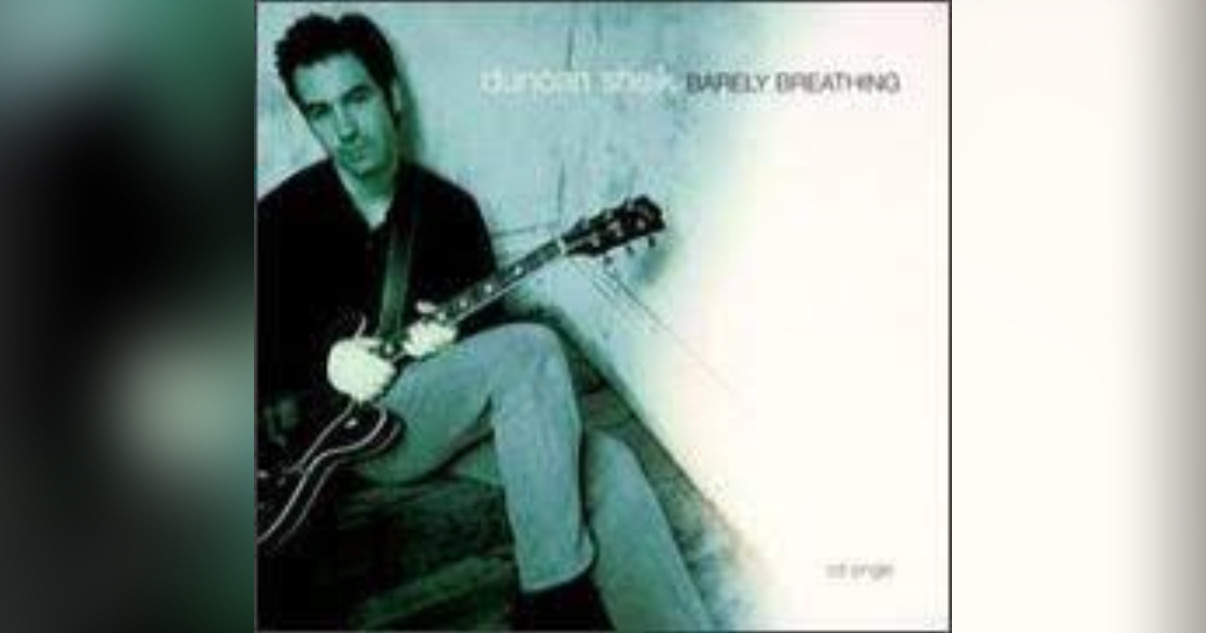
(September 18, 2026) – I was genuinely saddened to learn of the death of Duncan Sheik yesterday (Sept. 17) from heart failure. “Barely Breathing” was one of my favorite songs of the 1990s.
I purchased the CD single and played the thing incessantly.
There was something almost paradoxical about “Barely Breathing.” Despite its title — and despite lyrics describing the slow realization that a relationship was dying — the record itself somehow felt like a breath of fresh air.
And maybe that’s because of when it arrived.
Think about the world into which “Barely Breathing” emerged in late 1996 and became a hit during 1997, peaking at No. 16 on the Hot 100 and enjoying more than a year on the chart when that was practically unheard of. America was increasingly consumed by political scandal and investigation, from Whitewater to the controversies that would eventually give way to the Monica Lewinsky scandal. Hip-hop’s East Coast-West Coast rivalry had moved beyond records and rhetoric into something horrifyingly real: Tupac Shakur was murdered in September 1996; Christopher Wallace — the Notorious B.I.G. — followed six months later.
Popular music itself was in transition. Grunge had already altered rock forever and was becoming a thing of the past. Alanis Morissette’s Jagged Little Pill embodied toxicity in relationships and had helped redefine what mainstream singer-songwriter music could sound like. Hip-hop was becoming an increasingly dominant cultural force. And the record industry was enjoying the enormous profits of the CD era, when consumers often had little choice but to spend $15 or more on an album because they wanted one particular song.
Napster was still two years away.
Meanwhile, the Internet was rapidly escaping the confines of universities, government offices and computer enthusiasts and entering ordinary American homes. Dial-up modems were chirping and screeching their way into our lives. The World Wide Web was becoming something regular people actually used. We didn’t fully understand it yet, but the infrastructure of an entirely different way of living — and eventually consuming music — was being assembled around us.
And amid all that noise came Duncan Sheik.
“Barely Breathing” — a commercially available CD single in a market where that was increasingly rare for pop songs — didn’t have to scream for attention. It certainly didn’t need to.
Its acoustic guitar, understated rhythm, gorgeous melody and Sheik’s restrained vocal gave the record an almost old-school singer-songwriter sensibility. It sounded contemporary without sounding desperate to prove that it was contemporary. There was melancholy in it, certainly, but also warmth. Even its frustration seemed measured.
For me, it was calming.
Nearly three decades later, that may be what I remember most about it and Sheik. “Barely Breathing” felt like a soothing balm during a period when the culture around it seemed to be accelerating. Put that CD single in the player, press play, and for four minutes or so the temperature of the room seemed to drop a few degrees.
There is also something haunting about considering that title today.
In 1997, “barely breathing” was principally the metaphor at the center of a beautifully crafted breakup song. The narrator was emotionally suffocating inside a relationship whose truth he had finally begun to recognize.
But we have lived a lot of history since then.
We have lived through September 11 and its aftermath. Wars. Terrorism. Mass shootings. A pandemic in which the ability to breathe became frighteningly literal for millions of people. And we have lived through a national reckoning over race and policing in which the words “I can’t breathe” became inseparable from the deaths of Black Americans and from the protests that followed.
I don’t impose any of that history retroactively upon Duncan Sheik’s song. “Barely Breathing” wasn’t written about those things, and it shouldn’t be recast as though it were.
But listeners change. History changes us. And sometimes that means a phrase we once understood purely as romantic metaphor accumulates meanings its writer could never have anticipated.
That is one reason “Barely Breathing” hits differently now.
There is another irony in Sheik’s legacy. He will forever be identified by many casual listeners as the quintessential “one-hit wonder,” because no subsequent Duncan Sheik single reached the Hot 100 much less approached the extraordinary staying power of “Barely Breathing.” But reducing him to one-hit status obscures what came afterward. His career continued beyond the pop charts, most notably into musical theater, where Spring Awakening brought him Tony Awards and demonstrated that the guy behind that ubiquitous 1997 radio song had considerably more music left in him.
Still, for some of us, one song will always be the portal.
Mine is that CD single.
I can still mentally place myself in that peculiar moment between the analog world we had known and the digital one that was arriving — before Napster, before streaming, before smartphones, before social media, before playlists containing virtually every song ever recorded could sit inside our pockets.
Back then, you bought the record.
And when you found one you loved, you played it over and over and over again.
I did that with “Barely Breathing.”
Maybe that’s why Duncan Sheik’s death saddens me more than I would have expected. Sometimes an artist’s passing isn’t simply about losing the person who made the music. It’s about suddenly being reminded of the person you were when you first heard it — me, a 30-year-old body trapping an older man’s soul — and realizing how much living has happened between then and now.
“Barely Breathing” arrived during one turbulent era and Duncan Sheik leaves us during another.
Yet when I hear those opening notes today, the effect is remarkably similar to what it was nearly 30 years ago.
The world gets a little quieter.
And for a few minutes, I can breathe.
Thank you, Duncan Sheik, for giving me — and so many others — a song that somehow made breathing a little easier.
Rest in peace.
DJRob
DJRob (he/him) is a freelance music blogger from the East Coast who covers R&B, hip-hop, disco, pop, rock and country genres – plus lots of music news and current stuff! You can follow him on Bluesky at @djrobblog.bsky.social, X (formerly Twitter) at @djrobblog, on Facebook or on Meta’s Threads.
You can also register for free by selecting the menu bars above to receive notifications of future articles. Also, please feel free to share this article on your social media feeds.
I just pulled out my CD Single as well – Great song – hits harder when you realized he had a cardiac event at 56, a year older than me. When you start to lose people around your age it hits even harder. – Tony
Exactly about hitting hard. He’s a few years younger than me. I’ve played this song on repeat several times today.