


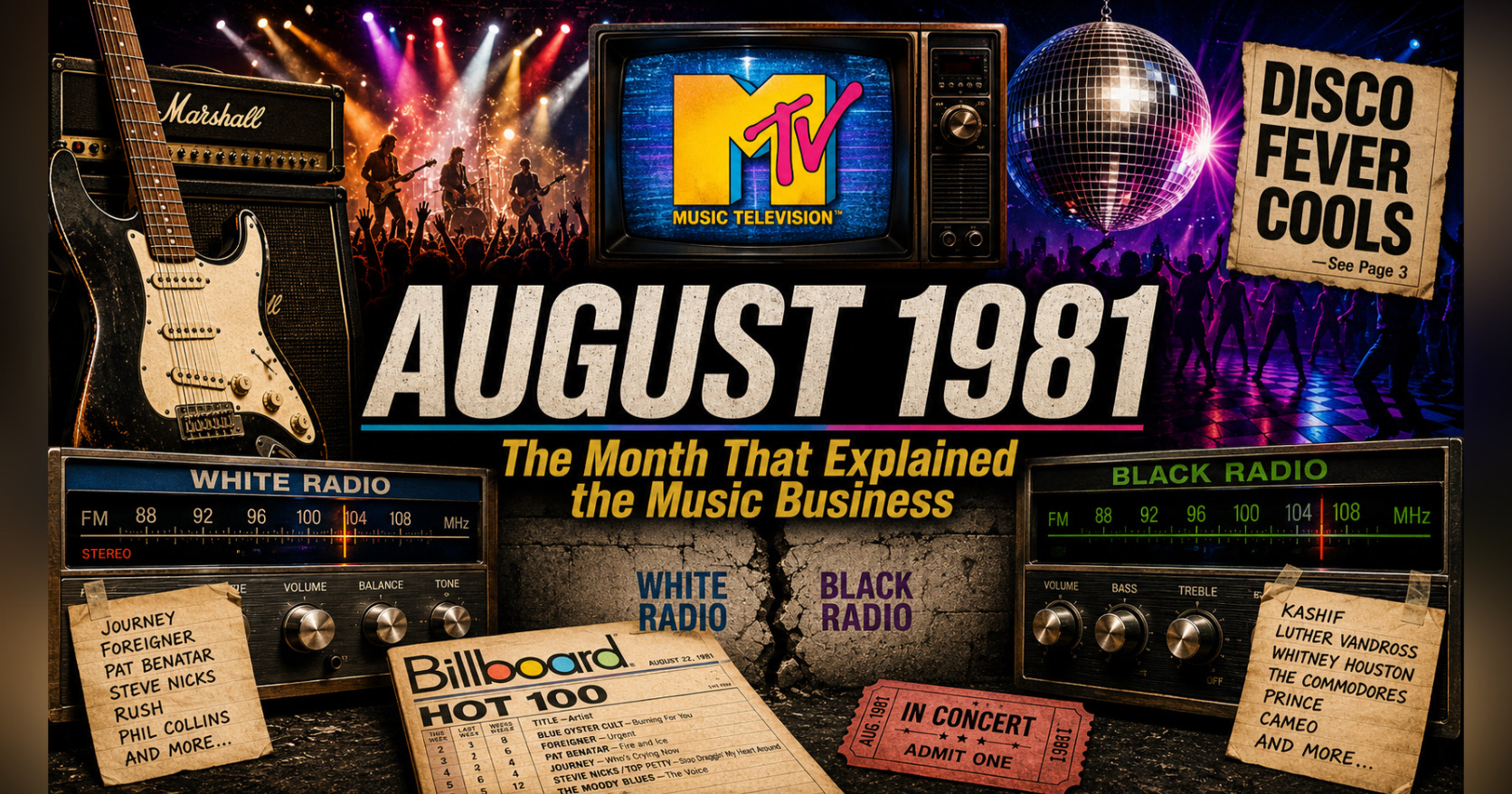
MTV Debuted, Music’s Color Barrier Was Strong, and Rock’s Best Era Was In Full Swing
(August 22, 2026) – If someone wanted to understand the American music industry in 1981, they wouldn’t need to study the entire year. August alone would tell the story.
Rarely has one month provided such a revealing snapshot of where popular music had been, where it stood, and where it was about to go.
Rock music was arguably at its creative and commercial zenith, with an astonishing collection of current songs and albums (see one of the earliest Billboard Rock Tracks charts below) that would eventually become staples of classic-rock radio. Disco, meanwhile, had completed a spectacular fall from its late-‘70s dominance and, for the first time in more than half a decade, had no records among the top 40 positions on Billboard’s Hot 100. Legendary radio DJ Casey Kasem, who had chronicled disco’s rise on his countdown show American Top 40, keenly pointed out the genre’s historic absence in its August 29 episode.
Radio and the record industry were also heavily segregated, with Black and white artists increasingly funneled toward formats designed for audiences that record executives apparently believed had little interest in hearing one another’s music. That same month, Billboard published a remarkable commentary by artist manager Howard Bloom essentially calling the industry out on it — and explaining why those artificial barriers weren’t just culturally limiting, but potentially costing record companies millions of dollars, with examples to back up his claim.
And on August 1, a new cable television channel called MTV — Music Television — signed on.
Its arrival would ultimately transform popular music. But the MTV that debuted that Saturday morning didn’t so much create the music industry’s existing tensions as it put them on full display — on television.
A Comeback? Rock Was Already Winning
It is tempting, with prevailing narratives, to divide the late 1970s and early ‘80s into the “disco era” and “rock’s return,” respectively.
But with 45 years of hindsight, it’s worth remembering that the charts told a considerably messier — and more interesting — story.
Even at disco’s commercial peak in 1978 and ‘79, rock wasn’t exactly a wilting wallflower waiting for the mirror balls to come down. If anything, the late 1970s were simultaneously one of rock’s most commercially potent periods.
Fleetwood Mac’s Rumours became a sales phenomenon. The Eagles’ Hotel California and The Long Run were blockbusters. Boston’s first two albums sold millions. Foreigner, Styx, Supertramp, Journey, Heart, and Cheap Trick all helped establish the polished, radio-friendly sound that would eventually acquire the not-always-affectionate label “corporate rock.”
Meanwhile, harder-edged acts like AC/DC and Van Halen were thriving, established stars such as Queen were reaching new commercial heights, and album-oriented rock radio had become an enormously powerful force in determining what millions of mostly young, mostly white listeners heard. Indeed, 1978 had been the industry’s most financially successful year yet with sales revenue topping $4B for the first time, thanks in large part to Saturday Night Fever but also with major contributions from the rock elite.
So when disco’s extraordinary pop-chart run abruptly receded after 1979, rock didn’t have to mount a “comeback.”
It was already there.
What disappeared by 1981 — with the help of some of rock music’s most frustrated ambassadors who’d seen their genre decimated in radio ratings and many of their disc jockeys’ jobs lost to format changes — was one of its biggest competitors for mainstream attention: traditional disco.
The backlash against disco was unmistakable, and its commercial retreat was astonishingly swift. Despite producing what this writer contends was some of its best music in the early ‘80s — classics like Grace Jones’ “Pull Up to the Bumper,” The Strikers’ “Body Music,” Convertion’s “Let’s Do It,” and Taana Gardner’s “Heartbeat” — in just two years the genre had been relegated to a niche, post-disco sub-format, one that still thrived in big urban markets but had lost its appeal elsewhere.
Even on the disco chart itself, rock artists were beginning to make waves. On the Billboard disco chart dated August 22, fledgling British acts like Duran Duran, Depeche Mode, the Human League, and The Cure were moving in and moving up. They would soon be a huge part of a second British Invasion of the pop charts that would shape how we heard (and saw) dance music for years to come.
By 1981, the center of gravity had shifted unmistakably toward rock (alongside MOR and country music). Journey was approaching its commercial peak. Foreigner was about to experience its biggest success yet, as had REO Speedwagon who’d become the unlikeliest of arena-rock juggernauts. Pat Benatar had emerged as one of rock’s biggest new stars. Stevie Nicks, meanwhile, was launching a blockbuster solo career with Bella Donna while Fleetwood Mac remained very much intact.
As the August 1981 Billboard charts showed, rock wasn’t merely surviving the post-disco transition. It was feasting on it.
“Ladies and Gentlemen, Rock and Roll”
At 12:01 a.m. Eastern time on August 1, 1981, MTV went on the air with footage of the Apollo 11 launch, an astronaut planting an MTV flag on the moon and the words: “Ladies and gentlemen, rock and roll.”
It may have been the most accurate mission statement imaginable.
The first video, famously, was the Buggles’ prophetically titled “Video Killed the Radio Star.” But anyone watching MTV’s first hours would have quickly discovered that the operative word in the channel’s opening declaration wasn’t necessarily “video.”
It was rock.
MTV’s early playlist leaned heavily toward the same rock and New Wave artists already being championed by album-oriented rock radio. That partly reflected two realities: (1) relatively few American record companies had built large libraries of promotional music videos, while British and European acts had been making them more routinely for years; and (2) the racial compartmentalization that was the American music business of 1981.
Rock radio played rock. Black radio played R&B. Country had its stations. Adult contemporary had its own. Mainstream pop radio purported to mix all of them, but increasingly phased more aggressive, dance-oriented R&B (or post-disco) out of the mix. Record companies staffed separate promotional departments to service those formats, and an artist’s race could play an uncomfortable role in determining which side of those musical fences the industry believed he or she belonged.
MTV inherited that world.
Its overwhelmingly white early rotation would eventually make the channel’s racial exclusion one of the most controversial chapters in its history. But focusing exclusively on MTV risked mistaking the most visible symptom for the disease itself.
The barriers had been erected long before MTV switched on its video feed.
In fact, just a week after MTV debuted, one music-industry insider was using the pages of Billboard to describe those walls in unusually blunt terms.
His name was Howard Bloom.
In the August 8, 1981, issue of Billboard ran an op-ed piece by Howard Bloom, then-president of a NYC-based public relations firm that included “a number of top black and white acts on its client roster.” Calling the music industry the “strangest example of segregation since South African apartheid,” Bloom noted how the industry’s frequent segmenting of Blacks and whites “subtly and insidiously damages” the music business.
Just one week prior, in its August 1 issue’s Chart Beat column (still published weekly online, btw), Billboard noted that “going to No. 1 on its R&B chart didn’t mean what it used to in pop programming.” It cited as examples how five of the year’s nine No. 1s to that date had failed to make the pop top 30 — including No. 1 soul hits by Lakeside, the Gap Band, Rick James, and Chaka Khan, and only three — Ray Parker, Jr.’s “A Woman Needs Love,” A Taste of Honey’s “Sukiyaki,” and Smokey Robinson’s “Being With You” — reached the pop top ten. The average pop peak of the year’s No. 1 soul hits through August 1 was No. 32 — down from No. 15 in all of 1980 and the worst since Billboard reinstated its R&B chart 16 years earlier.
Bloom, in his Aug. 8 column, cited then-recent examples of records that had successfully crossed those racial and format lines. He made an argument that was as much economic as social: the music industry’s self-imposed segregation wasn’t merely unfair, it was bad business.
He knew from firsthand experience. In 1974, while working in publicity and artist relations at ABC Records, Bloom had been assigned to the band Rufus, whose “Tell Me Something Good” was becoming one of the label’s biggest hits. Yet he recalled that many of the company’s white staffers — rock fans themselves — had little interest in working with Rufus because the group fell outside their musical tastes. Bloom mounted an aggressive publicity campaign that helped introduce its then-little-known singer Chaka Khan to mainstream publications, while his colleagues, he wrote, missed out because they feared “sullying their rock’n’roll purity” by working with a Black pop act.
Seven years later, Bloom saw plenty of evidence that crossing those artificial boundaries paid off.
He cited Earth, Wind & Fire and the Commodores as Black acts that had enjoyed significant exposure on traditionally white formats, while white acts including Devo, the Clash and Rod Stewart had newfound audiences at Black radio and clubs. He also singled out Prince, whose Warner Bros. AOR promotion team was supporting his music despite the reluctance of many rock stations to play Black artists.
But Bloom’s most compelling example was Queen’s “Another One Bites the Dust.” The white British rock band’s funk-driven smash had received intensive Black-radio and club play and, according to the group’s management, sold more than three million singles in the U.S. alone. It reached No. 1 pop and No. 2 soul the prior year.
“The notion of segregated music has been endemic in our business since the days when black records were known as ‘race records,’” Bloom wrote.
His prescription was simple: “By integrating markets we can achieve greater sales.”
History would soon prove him spectacularly right.
Just 16 months after Bloom’s commentary appeared, Michael Jackson released Thriller. The album ultimately became a commercial phenomenon on a scale the record industry had never seen, while Jackson’s videos helped break through MTV’s own racial barriers and transformed both the network and the way music was marketed.
The irony is difficult to miss. In August 1981, Bloom was arguing that record companies were leaving money on the table by presuming Black and white audiences wouldn’t embrace the same music. Less than two years later, a Black artist would provide perhaps the most spectacular demonstration imaginable of what could happen when those assumptions were discarded.
And Bloom had even identified another part of the coming revolution. Among the Black artists he cited as successfully reaching white rock audiences was a 23-year-old Prince — three years before Purple Rain would make him one of the biggest stars on the planet.
The walls Bloom described wouldn’t disappear overnight. But the music industry was about to discover just how profitable breaking through them could be.
And About All That Rock…
For all the contradictions exposed by that extraordinary month, one other fact about August 1981 deserves to be remembered: Rock music was really, really good!
Below is Billboard’s Album Rock Tracks chart from August 22, 1981.

Journey. Stevie Nicks. Foreigner. Pat Benatar. Phil Collins. Santana. Squeeze. The Moody Blues. The Stones. Blue Oyster Cult. Recently exited were classics by AC/DC (“Dirty Deeds…”), Rush (“Tom Sawyer”), Joe Walsh (“A Life of Illusion”), and Ozzy Osborne (“Crazy Train”).
Today they’re rock classics. In August 1981, they were simply the new releases.
Forty-five years later, that chart reads less like a weekly ranking than a greatest-hits playlist assembled with the benefit of hindsight.
Except it wasn’t.
And perhaps that’s the perfect final snapshot of this extraordinary month.
August 1981 found the American music business at a fascinating crossroads: technologically on the verge of reinvention, racially and stylistically constrained by boundaries of its own making, emerging from disco’s spectacular rise and fall, and simultaneously enjoying one of the richest periods rock music would ever experience.
MTV had just given the industry a new way to see its music.
One of the industry’s own, Howard Bloom, via the music industry’s bible — Billboard — was challenging it to reconsider who it allowed to be seen and heard.
And the charts were documenting an extraordinary soundtrack to it all.
What a month!
DJRob
DJRob (he/him) is a freelance music blogger from the East Coast who covers R&B, hip-hop, disco, pop, rock and country genres – plus lots of music news and current stuff! You can follow him on Bluesky at @djrobblog.bsky.social, X (formerly Twitter) at @djrobblog, on Facebook or on Meta’s Threads.
You can also register for free by selecting the menu bars above to receive notifications of future articles.
This article brought back some great memories; since I, like you, have probaly listened to every music genre available. There were many crossover successes, but none greater than the Thriller album at the time. Hard to imagine the success of the Beastie Boys or Run DMC’s revival of Aerosmith’s Walk This Way without some of the early pioneers.
Yes it did! I didn’t realize how rich August 1981 was for multiple genres — but particularly disco and rock — until I began researching this. Thanks for the comment!