


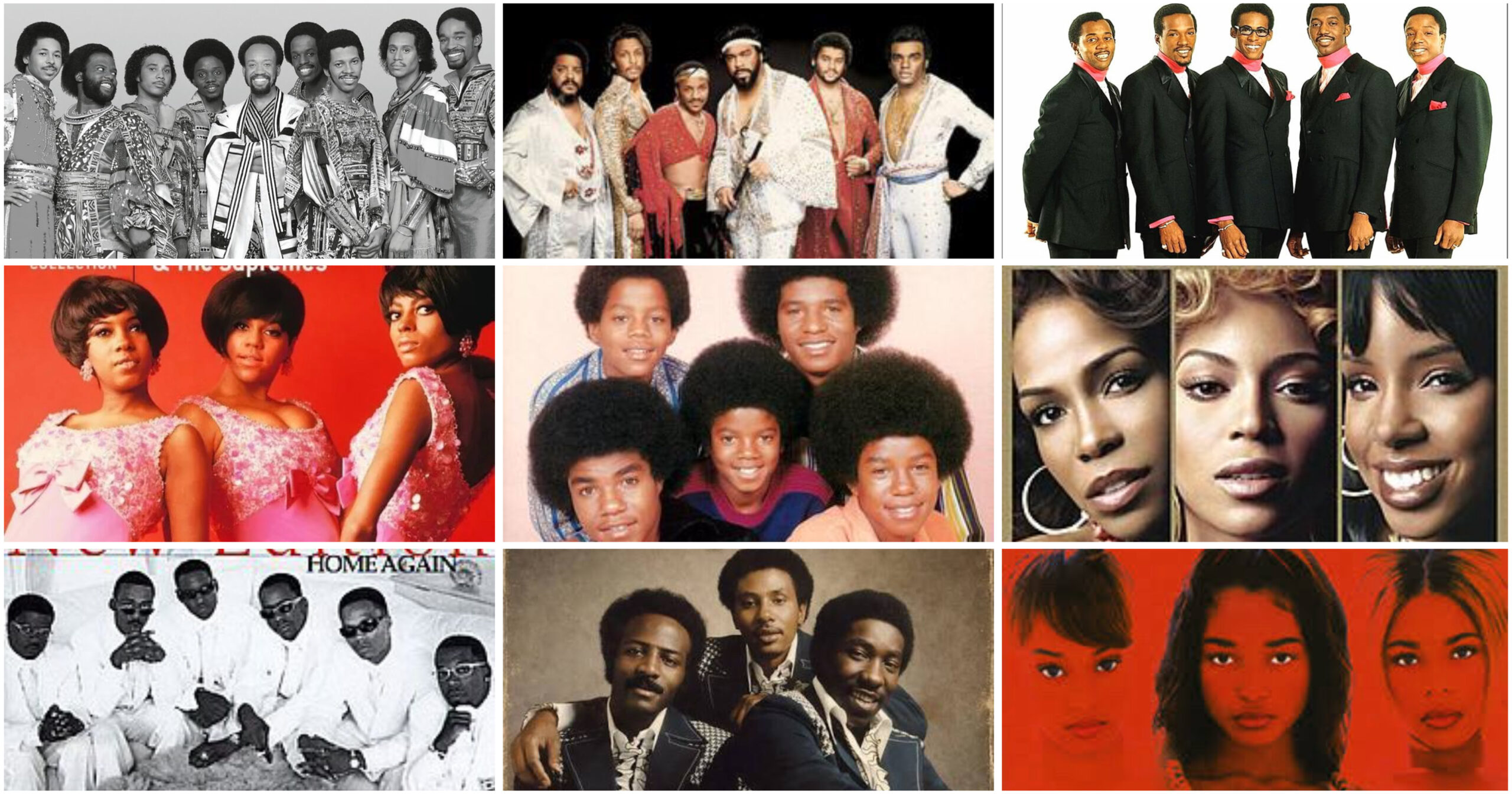
(July 20, 2026) – As part of its celebration of Black Music Month in June, Billboard ranked the “50 Best R&B Groups of All Time.” Their list was based on “staff picks,” not strictly chart performance.
That last fact means that the list was subject to writers’ opinions on everything from cultural significance, influence on other artists, and the groups’ legacies. As this blogger sees it, Billboard is the authority on matters of the charts. But when it comes to opinion pieces – especially those involving people who “weren’t there” when the groups they’re evaluating were in their heyday – their staffers leave a bit to be desired.
With that in mind, DJROBBLOG has re-ranked the 50 Best R&B Groups of All-Time using many of the same factors that powered Billboard editors’ “lively debates,” including influence, innovation, longevity, catalog quality, historical significance, and crossover – with that last factor being given slightly less weight here considering this is an “R&B” ranking. Of course, chart performance is always an important leveler of the playing field when weighing less tangible factors, and this blog takes R&B chart performance into account as well.
It’s worth noting that ranking groups is harder than ranking solo artists. Groups take on so many different shapes, including the vocal harmony variety (Temptations, Boyz II Men, the Drifters), and self-contained bands (Earth, Wind & Fire, Kool & the Gang, Isley Brothers). There are family acts (Jackson 5, Isleys, DeBarge, The Emotions), and groups that were created by producers (En Vogue, New Edition). Then there are groups whose members became huge solo stars – performers whose individual success might be conflated with that of the band that launched them (as it appears happened a few times in Billboard’s list).
Note, four of the groups that were on Billboard’s list have been replaced here. Three of them were simply overtaken by other recording acts while a fourth – Sam & Dave – was excluded from contention because they were a duo. Sam & Dave were the only duo on Billboard’s list, which seemed like a slight to other major R&B twosomes like Ashford & Simpson and the Brothers Johnson. To limit confusion, DJROBBLOG limited the re-rank to groups with three or more members.
Here is the new list, counted down from No. 50 to No. 1, with each act’s Billboard rank shown in parentheses.
50. Jagged Edge (BB: Not Ranked). The first of the four acts who were not ranked in Billboard’s list is Jagged Edge. Simply put, JE has stood the test of time perhaps better than any other group whose primary hitmaking occurred in the 21st century. With R&B No. 1 classics like “Let’s Get Married” and “Promise,” plus the butt-shaking anthem “Where the Party At” (with Nelly), the Atlanta-based quartet could do no wrong around the turn of the century. More impressively, they’ve remained together in their original lineup since 1995. Few other groups in any genre can make that claim. They’ve since graduated to Adult R&B status with the 2025 single “Just Might Get It” – from the appropriately titled All Original Parts Vol. 1 album – making the top 20 on that list, more than a quarter century after their first success.
49. Shalamar (BB: Not Ranked). Dick Griffey’s S.O.L.A.R. Records gave us the soul soundtrack of the late 1970s and early ‘80s with major hits from groups like Lakeside, Dynasty, the Whispers and Shalamar, all courtesy of Leon Sylvers’ magic production touch. While the Whispers barely made Billboard’s original list (at No. 41; I have moved them up much higher), Shalamar was shafted altogether. They get a nod here – thanks to classics like “Make That Move,” “The Second Time Around,” “This Is for the Lover in You,” and my personal fave, “A Night to Remember.” Shalamar may also be the only group to chart in two completely different incarnations, as none of the members who recorded their first top 40 hit, 1977’s “Uptown Festival,” were in the group for their second, 1979’s “The Second Time Around.” That classic lineup included Howard Hewitt and former Soul Train dancers Jody Watley and Jeffrey Daniel. By the time they recorded their last, 1984’s “Dancing in the Sheets,” only one of the singers (Hewitt) from the “Second Time Around” era remained.
48. Martha & the Vandellas (BB: 48). Martha & the Vandellas were at one point Motown’s premier girl group, with such hits as “Heat Wave,” and the multi-generational “Dancing in the Street.” The Supremes’ 1964 explosion relegated the Vandellas to second-string status with the label. But it didn’t stop them from continuing to churn out classics like “Nowhere to Run” and “Jimmy Mack.” They’re one of six groups to maintain the same rank here as they did in Billboard’s list.
47. SWV (BB: 20). SWV was one of the best vocal groups of the 1990s. And Billboard appropriately praised their three-part harmony and (especially) lead singer Coko’s distinctive vocal runs. But that praise simply didn’t add up to Sisters with Voices being ranked the 20th greatest R&B group of all time, just behind No. 19 Gladys Knight & the Pips and ahead of more iconic and uniquely talented groups like the Pointer Sisters, Chic and the Staple Singers. Make it make sense!
46. Bar-Kays (BB: 49). Registering a slight improvement over Billboard’s No. 49 ranking are the Bar-Kays – a legendary group whose tragic fate (four members were killed in the same plane crash that took Otis Redding’s life in December 1967) could have easily ended them. But they came roaring back, piling on hit after hit. Surprisingly, Billboard only mentioned their contributions of the late ‘60s and early ‘70s in defending their rank. Arguably more memorable were the trove of hits they produced in the late ‘70s and early ’80s while forging a whole new funk identity, like “Shake Your Rump to the Funk,” “Move Your Boogie Body,” “Holy Ghost,” “Boogie Body Land,” and “Hit and Run.”
45. The Chi-Lites (BB: 34). One of several Chicago-based groups on this list are the appropriately named Chi-Lites, a group whose “Oh Girl” and “Have You Seen Her” are two of the most recognizable soul and pop hits of the 1970s. Billboard respectfully credited their influence on new generations by citing Beyonce’s first solo hit, “Crazy in Love,” which sampled the Chi-Lites’ “Are You My Woman? (Tell Me So).” Still, their Billboard rank seemed lofty given their small repertoire of hits and their relatively small sphere of influence compared to others on this list.
44. The Emotions (BB: Not Ranked). The Chicago-based female vocal group The Emotions were omitted from Billboard’s list. This despite Billboard’s own ranking of their “Best of My Love” as the biggest “girl group” song of all time on their Hot 100 chart, based purely on chart performance. The Hutchinson sisters found minor success before “Best” with Stax Records, and it may have been a blessing in disguise that Stax folded in 1975, allowing the sisters to connect with EWFs Maurice White and Columbia Records. That union brought soul classics including “Best,” “I Don’t Want to Lose Your Love,” “Don’t Ask My Neighbors,” and “Flowers.” Their duet w/ EWF on “Boogie Wonderland” was the first top ten song pairing two groups since The Supremes and the Temptations’ “I’m Gonna Make You Love Me” ten years earlier. “Best of My Love” heavily influenced Mariah Carey’s “Emotions” (the song’s title was no coincidence) and was the prominent sample source of the 2023 hit “Lil Boo Thang” by Paul Russell. The Emotions have been cited as influences by several artists including two on this list: En Vogue and Destiny’s Child,
43. The Time (BB: 46). Perhaps no other group on this list has as much personality as The Time, which is incredible considering that they were Prince protégés (and employees) whose music and identity were initially crafted and controlled by the Purple One. That they were able to “morph into a vehicle for flashy frontman Morris Day” and out of the shadows of Prince was a remarkable accomplishment. That famed songwriter/producers Jimmy Jam and Terry Lewis emerged from its original lineup is even more astonishing. True Time fans will remember the pre-Purple Rain days of “Cool,” “Get It Up,” “The Walk,” and the percussion-heavy classic “777-9311.”
42. DeBarge (BB: 44). While integrity prevents me from combining DeBarge with their Gordy label forerunners Switch – a band that featured two older DeBarge brothers Tommy and Bobby – and then moving them further up the list, doing so might arguably be justified. After all, Bobby allegedly contributed some of the high-falsetto vocals on DeBarge classics like “I Like It” and “Time Will Reveal.” As it stands, DeBarge remains a singular entity here and their own stable of hits, like the two aforementioned songs plus “All This Love,” “Love Me in a Special Way,” “Rhythm of the Night,” and “Stay with Me,” are more than enough to justify moving them up slightly from Billboard’s rank of No. 44 to No. 42 here.
41. The S.O.S. Band (BB: 38). The first beneficiaries of Jimmy Jam & Terry Lewis’ stellar production work were the legendary S.O.S. Band, who bridged disco and early ‘80s soul arguably better than any other self-contained band. The debut hit, the non-Jam & Lewis affiliated “Take Your Time (Do It Right),” was a platinum smash that resonated with multiple audiences as disco’s influence was waning at pop radio. But it was their connection with the two former Time members that led to their sustained soul chart success in the 1980s with classics like “Just Be Good to Me,” “Tell Me If You Still Care,” “Weekend Girl,” and 1986’s “The Finest” (whose programmed drumline foreshadowed the Human League’s “Human” later the same year).
40. Guy (BB: 21). Billboard ranked Guy at No. 21 on its list, which felt a bit higher than merited when considering the iconic acts in that range, including Gladys Knight & the Pips, the Four Tops, Chic, and the Pointer Sisters. Sure, this trio was “instrumental to the evolution of modern R&B, pop and hip-hop” as Billboard stated. But the magazine then countered that Guy was “inspired by the ‘70s R&B groups that defined their childhoods,” making them seem more evolutionary than revolutionary. Guy certainly deserves credit for turning an “ebullient funk foundation into the era-defining sound new jack swing.” But that sound was really confined to an era. And placing them high above foundational acts like Zapp, Gap Band, and Cameo – funk groups that carried an era and had considerably more memorable catalogs – felt wrong.
39. The Drifters (BB: 50). Moving the Drifters from No. 50 on Billboard’s list to No. 39 here was more about ensuring that a legacy as great as theirs is not diminished by the passage of time. As one of the earliest acts on this list, it’s likely that the “lively debates” held by Billboard’s editors – many of whom are millennials or younger – simply didn’t recall or appreciate the impact the Drifters had on soul and pop music in the early rock-and-roll era. Songs like “There Goes My Baby,” “Save the Last Dance for Me,” “Up on the Roof,” “On Broadway,” and “Under the Boardwalk” have been covered by many artists for decades since they were first made hits by the “heavenly harmonizing” Drifters. And they continue to resonate today for a generation that isn’t incumbered by today’s hip-hop influenced R&B.
38. War (BB: 43). The multicultural group War mixed social commentary (“The World Is a Ghetto” and “Why Can’t We Be Friends”) with feel-good anthems (“Low Rider,” “Summer,” and “All Day Music”). Throw in the career-launching “Spill the Wine” (with Eric Burdon leading), “Galaxy,” “The Cisco Kid,” “Me and Baby Brother,” “Gypsy Man,” “Outlaw,” and “Slippin’ into Darkness” and you have the makings of one of the most distinctive sounds ever put on wax, one characterized by a powerful mix of “R&B, funk, and Latin rhythms,” as Billboard noted.
37. Jodeci (BB: 27). Music by R&B vocal groups enjoyed a renaissance during the 1990s thanks in large part to acts like 112, Boyz II Men, Silk, and Next. But few of them had the grit and the soulful chops of Jodeci, featuring brothers K-Ci and JoJo Hailey on lead vocals. They changed the game by embodying a bad boy image while still delivering romantic burners in “Forever My Lady,” “Stay,” “Lately,” “Cry For You,” and personal fave “Come & Talk to Me” – all No. 1 R&B hits. Billboard mentioned K-Ci & JoJo’s separate success away from the band as another factor in their No. 27 rank. But the group’s success stands on its own.
36. Harold Melvin & the Blue Notes (BB: 36). The second greatest group on Philly International’s roster was Harold Melvin & the Blue Notes. But they had the greatest secret weapon with lead vocalist Teddy Pendergrass who carried big hits like “If You Don’t Know Me by Now,” “The Love I Lost,” “Wake Up Everybody,” and “Bad Luck.” There’ll likely never be another like him, as Harold Melvin & the Blue Notes found out when he left the group in 1976 to forge a successful solo career. They maintain their Billboard rank for this list.
35. Zapp (BB: 37). While Billboard correctly noted that the Troutman family band Zapp – featuring Roger on Vocodered vocals – helped usher R&B out of the disco era and into the 1980s, one thing Zapp could not do that many others on this list could was score a huge crossover pop hit. That isn’t a crime, however, and Zapp is rightfully considered among the greatest R&B groups of all time (they move up on my list from where Billboard placed them), with a respectable catalog that includes classics like “More Bounce to the Ounce,” “I Can Make You Dance,” “Dance Floor,” “Doo Wa Ditty,” and “Computer Love.” Roger’s computer-aided vocals may have been an extension of similarly altered vocals in groups like Kraftwerk, but they were the forerunner of Autotune, which has been prevalent in R&B for the better part of the 21st century.
34. The Impressions (BB: 39). The Impressions were a product of the socially tense times of the late 1950s and early 1960s. Their music reflected that as they didn’t shy away from the challenges of the Civil Rights era. Classics like “People Get Ready,” “It’s All Right,” and “We’re a Winner” documented the angst, the love, and the hope that being Black in America required. The Impressions also thrived in the 1970s with hits like “I Finally Got Myself Together.” Most impactfully, the group made stars out of late legends Curtis Mayfield and Jerry Butler.
33. Tony! Toni! Toné (BB: 28). The three Tonys weren’t really Tonys. They were brothers D’Wayne Wiggins, Raphael Saadiq, and cousin Timothy Christian Riley. Together they rolled off a string of hits, including five R&B No. 1 – “Little Walter,” “The Blues,” “Feels Good,” “It Never Rains (In Southern California),” and “Whatever You Want.” But they’ll probably be best remembered for “Anniversary,” the 1993 No. 2 R&B smash that was the decade’s greatest ode to lasting love – in an era where it seemed to be increasingly fleeting. The Tonys played their own (real) instruments and were one of the last self-contained bands of the R&B genre. That alone merits a rank among the greatest of all time.
32. Destiny’s Child (BB: 10). I may be wrong, but it seemed like the staff at Billboard were overly influenced by recency, crossover success, and Beyoncé’s otherworldly celebrity in ranking Destiny’s Child No. 10 among the greatest R&B group of all time. Billboard’s editors delved into the trio’s trendsetting “fashion” as a basis for their lofty top ten position while citing their “treasure trove” of ten top 10 Hot 100 hits and four chart toppers. As I see it, an R&B group is best judged by its success on the Hot R&B/Hip-Hop Songs list (formerly Hot Soul Singles, Hot Black Singles, etc.), not the Hot 100. And ten is hardly a “treasure trove.” Many of the groups above them in my re-rank had much more success on the soul chart, with as much endurance, and arguably as much influence on other acts. Furthermore, today’s Billboard editorial staff likely don’t recall a time when the soul and pop charts were distinguished by separate radio and store panels, which made the R&B chart truly reflective of what R&B audiences (read Black folks) were listening to and buying. Billboard killed that distinction in 2012, which tends to elevate newer pop-friendly acts when chart data is factored into rankings like these.
31. The Delfonics (BB: 33). As the earliest beneficiaries of the immense talents of Philly Soul legend Thom Bell, the Delfonics were as important to their time as, say, Jodeci was to the early 1990s. Billboard correctly cited their iconic soul hits – which happened to crossover to the pop top ten – including “La-La (Means I Love You)” and “Didn’t I (Blow Your Mind This Time).” “Trying to Make a Fool of Me” remains this writer’s favorite. The late William “Poogie” Hart penned many of their hits, and his distinguished falsetto and cadence powered most of them. The Delfonics don’t improve much here from where they ranked in Billboard, but they are easily among R&B music’s greatest vocal groups.
30. The Stylistics (BB: 41). Okay, I’ll admit, male soul groups featuring lead falsetto vocals were about as commonplace as bell-bottom pants and afros in the early 1970s. But no one did it quite like Philadelphia’s own The Stylistics, featuring Russell Thompkins, Jr. They simply rose above the rest with one top ten hit after another, including twelve consecutive on the Hot Soul Singles chart. Five of those songs – all written by Thom Bell and Linda Creed – also made the pop top ten and each sold a million copies: “Betcha By Golly, Wow,” “You Are Everything,” “Break Up to Make Up,” “I’m Stone in Love With You” and “You Make Me Feel Brand New.” While the Rock and Roll Hall of Fame eludes them, they’re members of several others, including the Philadelphia Music Alliance Walk of Fame, The Atlantic City Walk of Fame, and the Vocal Group Hall of Fame. That legacy is good enough for a top 30 ranking on this list.
29. En Vogue (BB: 29). While the ‘90s quartet En Vogue maintained their No. 29 spot from the Billboard list, this re-rank does restore the relative order of where they should rank among the other “girl groups” here… namely, that they were rightfully placed behind TLC and the Pointer Sisters in Billboard but should have been ahead of the more evolutionary than revolutionary Destiny’s Child and SWV. Five of En Vogue’s first six singles – “Hold On,” “Lies,” “You Don’t Have to Worry,” “My Lovin’ (You’re Never Gonna Get It),” and “Givin’ Him Something He Can Feel” – reached No. 1 R&B, while the sixth, “Don’t Go,” just missed at No. 3. They eventually gained that sixth No. 1 with their 1997 smash, “Don’t Let Go (Love).”
28. The Pointer Sisters (BB: 23). The Pointer Sisters – siblings Ruth, Anita, Bonnie and June before Bonnie left in 1978 for a solo career – might have been too eclectic for their own good when it comes to ranking all-time R&B groups. They delved into everything from country to pop, and from boogie-woogie to disco. Their two funkiest hits – “How Long (Betcha’ Got a Chick on the Side)” and “Yes We Can Can” – helped solidify them as R&B hitmakers and the genre’s most successful sister act. But the groups that moved ahead of them on this re-rank simply mean more to the R&B community or to R&B history – in this blogger’s opinion.
27. Cameo (BB: 35). Every accolade Billboard gave the legendary funk group Cameo in support of their inclusion in the all-time list – minus the Larry Blackmon codpiece and hi-top fade references – were reasons this writer believes they deserved a higher ranking than No. 35. Don’t get me wrong, the codpiece and hi-top fade were certainly Blackmon trademarks and essential to the band’s unique personality, but they simply weren’t needed in justifying their legendary status. Also, while Billboard focused on high-charting, pop-friendly hits like “Word Up!,” “Candy,” “She’s Strange,” and “Back and Forth,” true soul music fans will recall deeper classics like “Shake Your Pants,” “I Just Want to Be,” “Why Have I Lost You,” “Sparkle,” “Flirt,” “Keep it Hot,” and the personal fave “Attack Me with Your Love.”
26. The Platters (BB: Not ranked). The highest of the four groups that Billboard did not include in its rankings is right here at No. 26 – The Platters. Their omission from the original list is the most shocking of all given their pioneering status as one of the earliest R&B/ doo-wop groups with dozens of Billboard Hot 100 singles spanning from the beginning of the rock-and-roll era to the late 1960s. Classics like “Only You (And You Alone),” “The Great Pretender,” “My Prayer,” “(You’ve Got) The Magic Touch,” “Twilight Time,” and “Smoke Gets in Your Eyes” should have made them shoo-ins for an all-time ranking. I can only believe that theirs was an error of omission by the editors at the music industry’s most trusted trade publication.
25. Sade (BB: 15). Sade is a band… a Rock and Roll Hall of Fame band at that. But Sade is also lead singer Helen Folasade Adu, the Nigerian-born British singer/songwriter whose vocals powered classics like “Smooth Operator,” “Sweetest Taboo,” “Your Love is King,” “Paradise,” “Hang on to Your Love,” and “Is It a Crime?” While their catalog is undeniable, it was difficult reconciling that they should be among the 15 greatest R&B groups of all time – as Billboard’s ranking suggested. This re-rank reflects nothing more than an opinion that while Sade’s musicianship and mystique have few peers in the industry, the bands above them on my list have simply meant more to the core R&B community.
24. The Whispers (BB: 42). The Whispers – featuring identical twin lead singers Walter and Wallace Scott – were among R&B’s most consistent and reliable hitmakers from the 1970s to the early ‘90s. They quietly racked up nearly four dozen R&B/Hip-Hop chart hits and created a sound that was instantly recognizable and uniquely theirs. There were many bedroom burners (“Say Yes,” “Lady,” “In the Mood”) to go along with dancefloor classics (“It’s a Love Thing,” “And the Beat Goes On,” “In the Raw”). Their No. 42 rank on Billboard’s list felt like a slight, perhaps owed to the fact that only four of their 46 R&B chart hits reached the top 40 of the Hot 100. While their crossover appeal wasn’t as great as others on this list, the Whispers’ legendary standing with R&B audiences remains intact.
23. The Gap Band (BB: 31). Part of a band’s legacy is its ability to rise above circumstances that might have doomed other groups. When the Gap Band first rose to fame with their brand of funk-laden R&B, they were overtaken by the huge tidal wave that was disco. When disco’s demise happened in the early ‘80s, the Gap Band’s chances of attaining huge pop crossover success seemingly vanished right along with it, despite their disassociation with disco plus the band’s funkier soul leanings. That didn’t stop them from quickly accumulating several No. 1 R&B chart singles, including the rock edged “Burn Rubber,” the synthy “Early in the Morning,” and the timeless mid-tempo gem “Outstanding.” Other big top ten R&B hits, like “I Don’t Believe You Want to Get Up and Dance (Oops!),” “You Dropped a Bomb on Me,” and “Party Train” further cemented their status as one of the premier funk bands of the early ‘80s, one that without the post-disco backlash might have been even bigger.
22. The Staple Singers (BB: 25). Registering a slight improvement here over their rank in Billboard’s list, the Staple Singers are another of those “one of one” groups. Billboard accurately noted their gospel background and their status as catalysts for change during the Civil Rights and post-Civil Rights eras. But I believe those traits merit a higher rank than Billboard’s No. 25 slot. The Staples were the only group to achieve sustained success on both the pop and soul charts with that unique gospel-R&B blend on songs like “Respect Yourself,” “I’ll Take You There,” “Let’s Do It Again,” and my personal favorite – “If You’re Ready (Come Go with Me).” As evidence of their enduring legacy, ex-President Joe Biden used their 1972 tune “We the People” as his election night victory song in November 2020.
21. Ohio Players (BB: 13). While many self-contained bands emerged from the Dayton, Ohio music scene – including Slave, Zapp, Aurra, Sun, and Lakeside – none were more popular or beloved than the Ohio Players. Their blend of funk, R&B, jazz, and proto disco was like no other band before or since. The playful vocals of frontman Leroy “Sugarfoot” Bonner made the band instantly recognizable, with the kind of distinct personality that became rarer in the producer-driven 1980s and beyond. Still, Billboard’s No. 13 ranking seemed a little high considering the bands ranked above them on this blog’s list. No disrespect, because there’s no shame in being anywhere among the top 25 greatest R&B groups of all time. And given the dearth of R&B groups making inroads in the 21st century, it’s a status that will likely remain.
20. The Miracles (BB: 17). The Smokey Robinson-led Miracles were a force to be reckoned with during the 1960s, though they never rose to the level of acclaim that fellow Motown groups like the Four Tops, the Supremes, and the Temptations achieved. Still, as Billboard correctly pointed out, Robinson was essential to both his band’s sound and that of Motown. The group experienced success after Smokey left with the No. 1 pop and soul hit “Love Machine,” but – replacement members aside – they didn’t enjoy the touring success that the Tempts and the Tops achieved after their charting heydays. A small drop to No. 20 from Billboard’s rank of No. 17 feels appropriate.
19. TLC (BB: 11). Billboard placed TLC just outside the top ten greatest R&B acts of all time. While I agree with their assessment of the ‘90s act as an instant cultural phenomenon, Billboard quickly cited as evidence “the group wearing packs of condoms attached to their colorful clothes and pacifiers around their necks.” The write-up got better as it went along, with more focus on their incredible line-up of hits from 1992’s “Ain’t 2 Proud 2 Beg” to 1999’s “Unpretty.” But anytime a group’s legacy begins with condoms and pacifiers, it feels like the early gimmicks overshadowed their otherwise noteworthy legacy of empowering women and raising the bar for “girl group” success. A No. 19 rank feels about right with that legacy being countered slightly by their success being confined to one decade following Lisa “Left Eye” Lopes’ untimely death in 2002.
18. Chic (BB: 24). I was pleasantly surprised that Billboard gave Chic a respectful No. 24 ranking on their list. Often relegated to the disco trash heap along with other period acts, the ensemble formed by Nile Rodgers and the late Bernard Edwards is often overlooked when it comes to retroactive lists. But Chic wasn’t the Rock and Roll Hall of Fame’s most-nominated act (eleven nods) for nothing. Okay, fair enough, they didn’t get in (and Nile eventually did by himself for musical excellence). But their influence on pop culture – beyond the No. 1 hits “Le Freak” and “Good Times” – is beyond measure. The Billboard writers focused on the hip-hop legacy of “Good Times,” and the Studio 54-inspired story of “Le Freak,” well-known anecdotes indeed. But Chic’s influence extended to acts like Queen, Change, Narada Michael Walden, Vaughn Mason & the Crew, Luther Vandross, and many others. And that’s not to mention the trademark sound they placed on other artists’ hits bearing the “Chic Organization” production stamp, including Sister Sledge, Diana Ross, Carly Simon, Norma Jean, and Sheila & B. Devotion.
17. Kool & the Gang (BB: 26). One of Billboard’s biggest missteps was to have Kool & the Gang in the bottom half of their rankings. Their No. 26 spot was baffling considering the impressive chart stats Billboard rattled off, as well as the level of influence the New Jersey band had in hip-hop with acts like Nas, 2Pac, Eric B. & Rakim, and Snoop Dogg. The Rock & Roll Hall of Fame inductees famously reinvented their sound in 1979 after a few years of dormancy following their funkier years in the early-to-mid 1970s. The resulting renaissance saw them become the most successful Black group of the first half of the eighties decade… at a time when Black artists struggled to find footing with pop radio in the wake of disco’s demise. Hits like “Get Down On It,” “Fresh,” “Misled,” “Big Fun,” “Let’s Go Dancin’” and “Ladies Night” continue to power nostalgia party playlists to this day.
16. Maze feat. Frankie Beverly (BB: 14). No group feels more essential to the cookout than Maze featuring Frankie Beverly. Accordingly, they never had a song reach the top 40 of the Billboard Hot 100 and only had four of their songs even reach the Hot 100. Still, no other group captured the soul of Black America for as long as Maze did. Rarely a cookout, wedding, or birthday party goes by without their timeless “Before I Let Go” populating playlists. While Billboard cited Beyonce’s 2019 cover as a multigenerational boost for the ubiquitous song, it clearly didn’t need that endorsement. It’s great that the Recording Academy posthumously recognized Beverly with a Lifetime Achievement Award in 2025. Now it’s time for the Rock and Roll Hall of Fame to induct the band into its hallowed chambers.
15. Rufus Ft. Chaka Khan (BB: 16). Billboard rightfully credited Rufus and Chaka Khan with an “arsenal of funk, R&B, jazz and other genres” in citing their biggest crossover hits (“Tell Me Something Good,” “Sweet Thing,” and “Ain’t Nobody”). But I’m more partial to the band’s “deep bench of strong albums” that contained gems like “Fools Paradise,” “Please Pardon Me,” “Once You Get Started,” “At Midnight (My Love Will Lift You Up),” “Hollywood,” “Everlasting Love,” “Close the Door,” “Stay,” and “Do You Love What You Feel.” Easily one of my all-time favorite groups featuring my all-time favorite female singer, there may be a bit of bias in having them ranked this high. But it’s only one spot higher than where Billboard placed them, which feels like validation.
14. Boyz II Men (BB: 9). Of the remaining 14 groups on this list, nine were signed to the legendary Motown label at some point in their careers. Philly’s Boyz II Men are often viewed as the last great Motown act, signed to the label in the early 1990s and running off a slew of record-breaking No. 1 singles, including “End of the Road,” “I’ll Make Love to You,” and “One Sweet Day.” As Billboard noted, their harmonies were ultra-smooth with heartfelt storytelling, but it seemed like Billboard rewarded them for their five No. 1 pop singles which, combined, spent a phenomenal total of 50 weeks at the top of the Hot 100 – sixth most all-time. But those hits came during the Luminate era where digital point-of-sale and airplay measuring technology allowed much longer runs at the top. Their lone chart entry after the ‘90s ended was the No. 80-peaking “Thank You in Advance,” making the group feel era-specific.
13. Commodores (BB: 30). My first reaction upon seeing the Commodores at No. 30 on Billboard’s list was that their staffers clearly hadn’t investigated the group’s catalog beyond the obvious hits like “Easy,” “Still,” “Brick House,” “Night Shift,” and “Three Times a Lady,” all of which were name-checked in the article. A deeper dive would reveal not just those big pop crossovers, but a string of platinum-selling albums that yielded soul music faves like “Slippery When Wet,” “Machine Gun,” “Sweet Love,” “Just to Be Close to You,” “Fancy Dancer,” and more. Few bands could navigate heartfelt ballads like “Sail On” and convincingly deliver nasty funk riffs in tunes like “Too Hot Ta Trot.” Another feather in their cap – no other Black group scored as many top tens during the second half of the 1970s as the Commodores (7). And only one group – the Bee Gees – scored more.
12. Gladys Knight & the Pips (BB: 19). Many fans think of Gladys Knight as a singular force in music – and with good reason. As Billboard correctly noted, she remains one of R&B’s defining vocalists and she’s been touring and recording without the Pips for more than three decades. But one need only check their resume to understand how vital Knight’s brother Merald “Bubba” Knight and late cousins William Guest and Edward Patten were to their success. How many of us found ourselves singing their backing arrangements in karaoke-like moments more so than Gladys’s lead? They practically created the template for otherwise all-male vocal groups being fronted by a lone female and are easily R&B’s most successful such group. Furthermore, they remain the only group to score at least one No. 1 R&B chart hit with five different record labels – Vee-Jay, Soul/Motown, Buddah, Columbia, MCA, with Gladys adding a sixth (Arista) as part of her appearance on Dionne & Friend’s “That’s What Friends are For.”
11. The Spinners (BB: 32). Many acts on this list began with Motown or joined the label’s roster at some later point in their careers. The Spinners were based in Detroit, so a Motown connection seemed natural. But with a roster featuring the Supremes, the Temptations, the Four Tops, and Gladys Knight & the Pips, among others, the homegrown Spinners were essentially a Motown afterthought. That’s what makes their Rock and Roll Hall of Fame career so remarkable. Powered by two main lead vocalists – Bobby Smith and ad-lib king Philippé Wynne — the incredible string of soul and pop hits they created after leaving Motown for Atlantic – from 1972’s “I’ll Be Around” to 1980’s “Cupid/ I’ve Loved You for a Long Time” – rivaled that of any Motown group during the era. It was even more remarkable that Billboard had them ranked at No. 32 on their list, outranked by many groups with far fewer credentials and much less influence.
10. Four Tops (BB: 18). I’ve often argued that “Bernadette” is perhaps the greatest Motown single ever released. In its article, Billboard appropriately mentioned their biggest chart successes in the No. 1s “I Can’t Help Myself (Sugar Pie Honey Bunch)” and “Reach Out I’ll Be There,” but “Bernadette” has one of the most urgently delivered vocal performances ever committed to tape, thanks to the late Levi Stubbs. No other vocalist on this list could have pulled it off as convincingly. The Tops may have been outshined by the Temptations as Motown’s premier vocal group – but not by much. Plus, unlike the Tempts, Levi and company were able to escape Motown’s clutches and forge more success with ABC/Dunhill Records and Casablanca with classics like “Keeper of the Castle,” “Are You Man Enough,” “When She Was My Girl,” and “Ain’t No Woman (Like the One I Got).”
9. The O’Jays (BB: 12). Billboard correctly called out The O’Jays’ status as the “poster group” for the Philly Soul sound under the tutelage of Kenny Gamble and Leon Huff, but to have them ranked outside the top ten seemed like a robbery – especially behind more modern groups like TLC, Destiny’s Child, and Boyz II Men. DJROBBLOG corrects that slight by moving them to their rightful place inside the top ten, with iconic tunes like “Back Stabbers,” “For the Love of Money,” “Use Ta Be My Girl,” and “Love Train” serving as evidence of their worthiness. And those were just the big pop hits. Throw in “Livin’ For the Weekend,” “Message in Our Music,” “Darlin’ Darlin’ Baby (Sweet Tender Love),” and “999 Arguments” – among many others – and you have the makings of a catalog so essential to Black music that there’s no way The O’Jays belong outside the upper echelon of R&B groups.
8. New Edition (BB: 8). Every group in this revised top ten has either been inducted or nominated to the Rock and Roll Hall of Fame. New Edition is the only one that has yet to move past the nomination stage. But, as fan favorites following their inaugural 2026 nod, something tells me it won’t be long before New Edition joins the others in the hallowed halls of the Cleveland museum. Billboard rightfully included them among the ten greatest R&B groups of all time, and I’ve kept them in the same position at No. 8. One thing Billboard didn’t mention that solidifies their legacy in my humble opinion: no other group with four or more members – whether R&B or pop, male or female – has managed to keep all its original members (plus “newcomer” Johnny Gill) for as long as New Edition has. Formed in 1982, the sextet is still together – and touring – after 44 years.
7. Parliament-Funkadelic (BB: 6). No other group – or family of groups – expanded the boundaries of funk like the P-Funk collective. Billboard correctly cited Funkadelic’s “Maggot Brain” as a premier part of Funkadelic’s legacy but oddly omitted the iconic “One Nation Under a Groove” and “(not just) Knee Deep” in their recap. They equally gave a nod to “Tear the Roof Off the Sucker (“Give up the Funk)” but left out “Flashlight” and the oft-forgotten No. 1 R&B smash “Aqua Boogie (A Psychoalphadiscobetabioaquadoloop).” Regarding that last hit, name any other band that could have set a lyric about the fear of water and never learning to swim to a funk beat and pulled off a No. 1 single. George Clinton and his Rock and Roll Hall of Fame ensemble did just that – and so much more.
6. Sly & the Family Stone (BB: 3). Moving Sylvester Stewart and his group down a few rungs from where Billboard ranked them might seem like a show of disrespect, but it’s not. It’s merely an opinion that the groups above them were more influential, more successful, and more iconic than Sly & the Family Stone. Still, the influence and legacy of Sly & Co. cannot be denied. As a racially integrated, mixed-gender band that emerged during the socially tense 1960s, they inherently reflected social consciousness at a time it was needed most. Their hits – especially their three No. 1 Hot 100 hits – are iconic, and their influence stretches from Parliament/Funkadelic to Prince & the Revolution and others. And, as Billboard noted, their musical DNA remains woven into contemporary pop, R&B and hip-hop with more than 1200 songs that have sampled their material.
5. The Supremes (BB: 5). Billboard got this right. No other “girl group” was more impactful and more influential than the Supremes. Their twelve No. 1 songs on the Hot 100 – several of which topped the R&B list – speak for themselves, but so does the fact that the original trio of Florence Ballard, Mary Wilson, and the iconic Diana Ross started from Detroit’s poorest projects and were elevated to becoming one of the most elegant and sophisticated groups of their era (and beyond). All the other girl groups on this list – and not on this list – owe a debt of thanks for the barriers the Supremes broke down during one of the most tumultuous decades of this country’s history.
4. Jackson 5/ Jacksons (BB: 7). Billboard undersold the Jacksons when, in its ranking, they were described as “in many ways” the quintessential American family band. My correction: in ALL ways they were the quintessential family band. No other family act has been more essential to music than the Jacksons. Michael’s solo career notwithstanding, the Jackson 5 had a phenomenal start with their first four singles topping the Hot 100, and then – after leaving Motown – had to change with the times as the 1970s progressed into Philly soul and then disco. The Jacksons’ best work, IMHO, came when they decided to write and produce their own material with the Destiny and Triumph albums in 1978 and 1980, respectively. That was years after they’d stepped out of the shadows of Motown’s protective wing and into Epic Records’ less authoritative style of management. Simply put, the Jacksons’ cultural impact is almost impossible to overstate.
3. The Temptations (BB: 2). It may seem blasphemous to drop the Temptations from Billboard’s No. 2 placement to No. 3 on this list, but the two groups ahead of them were self-contained entities who mostly wrote and played instruments on all their biggest hits. As a vocal group, the Temptations didn’t. But there’s no shame in being No. 3 overall and No. 1 among pure vocal groups. The Tempting Tempts had one of the most iconic lineups with their five original members plus David Ruffin replacement Dennis Edwards. They weren’t the first group to sing R&B, but they practically invented the modern R&B vocal group template. Nearly every male harmony group that followed owes them something.
2. The Isley Brothers (BB: 4). Fewer groups have successfully reinvented themselves across as many decades as the Isleys. Billboard was right to call this family act a musical institution – no other band has recorded songs and/or toured across all eight decades from the 1950s to the present. From early rock and roll classics like “Shout,” “Twist and Shout,” and “It’s Your Thing,” to their T-Neck heyday with funk-and-roll classics like “Fight the Power,” “That Lady,” and “The Pride,” plus ballads like “For the Love of You,” “Make Me Say It Again, Girl,” and their superb reworkings of rock hits like “Hello, It’s Me” and “Summer Breeze,” no group has reinvented itself more and still remained relevant. And all of that is without mentioning their 1990s renaissance with R. Kelly, as well as the fact that their songs have been sampled on more hip-hop classics than anyone not named James Brown. The fact that The Isleys had to leave Motown’s orbit to find this success is what elevates them above the Temptations in my book.
1. Earth Wind & Fire (BB: 1). No argument with Billboard here. While I can’t help but believe that the timing of Questlove’s 2026 documentary Earth, Wind & Fire (To Be Celestial vs. That’s the Weight of the World), which was released only days before Billboard completed its ranking, had some influence on where they landed, it’s tough to argue that a band so universally loved with unparalleled sophistication, innovation, live performances, and two distinctive lead singers as identifiable as Maurice White and Philip Bailey doesn’t belong at the top. At their peak, they were unstoppable with one double-platinum album after another. When all is said and done, Maurice White may have assembled the most complete band in soul music history.
So that’s my list. Billboard’s article asked (and answered), “Who was the greatest R&B group?” But there isn’t a single correct answer because that changes depending on whether you give more credence to self-contained bands, outsized lead vocalists, or crossover appeal. Should innovators like Parliament-Funkadelic or Sly & the Family Stone have been given more credit than more evolutionary vocal groups like the Spinners or Jodeci?
The answer also depends on who’s doing the evaluating, and that’s where you come in. Who would top your greatest R&B groups list? Feel free to comment in the “Your Thoughts” section below.
DJRob
DJRob (he/him) is a freelance music blogger from the East Coast who covers R&B, hip-hop, disco, pop, rock and country genres – plus lots of music news and current stuff! You can follow him on Bluesky at @djrobblog.bsky.social, X (formerly Twitter) at @djrobblog, on Facebook or on Meta’s Threads.
You can also register for free by selecting the menu bars above to receive notifications of future articles.