


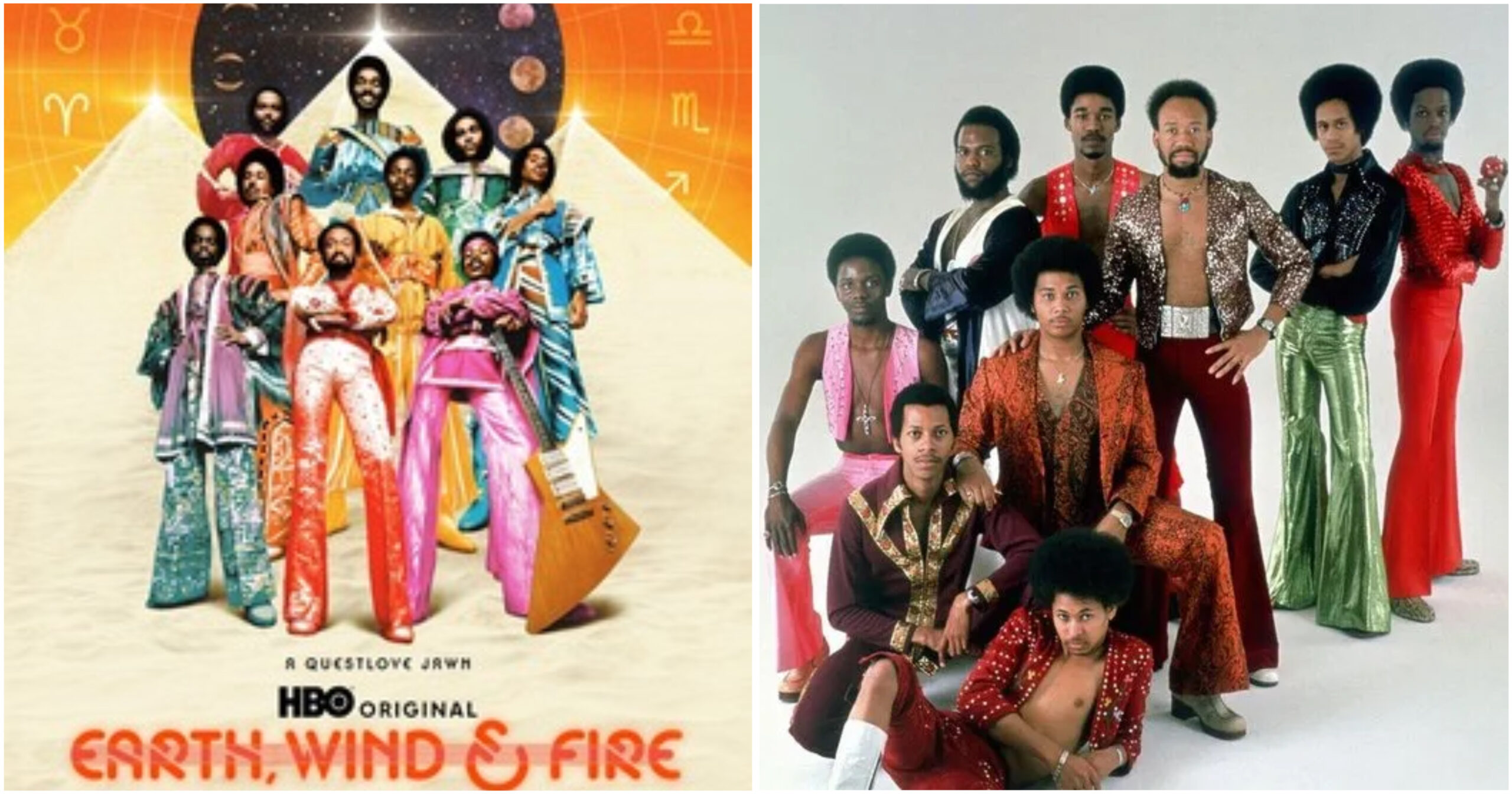
(June 25, 2026) – Turns out the brilliant man whose vision was responsible for the band Billboard recently named the “best R&B group of all time” was not always a sympathetic figure.
Instead, Maurice White is revealed to be a complicated man — far more complex than the astrologically focused, Afrocentric, pop-minded music hero that I and millions of others came to love over decades of listening to Earth Wind & Fire.
That’s probably the biggest of many takeaways from Questlove’s latest masterpiece, Earth Wind & Fire (To Be Celestial vs That’s the Way of World), the documentary whose content more than lives up to its lengthy title.

As regular readers of DJROBBLOG know, Earth, Wind & Fire has long alternated with another group as my favorite of all time, so plopping down the streaming fee for HBO Max to see this film was a no-brainer (plus I can always cancel the subscription). The fact that a music man and proven documentarian like Questlove was the mastermind behind it practically guaranteed satisfaction.
But perhaps I wasn’t prepared for what was characterized as the “human” side of the man so steeped in mysticism that he seemed otherworldly. The man whose astrological chart had been the basis for his group’s name and whose fascination with the motherland had underpinned EWF’s classic album period between 1975-79. And the man whose “September” — cowritten by White with bandmate Al McKay along with lyricist Allee Willis — is now revered as one of the greatest R&B/pop tunes of the 20th century.
Appropriately, Questlove saves “September” for the film’s emotional climax. Yet the song functions here as more than a celebration of Earth, Wind & Fire’s musical peak. It serves as a tribute to a man the documentary has already revealed to be far more complicated than his public image suggested.
In fact, the three bandmates who have continued White’s vision for the better part of three decades after he stopped touring due to health reasons were unified in their one-time anger towards the bandleader for his “betrayal” of them after the hits stopped coming in the early 1980s. When White disbanded EWF to pursue a solo career in 1984 (after what many view as their worst album, Electric Universe, had flopped the previous year), Verdine White, Philip Bailey, Ralph Johnson — who’d remained loyal to White after other members began jumping ship — were left high and dry.
It is during this part of the film that White’s life partner and mother to one of his kids, Marilyn White, provides a glimpse into his rockstar side. While never committing to marriage, White fathered several children “out of wedlock” and justified his right to sleep around by telling Marilyn “I’m a star,” eventually prompting her to end the relationship.
Indeed, the documentary shows more depth than that declaration might suggest. It explores White’s childhood where his mother abandoned him in Mississippi at age 5 for a life in Chicago. It tells of his reunion with that mother years later by which time White discovered he had eight new siblings (including bassist Verdine and late ex-drummer Fred). His mother’s abandonment and its impact on White is played as a recurring theme here.
The film also unflatteringly shows how White’s exploits extended beyond his romantic life. At the height of EWF’s success in 1978, what had once been a more collaborative affair between White and the band’s other members — especially bassist and co-songwriter Al McKay and fellow lead singer Bailey — was becoming increasingly authoritarian. It didn’t help that White brought in Canadian producer/songwriter David Foster to work on 1979’s I Am. For that recording, band members recounted how they were relegated to being session musicians. (Foster, who is interviewed in the film, doesn’t deny this and admits to his own authoritarian involvement.)
The result may have justified the means in the short term — EWF had two top ten pop hits from I Am, more than any of their other albums — but it clearly set the stage for the group’s downfall. Their 1980 follow-up Faces, which again included contributions from “outsiders” like Foster, became their first album in seven years not to generate any top 40 pop hits. It was the last one to include contributions from all nine of the band’s classic lineup.
The ensuing years saw the band’s return to the top 40 with “Let’s Groove” (from 1981’s Raise! album) and “Fall in Love With Me” (from ‘83’s Powerlight), but the band’s 1984 break resulted in brothers Maurice and Verdine not being on speaking terms, as the film reveals. It wasn’t until after Bailey’s huge solo success (with Phil Collins on the mega hit “Easy Lover”) — and White’s modest success with a remake of Ben E. King’s “Stand By Me” — that White decided to reunite the band in 1987.
That reunion manifested in the album Touch the World, which only brought back some of the band’s classic lineup. But more importantly, it changed the terms of their partnership with White no longer taking sole label credit for its production, something he had done on every album between 1979-83. It marked a renewed relationship with Bailey who — listed as co-producer on Touch — has been one of EWF’s three chief torch bearers ever since.
That happy outcome is one of many positive moments shared in the film. The group’s 2000 Rock and Roll Hall of Fame induction is another. By then, White hadn’t toured with his band in seven years due to having Parkinson’s disease, a degenerative condition that ultimately took his life.
Those later developments are setup superbly in the film by Earth Wind & Fire’s early days. In the story, we see an early prototype of the band struggling in the late 1960s and early ‘70s before they hit their commercial stride with 1974’s “Mighty Mighty.” A Soul Train clip of dancers getting down to that song is a terrific touch. White’s trips to the Motherland and subsequent discovery of the African thumb harp, the kalimba, reveal how that instrument came to be part of the band’s signature sound in the mid 1970s.
Pure EWF fans will appreciate the film’s next sequence — their 1975 recording of the That’s the Way of the World album for a movie of the same name. Behind-the-scenes footage of photo shoots, studio sessions, and clips from the ill-fated movie are true gold. Maurice’s desire to achieve a much more crisp sound with that album is realized by bringing in friend and co-producer Charles Stepney, with whom White had worked in the 1960s as a studio drummer for Chess Records.
We’re later treated to the creation of the stellar tune “Shining Star,” the album’s lead single and the band’s only No. 1 pop hit. The Phenix Horns had just become an integral part of the band’s sound, while the guitar and bass riffs that open the song give rise to the revelation that it was “Shining Star” — both its instrumentation and its uplifting message — that inspired Stevie Wonder’s “I Wish” the following year.
The group’s success continued with 1975’s Gratitude and the bicentennial’s Spirit, although Stepney’s sudden death from a heart attack during the making of that album impacted White profoundly, as the film deftly explores.
All of these moments are what makes Questlove’s depiction so compelling. Creating a movie about a beloved band and exposing unknown (and often unflattering) facts about its complicated leader comes with risks — risks substantiated in telling interviews from ex-EWF members like McKay, Larry Dunn, Johnny Graham, as well as current members Verdine, Bailey and Johnson.
Questlove balances those revelations with testimonials from figures ranging from Stevie Wonder and Lionel Richie to Jimmy Jam, Flea, Wanda Vaughn (of the Emotions), and the Obamas. Their perspectives reinforce the immense admiration White inspired, even among those who recognized his flaws.
But for as complicated a man as he was, White was no more so than other soul music legends like Prince, Marvin Gaye, Sly Stone, James Brown, or Michael Jackson. In fact, the executive producers behind Jackson’s recent Michael biopic could learn a thing or two from Questlove about how to dig beyond the surface and still preserve the subject’s legacy.
Questlove understands that complexity doesn’t diminish greatness. If anything, it makes achievement more remarkable. By trusting viewers with the uncomfortable parts of White’s story, the film ultimately strengthens rather than weakens his legacy.
In that regard, we should not be surprised that this man — whose views on spirituality and mysticism opened millions of eyes to accepting those as guiding principles — was just as “human” as those other, more celebrated figures.
Indeed, EWF once sang that the world can’t erase our fantasies. This film doesn’t do that. It instead illuminates another side of a visionary for whom the band’s current members still hold a lot of love and respect.
As does yours truly.
If you haven’t seen the documentary yet, I recommend you check it out.
DJRob
DJRob (he/him) is a freelance music blogger from the East Coast who covers R&B, hip-hop, disco, pop, rock and country genres – plus lots of music news and current stuff! You can follow him on Bluesky at @djrobblog.bsky.social, X (formerly Twitter) at @djrobblog, on Facebook or on Meta’s Threads.
You can also register for free by selecting the menu bars above to receive notifications of future articles.