


(June 22, 2026) – Four years after scoring a No. 1 hit and establishing herself as one of pop music’s most relevant stars, Lizzo is confronting a commercial downturn so severe that her latest album failed to reach the Billboard 200 and has produced no Hot 100 singles. For an artist who recently seemed untouchable, the speed and scale of the collapse – likely due to a combination of factors – raise a larger question: where does Lizzo’s decline rank among the most dramatic chart reversals of the modern music era, and what does it reveal about today’s marketing methods and the fragility of superstar status?
From the Top to Nowhere to be Found
Just four years ago, Lizzo was one of the biggest names in popular music. Her 2022 album Special debuted at No. 2 on the Billboard 200 (behind only a Bad Bunny album), while its signature hit, “About Damn Time” spent two weeks at No. 1 on the Hot 100 and became one of the defining songs of the post-pandemic era. The album won multiple Grammy awards – including Record of the Year for “About Damn Time” – and seemingly cemented Lizzo as one of the most commercially viable artists of her generation.
Fast forward to 2026, and the contrast is startling.
The “Truth Hurts” singer’s latest project, Bitch, reportedly sold only about 6,000 album equivalent units (which factors in streaming and downloads) and failed to reach the Billboard 200 during its first eligible week. Even more surprising, none of the album’s songs have cracked the Hot 100 – a chart whose upper half Lizzo hasn’t seen since “About Damn Time” exited the list in late 2022. For an artist who spent much of the early 2020s dominating the charts and the conversation, the decline has been swift and dramatic.

Many have speculated about the reasons for Lizzo’s collapse. Chief among those is the notion that the millions of fans who were once enticed by her flute-twerking, body-positive persona have now jumped off the bandwagon after several years of controversy around workplace harassment claims levied against the singer, as well as rumors around dubious weight-loss tactics. Ironically, the harassment claims center on her alleged treatment of other full-figured former employees.
Coupled with those image issues may be Lizzo’s seemingly unapologetic approach to it all. Certainly, the singer is right to stand her ground, especially if she’s been wrongly accused. But both Bitch and its predecessor, the mixtape My Face Hurts from Smiling, feature a middle-finger wielding Lizzo – images that depict the singer as non-empathetic to those for whom she was once viewed as a champion.
Then there’s the changes in society itself. In the Trump 2.0 era, which has been characterized by the “manosphere” and all its permutations, songs from big Black women about self-empowerment and reclamation just don’t fit easily into today’s prevailing pop culture narratives. The irony is that the Hot 100’s top ten has been practically dominated by women throughout 2026.
And then there’s a factor that Lizzo herself alleged recently – that “streaming replaced radio, and (she) was a radio darling.” She also cited changing social media algorithms, which no longer use a chronological feed approach. This means her fans don’t see posts advertising her music until long after they’re made. Interestingly, however, this theory doesn’t explain why Lizzo’s songs have fallen out of favor with radio. Previous singles “About Damn Time,” “Good as Hell,” and the recently diamond-certified “Truth Hurts” all topped Billboard’s Radio Songs chart, while none of her releases since 2023 have even made an appearance, including the pre-released tracks from Bitch.
Which leads to the final theory, the possibility that people have simply moved on from her sound, which critics have increasingly dunked on as being non-evolutionary and flat (although this hasn’t stopped other artists from having sustained success – including some who are well into their second decades of using reliable formulas to get chart toppers).
Of course, music history has seen its share of abrupt falls from commercial grace. Some artists were undone by changing musical tastes. Others struggled to follow career-defining breakthroughs. Still others found their momentum derailed by controversy, industry shifts (or more accurately, changes in label priorities), or simple overexposure.
The question is not whether Lizzo belongs on that list. She clearly does. The more intriguing question is where her decline ranks among the most drastic chart collapses of the modern era.
To answer that, DJROBBLOG examines these other artists who went from chart titans to chart afterthoughts in remarkably short order.
Paula Abdul (1989-95)

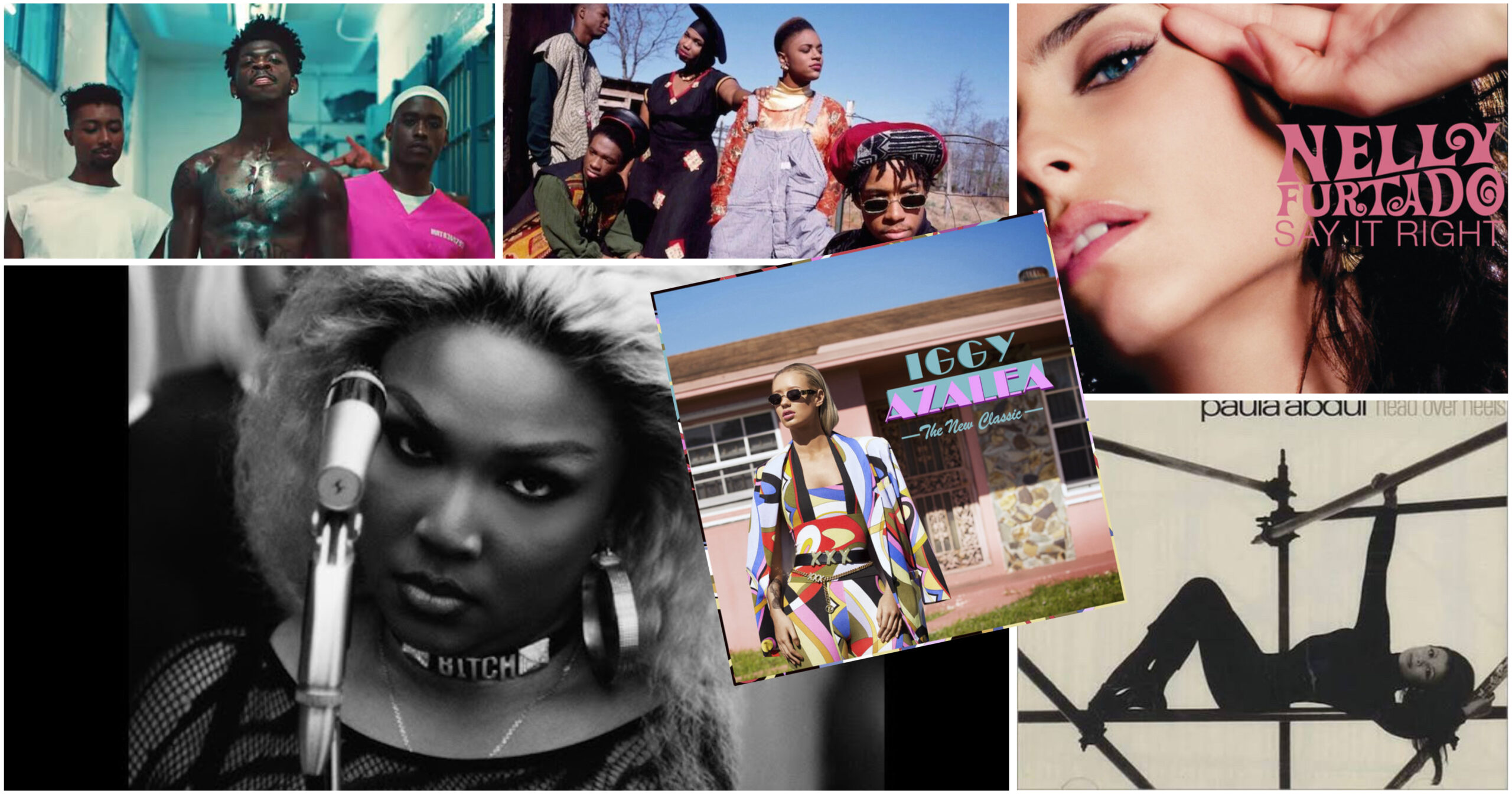
Between 1989 and 1991, Abdul charted two No. 1 albums, six No. 1 singles, and a host of other top 20 hits. The albums Forever Your Girl and Spellbound each sold millions, with the former still ranking as one of only nine albums in history to generate at least four No. 1 singles. Even a 1990 remix album reached the top ten and sold a million copies.
Then in 1995, after a brief hiatus, her third studio album Head over Heels didn’t knock people off their feet. It peaked at No. 18 that year and generated zero top 20 hits. The album’s lead single, “My Love Is for Real,” managed to reach No. 28, making it Abdul’s last top 40 appearance. The album’s commercial decline, as well as her subsequent success as one of the inaugural hosts of TV’s American Idol, prompted a recording hiatus that has now entered its fourth decade.
Abdul’s decline, while dramatic, is not as severe as Lizzo’s. At least Abdul’s last album made the chart and was ultimately certified gold.
Arrested Development (1992–94)

Today when people hear “Arrested Development” they think of the TV series that ran on-and-off between 2003-19 and starred Jason Bateman. But the pop and hip-hop worlds had their own Arrested Development in the form of a group founded by Todd “Speech” Thomas and turntablist Timothy “Headliner” Barnwell.
In 1992, their debut album, 3 Years, 5 Months and 2 Days in the Life of… sold six million copies worldwide and spawned top ten hits in “Tennessee,” “People Everyday,” and “Mr. Wendal.” The album also gave the band two Grammy wins including Best New Artist, a first for a hip-hop act.
Their 1994 follow-up, Zingalamaduni, didn’t do nearly as well. It reached only No. 55 on the Billboard 200 (compared to its predecessor’s No. 7 peak) and generated no top 40 singles (“Ease My Mind” charted at No. 45). The decline prompted Arrested Development’s breakup in 1996, although it reunited in 2000 and has released 14 albums since – although none have charted.
Biggest post-fame claim: Arrested Development sued the producers of TV’s Arrested Development for name infringement in 2003.
Terence Trent D’Arby/ Sananda Maitreya (1987-93)
Terence Trent D’Arby, who now goes by Sananda Maitreya, exploded onto the scene with his debut album Introducing the Hardline According to… It generated two top ten pop and R&B crossover hits in “Wishing Well” and “Sign Your Name” (as well as the top 40 “Dance Little Sister”) and sold two million copies. No one could have predicted the collapse that would follow.
His next album, 1989’s Neither Fish nor Flesh, followed some controversial statements in which the young upstart claimed his debut was the most important album since the Beatles’ Sgt. Peppers Lonely Hearts Club Band 20 years earlier. He also couldn’t shake early comparisons to Prince given their similar appearance and genre-bending musical styles. Neither Fish nor Flesh stopped at No. 75 on the R&B chart and No. 61 pop, a steep decline from the No. 1 and No. 4 placements of Introducing the Hardline.
His next two albums failed to crack the top half of the Billboard 200 and his next nine studio albums failed to chart altogether.
Hootie & the Blowfish (1995-2004)

Hootie & the Blowfish have never missed the Billboard 200 with any of their studio albums, unlike Lizzo. They’re on this list solely for the magnitude of the sales decline between their No. 1 debut, Cracked Rear View, which was certified for 22 million sales in the U.S. alone, to their self-titled fourth LP just nine years later, which failed to crack the top 40 and failed to earn an RIAA certification.
After “Tucker’s Town,” the second single from their sophomore effort, Fairweather Johnson, Hootie had not reached the Hot 100 with any of their singles until they teamed up with Scotty McCreery for 2025’s “Bottle Rockets,” which reached No. 32.
Nelly Furtado (2000-09)

Nelly Furtado’s career began with her double-platinum debut Whoa, Nelly! In 2000, but exploded with her third, 2006’s Loose, which topped the Billboard 200 and generated two No. 1 singles: “Promiscuous” and “Say It Right.” The album sold 10 million copies worldwide and was certified triple-platinum in the U.S.
A Spanish-language album marked an artistic departure for her follow-up, Mi Plan, which reached the top 40 of the Billboard 200 but failed to generate any hit singles. That essentially killed the momentum from Loose, as subsequent albums either ranked low or failed to chart altogether.
Since the No. 1 run of 2007’s “Say It Right,” her only three Hot 100 entries have been the songs “Do It,” the ironically titled “Keep Going Up” (with Timbaland and Justin Timberlake), and the more prescient “All Good Things (Come to an End),” all three of which peaked in the 80s on the chart.
Iggy Azalea (2014-19)

Australian rapper Iggy Azalea recorded three studio albums, a reissue, and a host more extended plays. The debut LP, The New Classic, reached No. 3 on the Billboard 200 in 2014 and sold two million units. Its feature single, “Fancy,” was a viral phenomenon that topped the Hot 100 and was certified platinum nine times over. In 2014 alone, Azalea scored three multi-platinum singles that peaked in the top three.
Within five years, after having to defend herself against accusations of Black cultural appropriation, her next album, In My Defense, sold far less and only reached No. 50. Her third album, 2021’s The End of an Era, was just that, as it failed to chart anywhere and received no certifications.
With none of her albums or singles charting on Billboard’s main charts since 2019, Iggy’s story is perhaps as close to Lizzo’s as anyone in this article.
Meghan Trainor (2014-17)
While not as severe as Lizzo’s downturn, pop singer Meghan Trainor has had a downward spiral since her debut album, Title, hit No. 1 in 2014 and sold more than three million units. Its follow-up, Thank You, was also a platinum success and peaked at No. 3 on the Billboard 200. Her most recent album, this year’s Toy with Me, only reached No. 198.
Her singles decline has been more pronounced. Between 2014-16 she had seven top 40 entries, including the diamond-certified No. 1 “All About that Bass” and its worthy follow-up, “Lips are Movin.” From 2017 onwards she’s only reached the top 40 once, with the No. 11 hit “Made You Look” in 2022.
Fetty Wap (2014-16)
Some will be quick to cite Fetty Wap’s recent prison stint (for drug trafficking) as the reason for his quick chart decline following the blockbuster debut of his self-titled album and its viral hit, “Trap Queen,” in 2014. But after charting four top 40 hits from that album, the rapper born Willie Maxwell, II, couldn’t buy a hit. Follow-up singles “Jimmy Choo” and “Wake Up” peaked at Nos. 65 and 50, respectively, in 2016. And except for the No. 43-peaking “Keke” (featuring 6ix9ine and A Boogie wit da Hoodie) in 2018, none of Fetty’s singles have reached the Hot 100.
After two intervening albums failed to chart, Fetty released Zavier in 2026. That became his first new Billboard 200 entry in more than a decade, reaching No. 169.
Lil Nas X (2019-22)

It appears rapper Lil Nas X has built a career on proving his detractors wrong. After scoring with the record-breaking No. 1 single “Old Town Road” in 2019, he mounted a strong comeback with his first official album, the double-platinum Montero, and its own No. 1 hits, “Montero (Call Me by Your Name)” and “Industry Baby” (with Jack Harlow) in 2021.
In the five years since, a steady diet of non-album singles have disappointed on the Hot 100, while the eight-song album, Days Before Dreamboy, and its singles failed to chart altogether.
The rapper, born Montero Lamar Hill in 1999, recently dealt with legal issues stemming from an alleged battery of a police officer. He’s since claimed to be diagnosed with bipolar disorder and earlier in June 2026 issued a statement saying he was “doing much better” after completing rehab.
Like Lil Nas X and some of the others above, Lizzo appears to have encountered a sudden shift in the dynamics that once propelled her to the top.
What makes Lizzo’s case so unusual is that her decline occurred after she had already survived one career resurgence. Her first hits were older recordings that had been discovered years later by the streaming generation. She successfully parlayed that into a second wave of success with Special, which is what makes the abruptness of the current downturn so remarkable.
Can readers think of others who might fit this article? Let us know in the comments section below.
DJRob
DJRob (he/him) is a freelance music blogger from the East Coast who covers R&B, hip-hop, disco, pop, rock and country genres – plus lots of music news and current stuff! You can follow him on Bluesky at @djrobblog.bsky.social, X (formerly Twitter) at @djrobblog, on Facebook or on Meta’s Threads.
You can also register for free by selecting the menu bars above to receive notifications of future articles.
Carly Rae Jepsen comes to mind immediately. And perhaps not as noticeable to as many here in the US, but I was a big fan of Craig David and he came and went fast (even though I still bought every release).
Yeah Carly’s is a great example. I should’ve considered her. To go from one of the biggest hits of 2012 to almost no sales afterwards. The distinction is that the others on this list had multiple big hits and big albums… and then had a sudden collapse. Carly’s success seemed confined to one year or era.
The first example that came to my mind was The Knack. They fell hard after having the biggest hit of 1979.
Definitely a great example!
Didn’t this used to be the norm? The pre-British Invasion artists found themselves personas non grata by 1965. The Rascals hit with “People Want to Be Free,” their third No. 1, and then had one or two Top 40 hits before collapsing.
I think we’ve gotten used to stars maintaining longer careers, but pop music is still fickle, with the audience growing up and the stars trying to figure out how to stay relevant.