


(April 26, 2026) – There are moments as a music fan when the distance between you and the artists—or the stories behind them—suddenly collapses.
On Wednesday (April 22), that distance disappeared for me.
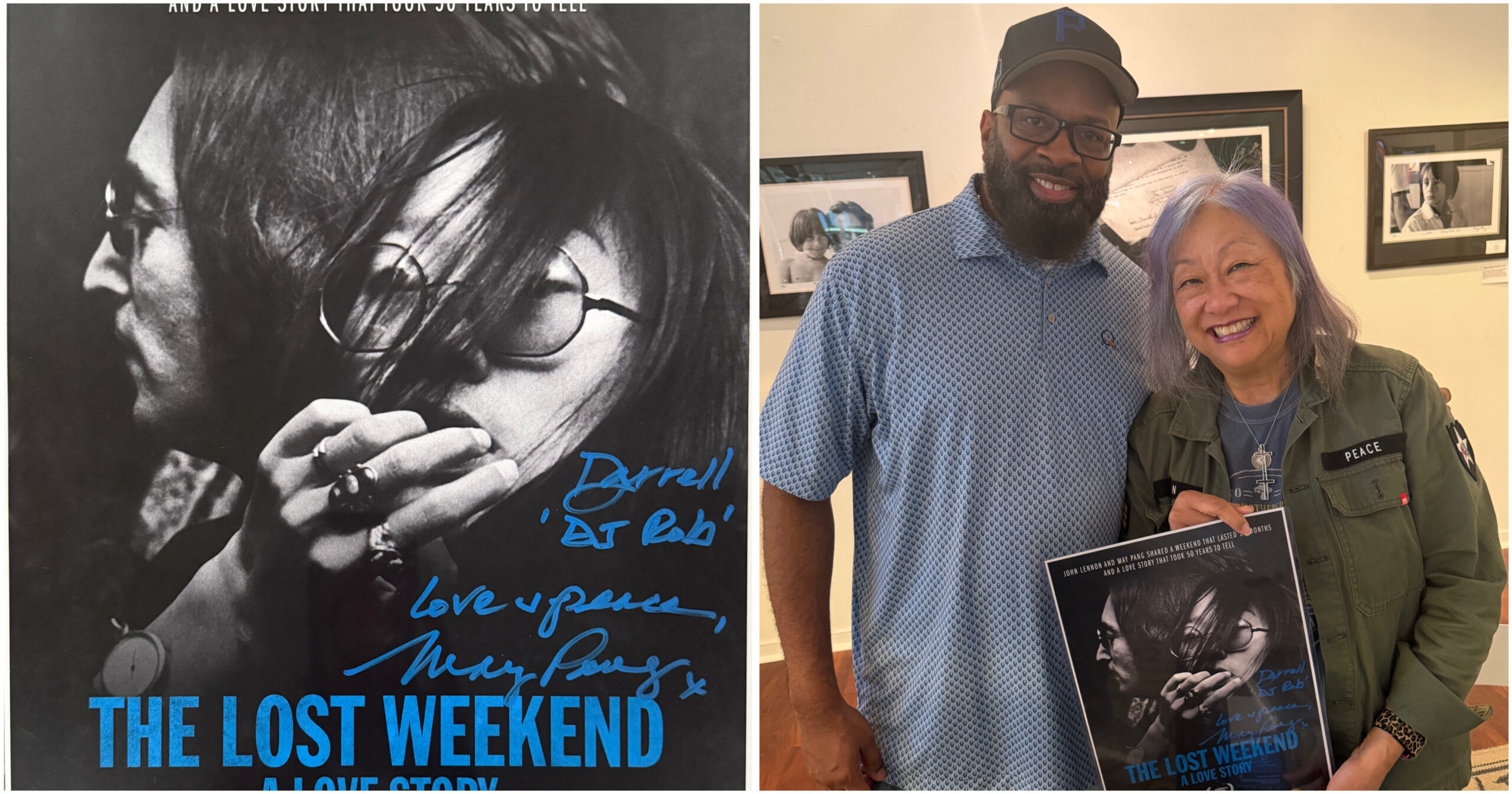
For about 30 minutes that day, I was face-to-face with May Pang—the woman who shared one of the most talked-about chapters in John Lennon’s life, his mid-1970s “Lost Weekend”—at an exhibit featuring her photographs from that era, and where she was promoting her documentary The Lost Weekend: A Love Story.
And for someone like me, who has long been fascinated not just by Lennon’s music but by the stories surrounding it, the experience became both a chance to confront history and step into the margins of a song I’ve loved since childhood, one to which Pang memorably contributed.
That song is Lennon’s “#9 Dream.”
The faithful know it well. It was his final top ten single—prophetically peaking at No. 9 in the U.S.—before John began a five-year hiatus that ended with his ill-fated comeback in 1980. It was a tune that Yoko Ono was featured prominently in a music video years after the song’s release, but on which Pang is heard softly whispering John’s name.
From the first time I heard it decades ago, “#9 Dream” sounded like nothing else. The melody, a mixture of melancholy and hope, floated like the song’s own atmosphere. The chords were driven by a beautiful string arrangement that felt orchestral. The vocal arrangement, especially John’s elongated, reverbed verses, was appropriately dreamlike. And that chorus — “ah! böwakawa poussé, poussé” — felt like it had to mean something, even if I couldn’t quite figure out what.
Like a lot of listeners, I assumed there was something hidden in those words. Something poetic or maybe even a little provocative. It’s been reported that Lennon chose the phonetic “poussé poussé” to avoid running afoul of pop radio censors. Or maybe, I once thought, the whole phrase was a religious chant from some exotic tribe Lennon had encountered during his many travels.
Speaking with Pang at Anne’s Visual Art Studio Gallery in my hometown of Richmond, she confirmed something that has since been well documented: it didn’t really mean anything at all. The song and its chorus were inspired by nothing more than a dream Lennon had during their time together; its title a nod to John’s favorite number. And while I’d read that story previously, it was satisfying hearing that account from someone who was in the room when it happened.

Ms. Pang, whose fame is almost entirely tied to the 18-month “lost weekend” she had with Lennon, makes no attempt to hide this fact. The significance of their romance — an affair orchestrated and supported by Yoko Ono, Lennon’s wife, to salvage their marriage — cannot be overstated for several compelling reasons. First, it succeeded in doing just that, helping to restore Ono’s and Lennon’s marriage that lasted the remainder of John’s life — a union that would produce their son, Sean Ono Lennon, in October 1975.
Secondly, as documented by many of Pang’s candid photographs adorning the walls of the exhibition, some of which had never been shown previously, the 75-year-old New Yorker had also been instrumental in rekindling John’s relationship with his son Julian (from John’s first marriage to Cynthia Powell). How ironic is it that Pang contributed significantly to Lennon’s reunion with his first son, as well as indirectly being the catalyst for the existence of his second one? Almost as much as the notion that Ono’s marriage to Lennon was both created and later salvaged by his extramarital affairs.
Another Lennon relationship documented by Pang’s photos was that of the late Harry Nilsson (of “Everybody’s Talkin’” and “Without You” fame). He and Lennon were close friends at the time and made headlines — often for their now-legendary drunken antics in California while Pang and John took up residence there. Lennon famously contributed to Nilsson’s 1974 Pussy Cats album, which was only moderately successful.
But, perhaps more significantly for Lennon’s fans, his and Pang’s “lost weekend” was recalled as one of the happiest periods of John’s life and ignited a spark in the music he was creating at the time. This led to the album that produced his first No. 1 single — the only one he lived to witness — “Whatever Gets You Thru the Night,” and its follow-up, “#9 Dream.”

Inspired by his newfound “freedom,” that album, Walls and Bridges, included songs that lamented his separation from Ono, such as “What You Got” and “Bless You,” while also reflecting on his time with Pang, like “Surprise Surprise (Sweet Bird of Paradox).” Notable lyrics from the latter include “Her body’s warm and wet… she gets me through this god-awful loneliness” and “well, I was wondering how long this could go on.”
It went on for those 18 months, ending around the time that “#9 Dream” was peaking on the Hot 100 in February 1975. This timing gave even more meaning to the song’s lyrics, notably asking “was it just a dream?”
On a wall of the exhibition last week was a framed gold-plated disc of the single, which prompted a story from Pang about how Lennon had gifted her and others gold records for their contributions to Walls and Bridges after the album’s certification by the RIAA. Pang then noted that she, John, Joey Dambra, and Lori Burton had recorded the famous “Ah! böwakawa” chorus (under the name The 44th Street Fairies). Pang is the sole survivor among them.
Meeting Pang and hearing her accounts of her time with John Lennon offered a unique insight from one of the few people with such proximity to the former Beatle’s story. The greatest example of this hung on the wall directly behind the table where she sat: an enlarged framed picture she’d snapped of Lennon’s signature on the legal documents officially dissolving the Beatles’ partnership in ‘74.
Immediately, another irony came to mind: the one woman so often — and I believe wrongly — blamed for the Beatles’ breakup had been replaced, temporarily, by the woman who documented the group’s official ending.
And now, decades later, Lennon’s “sweet bird of paradise” sat beneath that image, greeting a steady flow of visitors — most of them older than me, all fans of John Lennon, and all keenly aware of exactly what they were witnessing.
At 75, Pang was every bit as engaging as the stories she tells. Her energy never dipped. Her New York accent remains unmistakable. And that signature look—purple-hued hair lightly framing her face—gave her an unmistakable presence that was equal parts artist, storyteller, and living archive.
There was so much she could have shared (or I could’ve asked). So many directions the conversation could have gone. Like, “What about the UFO she and Lennon allegedly saw in 1974?” Or “How is her relationship with Ono now?” But with a constant stream of patrons waiting their turn, some questions felt inappropriate and every minute with Pang felt borrowed.
In that brief span, I discovered something I hadn’t realized I’d value: not necessarily verification of Wikipedia entries, but a connection, however fleeting it may have been.
And confirmation that the song I’d long admired for its beauty and mystery was born not from some elaborate hidden meaning, but from something far simpler — and, in its own way, more profound.
It was simply in a dream, one manifested into reality by a handful of voices in a room — and one of those voices was right before me!
Before I left, I snapped a photo with Pang — she holding an autographed copy of her artwork I had just purchased: a photo of her and Lennon that provided a tangible reminder of what had truly been a “lost weekend” for them — and a surreal moment for me.

For me, it was just 30 minutes with someone who stood beside one of the most important musicians of all time—and helped shape, in her own quiet way, a song that’s stayed with me for half a century.
And sometimes, that’s more than enough.
DJRob
DJRob (he/him) is a freelance music blogger from the East Coast who covers R&B, hip-hop, disco, pop, rock and country genres – plus lots of music news and current stuff! You can follow him on Bluesky at @djrobblog.bsky.social, X (formerly Twitter) at @djrobblog, on Facebook or on Meta’s Threads.
You can also register for free by selecting the menu bars above to receive notifications of future articles.
W O W!!!
That’s what I said! Lol