


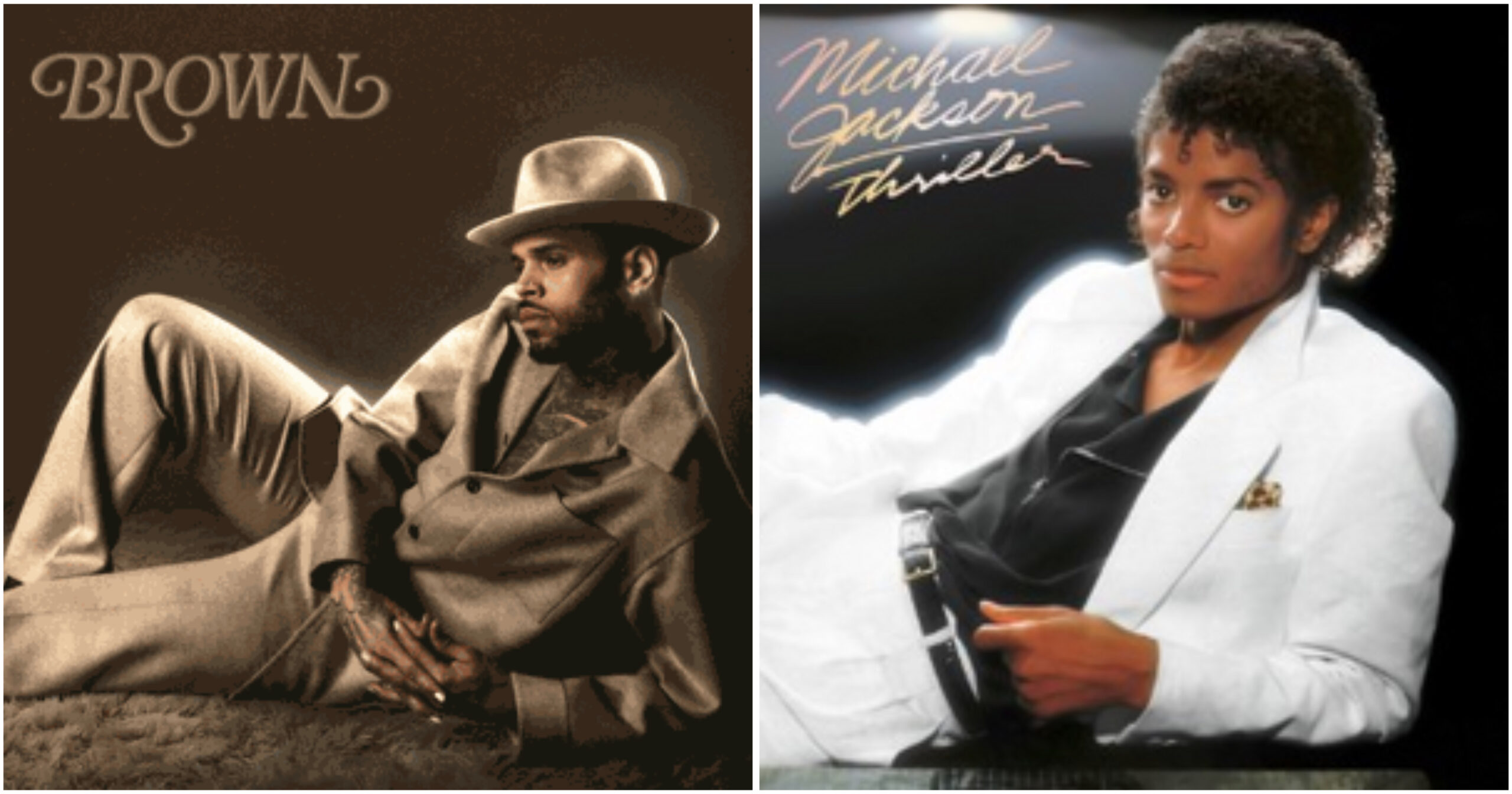
(May 14, 2026) – It’s been well known that R&B superstar Chris Brown regards Michael Jackson as one of his biggest influences and idols. He memorably paid multiple tributes to the late King of Pop in the wake of the latter’s sudden passing in 2009. Next week, in a plot twist no one could’ve predicted just weeks ago, the two will be competing for the top spot on Billboard’s Hot R&B/Hip-Hop Albums chart… and not just musically. Both No. 1 candidates feature the artist in that famous “soul lean” on the album cover… one that is a rite of passage for any R&B singer worth his weight in platinum.
Jackson, who holds the No. 1 spot this week with the return of Thriller to the top for the first time since 1984, is enjoying an extended renaissance following the historic success of the Michael biopic. Brown, on the other hand, has been a constant staple on the chart ever since his self-titled debut in 2005. Every one of his first 11 studio albums have charted at either No. 1 or No. 2 on the R&B/Hip-Hop chart (plus they’ve all reached the top ten on the all-genre Billboard 200), and his new semi-self-titled Brown, released Friday, May 8, is expected to do the same.
The only thing potentially standing in the way is his idol. Jackson is currently No. 1 and 2 on the list with Thriller and his Number Ones compilation. Next week, both those albums are projected to remain in the top three alongside Brown’s new set, with the only remaining question being their relative order on the chart.
Sweetening this chart drama is the fact that Brown’s album, which has received mixed-to-poor reviews from critics and fans alike, invokes a variation of that same famous “soul lean” on its album cover that Jackson used for Thriller. The reveal of the Brown album’s cover art weeks ago immediately sparked memes and comparisons between the “Run It” singer and his R&B forefathers, including Jackson, Lionel Richie, Teddy Pendergrass, and Luther Vandross – all of whom have famously used the pose for one of their 1980s releases.

Indeed, it was a bold move for Brown, 37, to do it. To the R&B faithful, the “soul lean” is akin to a declaration that he belongs in the same conversation with those 20th-century icons. And the truth is, whether we like it or not, he kind of does. Or at least he does for the current generation. On a relative scale, Brown is as important an R&B artist to millennials and Gen-Z’ers as Luther or Lionel were to my generation, arguably even more so. Unlike those artists, Brown has few other R&B peers that have matched his ubiquity this century. Luther and Lionel competed with Prince, Freddie Jackson, and yes, Michael, for R&B chart supremacy back then. Even if you include Usher, with whom Brown will embark on a tour later this summer, you’d be hard-pressed to name a contemporary R&B act who’s enjoyed the level of consistency that Brown has had over the past two decades.
But that consistency is also what appears to be hurting him. Brown knows what his fans like and the diehard ones will keep coming back for more of the same every time. While that seems to have stunted his growth creatively, it also has helped him maintain a continuous Billboard chart presence. Brown has had at least one song on both the Hot 100 and Hot R&B/Hip-Hop songs every year for 22 years, and that’s despite various efforts to cancel him in the wake of his domestic abuse incident with Rihanna 17 years ago, along with other legal allegations that have surfaced since.
Still, Brown’s commercial resilience hasn’t shielded him from increasingly brutal reviews. Pitchfork gave Brown a 1.3 rating this week, calling it “soulless” and “hit-chasing” while questioning whether the project justifies his continued cultural dominance. That assessment feels overly harsh, but the criticism does expose a recurring issue with Brown’s recent output: despite the sheer volume of material, there’s little evidence of artistic evolution. Much of the 27-track set revisits the same themes that have defined his post-2009 catalog — self-victimization (“Hate Me”), demands for respect (“Leave Me Alone”), and lingering resentment toward the public scrutiny that permanently altered his career trajectory.
For as pivotal a year as that 2009 was – for both Brown and, sadly, for Jackson – it could have represented the proverbial passing of the torch between the two. That year a 19-year-old Brown, whose career had been soaring, began his downturn in the wake of the Rihanna incident. Meanwhile, Michael was embarking on a musical comeback after years of legal battles involving unproven allegations of sexual abuse of children. He would hit an immediate stop on June 25 at age 50. Since then, instead of elevating to anywhere close to MJ’s level of otherworldly superstardom, Brown’s career has been the equivalent of cruising down a highway while riding the breaks.
But Brown’s new album isn’t so bad as it merely reflects where today’s society is in entertainment. In addition to the “Kiss Kiss” singer choosing to leave little to the imagination with overused lines like “wet the bed” and the unoriginal, WAP-esque “we’ll need a mop” trope, he doubles down on the ratchet factor by securing Sexyy Red and GloRilla on the track, “Call Your Name” (and let’s just say the two rappers don’t disappoint for those who appreciate their earlier work). Hookah lounges everywhere will revel in the haze-filled vulgarness of “Honey Pack” with lines like “I’m tryna put my tongue all in between your thighs…” and “I just wanna fuck you ‘til you screemin’ that you hate me.”
Compare that to the lone bedroom burner on Michael’s Thriller – “The Lady in My Life” – which wasn’t so much a baby-making romancer as it was a declaration of undying love (although the line “I will keep you warm through the shadows of the night…and make you feel alright” certainly left room for imagination).
In many ways, Thriller represented the last era when blockbuster R&B albums were designed to be shared experiences across generations — played in living rooms, family cookouts, roller rinks, school dances, and supermarkets alike. It’s why the album has found a whole new audience nearly half a century after its release. Albums like Brown, by contrast, are built for the streaming age: personal, immediate, algorithm-friendly, and often intentionally provocative in ways that cater to adult audiences and social-media virality.
And therein lies the difference. With Michael and Thriller, one could imagine. It’s a timeless wonder that kids of all ages could enjoy – and kids of all ages do. The fact that it’s the No. 1 soul album this week – 42 years after relinquishing that chart crown – speaks volumes. That it will be competing for the No. 1 spot next week against an album that portends to be created in its image is the stuff of legends.
Despite Thriller’s renewed ubiquity this year, curiosity alone about Brown’s 27 tracks will likely give the younger artist the edge over MJ’s 9-song masterpiece, just by simple math. Still, their chart battle hardly feels like the passing of a torch that should have happened 17 years earlier, and would have under different circumstances.

And as for that soul lean?
Maybe that’s why the image still matters so much.
For decades, the pose has symbolized cool, confidence, romance, and superstardom in Black music — a visual shorthand for artists who believed they belonged among the greats. Those who dare embody it bear a heavy burden. Michael Jackson’s Thriller immortalized it at the precise moment the then-24-year-old became larger than music itself. Luther Vandross wore it for 1986’s Give Me the Reason, after securing his place as R&B’s top crooner with four prior platinum albums under his belt. Teddy Pendergrass used it on 1981’s It’s Time for Love, his fifth solo studio release and the last one he issued before the tragic accident that paralyzed him for life and imperiled his status as R&B’s top sex symbol.

Chris Brown’s Brown revisits the stance from an entirely different era, one driven less by mystery and imagination than by nonstop content, controversy, and streaming survival, and as the artist himself approaches middle age.
Yet next week, despite all those differences, the student and his idol may reside side by side atop the same Billboard chart — leaning across generations, separated by time, tragedy, and talent, but connected forever by R&B’s enduring desire to crown its next king.
DJRob
DJRob (he/him) is a freelance music blogger from the East Coast who covers R&B, hip-hop, disco, pop, rock and country genres – plus lots of music news and current stuff! You can follow him on Bluesky at @djrobblog.bsky.social, X (formerly Twitter) at @djrobblog, on Facebook or on Meta’s Threads.
You can also register for free by selecting the menu bars above to receive notifications of future articles.