


70 Years of Crossover — Part 1: How White Artists First Broke Into the R&B Charts—(1956-90)
(March 26, 2026) – R&B has always been rooted in Black artistry—but its charts have never been exclusively Black.
Over the decades, white artists have periodically crossed into the genre, sometimes scoring massive hits, other times simply making a dent. But how often have they truly broken through—and to what extent?
To find out, I went year by year through Billboard’s R&B charts dating back to 1956–the first full year of the rock-and-roll era and a 70th anniversary milepost—and identified the highest-ranking song by a white recording act on each year’s final recap chart. Not the biggest R&B hit overall—but the one by white acts that outperformed any other white act that year within the genre. In cases where a Billboard ranking was unavailable, I used Cashbox information.
I’ve broken the 70-year history into two parts: 1956-90 and 1991-2025. Not just because it’s a convenient halfway point, but because that breakpoint also represents a major shift in musical styles and charting methodologies. Hip-hop’s dominance of R&B radio came more into focus and SoundScan’s point-of-sale technology made the charts more immediate and accurate.
The results tell a deeper story—one of crossover, cultural exchange, shifting genre lines… and a few surprises that might make you look twice at the artist’s name. Some artists did it on their own, others crossed over by partnering with superstar Black acts, while still others benefited from changes in chart methodologies.
Today, white artists top the Hot R&B/ Hip-Hop Songs chart more than ever before thanks to streaming’s influence, which democratizes the list and minimizes traditional R&B radio’s influence. But we’ll get to that in Part 2. Right now, DJROBBLOG presents Part 1 of the highest charting songs by white acts on the R&B charts each year from 1956-90. Enjoy, and feel free to comment in “Your Thoughts” below about what surprised you!
📅 1956
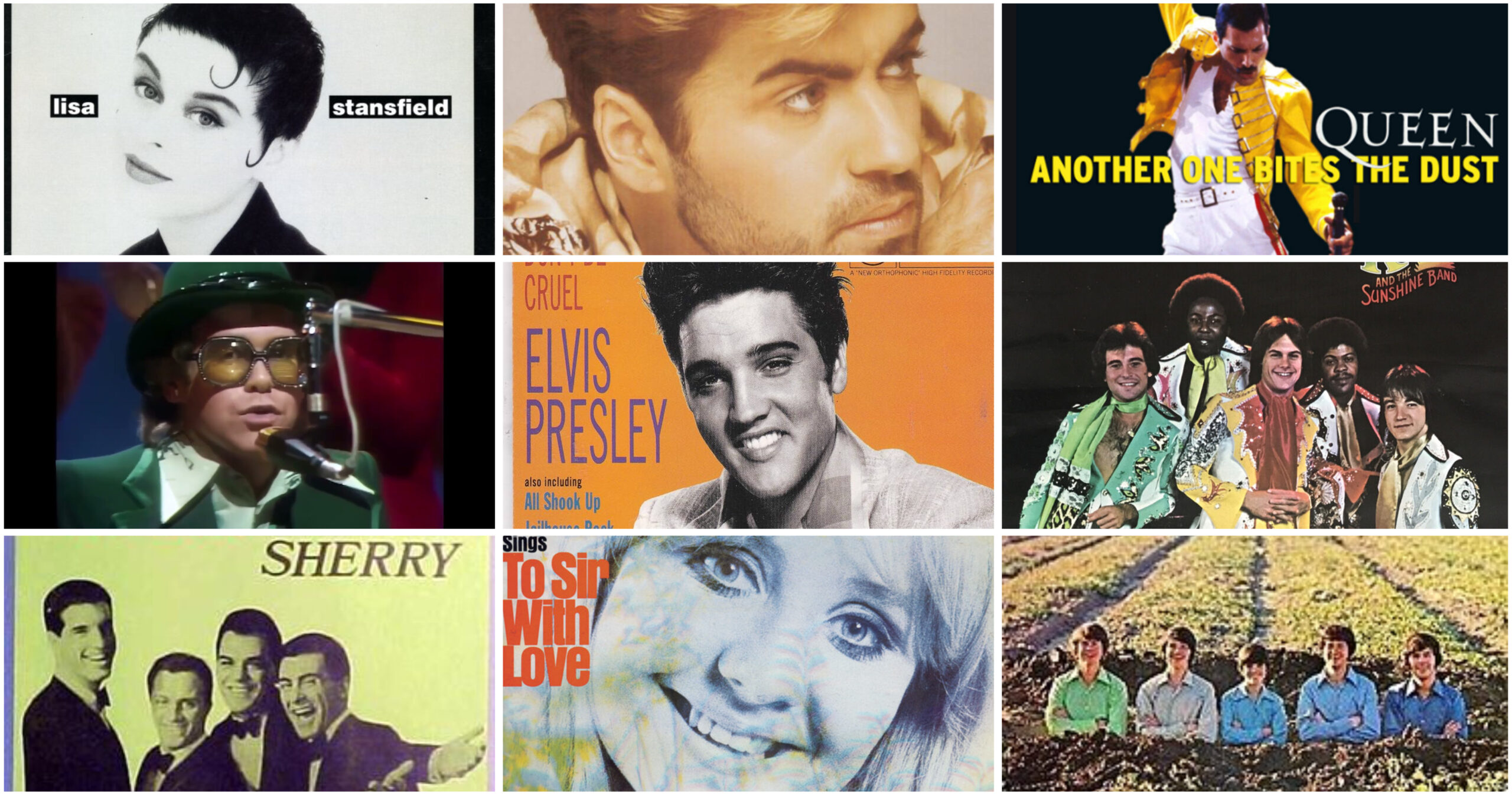
🎤 Artist: Elvis Presley
🎵 Song: “Don’t Be Cruel”/ “Hound Dog”
📊 Year-End R&B Rank: n/a
📝 DJROBBLOG Take:
Before Billboard and Cashbox began creating year-end lists, Elvis’ “Hound Dog” and “Don’t Be Cruel” were the best-performing songs on Billboard’s R&B chart, peaking at No.1. The two-sided vinyl 45 also made the top five on Cashbox’s R&B chart. Elvis was undoubtedly the King of Crossover in Rock and Roll’s first full year.
▶️ Listen:
>>>>>>>
📅 1957
🎤 Artist: Elvis Presley
🎵 Song: “All Shook Up”
📊 Year-End R&B Rank: n/a
📝 DJROBBLOG Take:
Elvis continued his dominance on both the pop and soul charts during this era by scoring with both “Jailhouse Rock” and “All Shook Up” in 1957. While the former topped Billboard’s R&B chart for five weeks, the latter topped that chart in both Billboard and Cashbox for four and two weeks, respectively.
▶️ Listen:
>>>>>>>
📅 1958
🎤 Artist: The Everly Brothers
🎵 Song: “All I Have to Do Is Dream”
📊 Year-End R&B Rank: n/a
📝 DJROBBLOG Take:
Early rock-and-roll’s most popular crooning siblings scored in both pop and R&B in 1958 with “All I Have to Do Is Dream,” a No. 1 pop hit that topped the R&B charts in Billboard for five weeks, helping make the pop and R&B charts largely indistinguishable during the two genres’ formative years.
▶️ Listen:
>>>>>>>
📅 1959
🎤 Artist: Bobby Darin
🎵 Song: “Mack the Knife”
📊 Year-End R&B Rank: n/a
📝 DJROBBLOG Take:
This pop classic topped the R&B chart in Cashbox for four weeks, while reaching No. 6 on Billboard’s R&B list – spending 17 weeks on the survey. Like the others mentioned earlier, “Mack the Knife” was also a huge No. 1 pop hit and stands as Darin’s biggest hit on either list.
▶️ Listen:
>>>>>>>
📅 1960
🎤 Artist: Bill Black’s Combo
🎵 Song: “White Silver Sands”
📊 Year-End R&B Rank: n/a
📝 DJROBBLOG Take:
Bill Black was a white musician and bandleader who played the double bass and bass guitar. During World War II, he was stationed right here in Fort Lee, Va, just outside of my hometown of Petersburg. Recording for Hi Records, Black’s Combo topped the R&B charts with two instrumentals: “Smokie, Part 2” and “White Silver Sands,” the latter being the bigger of the two.
▶️ Listen:
>>>>>>>
📅 1961
🎤 Artist: The Mar-Keys
🎵 Song: “Last Night”
📊 Year-End R&B Rank: No. 4 (Cashbox)
📝 DJROBBLOG Take:
Not to be confused with the Bar-Kays, the Mar-Keys were a mostly white house band for the label that eventually became Stax Records. In fact, the band was originally all white, and it was the tenor sax player Charles “Packy” Axton’s uncle Jim Stewart, and mother, Estelle, who founded Stax, which was a portmanteau of the first two letters of Stewart and Axton.
▶️ Listen:
>>>>>>>
📅 1962
🎤 Artist: The Four Seasons
🎵 Song: “Sherry”
📊 Year-End R&B Rank: No. 25 (Billboard)
📝 DJROBBLOG Take:
Featuring Frankie Valli’s unmistakable falsetto, “Sherry” was the biggest R&B hit of 1962 by a white act, although “Big Girls Don’t Cry” – released late in the year – spent more weeks at No. 1 (three vs. just one for “Sherry”). Both songs made the Jersey Boys the only white act to top Billboard’s R&B chart that year.
▶️ Listen:
>>>>>>>
📅 1963
🎤 Artist: The Four Seasons
🎵 Song: “Candy Girl”
📊 Year-End R&B Rank: No. 12 (Cashbox)
📝 DJROBBLOG Take:
Billboard famously cancelled its R&B charts in late 1963, mainly because they had mimicked the Hot 100 pop chart so much. The trade mag’s R&B rankings were not reinstated until early 1965, making Cashbox the main charter of R&B sides. While white female singers Little Peggy March (“I Will Follow Him”) and Lesley Gore (“It’s My Party”) topped the Billboard R&B chart before it was disbanded, the Four Seasons had the biggest R&B hit in Cashbox by a white act, this time with “Candy Girl.”
▶️ Listen:
>>>>>>>
📅 1964
🎤 Artist: Sunny & the Sunglows
🎵 Song: “Talk to Me”
📊 Year-End R&B Rank: No. 49 (Cashbox)
📝 DJROBBLOG Take:
Technically, Sunny & the Sunglows were a “Chicano” band, which doesn’t necessarily identify them as Caucasian. The group’s members were Americans born of Mexican heritage. That said, the soulful hit “Talk to Me” was identified as the biggest R&B hit by a non-Black act in Cashbox’s 1964 year-end wrap-up – the only full year in which Billboard did not offer a weekly R&B listing.
▶️ Listen:
>>>>>>>
📅 1965
🎤 Artist: The Righteous Brothers
🎵 Song: “You’ve Lost that Lovin’ Feeling”
📊 Year-End R&B Rank: No. 13 (Cashbox)
📝 DJROBBLOG Take:
Bill Medley’s soulful baritone powered this classic to No. 1 on the Hot 100 and No. 2 on the R&B chart. Even with the revamped survey in which Billboard’s soul chart became more distinguishable from its pop counterpart, the Righteous Brothers managed to score several R&B hits from 1965-66.
▶️ Listen:
>>>>>>>
📅 1966
🎤 Artist: Tommy James & the Shondells
🎵 Song: “Hanky Panky”
📊 Year-End R&B Rank: No. 35 (Cashbox)
📝 DJROBBLOG Take:
Although the song only reached No. 39 on Billboard’s R&B chart, “Hanky Panky” did well enough in Cashbox to finish as the 35th biggest R&B hit of the year. Tommy James hailed from Dayton, OH, a city notable for birthing future funk and R&B legends like the Ohio Players, Lakeside, Zapp, and Slave.
▶️ Listen:
>>>>>>>
📅 1967
🎤 Artist: Lulu
🎵 Song: “To Sir with Love”
📊 Year-End R&B Rank: No. 57 (Cashbox)
📝 DJROBBLOG Take:
Scottish singer/actress Lulu co-starred with Sidney Poitier in the movie To Sir with Love, which gave Poitier a Golden Globe (making him the first Black actor to receive the award after he’d done the same at the Oscars for Lillies of the Field in 1964). Fittingly, Lulu’s title song, which topped the pop chart, was also the year’s biggest R&B hit by a white act.
▶️ Listen:
>>>>>>>
📅 1968
🎤 Artist: Rascals
🎵 Song: “People Got to Be Free”
📊 Year-End R&B Rank: n/a
📝 DJROBBLOG Take:
The blue-eyed soul band the Rascals peaked at No. 14 and spent 9 weeks on the Billboard R&B chart with this No. 1 pop classic. However, it did not make a year-end R&B list in either Billboard or Cashbox, whereas Latino singer Jose Feliciano’s remake of “Light My Fire” finished at No. 71 in Cashbox. Still, the Rascals had the higher peaking and longer charting hit with this classic slice of social commentary.
▶️ Listen:
>>>>>>>
📅 1969
🎤 Artist: Dick Hyman & Electric Eclectics
🎵 Song: “The Minotaur”
📊 Year-End R&B Rank: n/a
📝 DJROBBLOG Take:
Musician and composer Bill Hyman just celebrated his 99th birthday in March 2026. Fifty-seven years earlier he scored what is considered the first big hit using the Moog synthesizer with “The Minotaur,” an experimental instrumental that clocked in at 7:30 on the 45-rpm vinyl single and fared better on the R&B chart (No. 27) than it did on the Hot 100 (No. 38).
▶️ Listen:
>>>>>>>
📅 1970
🎤 Artist: Rare Earth
🎵 Song: “(I Know) I’m Losing You”
📊 Year-End R&B Rank: No. 63 (Cashbox)
📝 DJROBBLOG Take:
Motown’s first successful white band took the pop and soul charts by storm with this Temptations remake in 1970. So vested was Motown in Rare Earth that it even created a new imprint – Rare Earth Records – as the group’s recording home and as the platform for all its rock-based acts.
▶️ Listen:
>>>>>>>
📅 1971
🎤 Artist: The Osmonds
🎵 Song: “One Bad Apple”
📊 Year-End R&B Rank: No. 48 (Billboard)
📝 DJROBBLOG Take:
Ogden, Utah’s answer to Gary, Indiana’s Jackson 5 were the five Osmond Brothers. The Jackson 5 scored a record four No. 1 pop (and soul) chart singles with their first four releases in 1970. The Osmonds stopped “Mama’s Pearl” from becoming the fifth when the No. 1 pop smash “One Bad Apple” held “Pearl” to No. 2 in 1971. Ironically, the Osmonds also did well on the Billboard soul chart, peaking at No. 6 and finishing the year at No. 48.
▶️ Listen:
>>>>>>>
📅 1972
🎤 Artist: Dennis Coffey & the Detroit Guitar Band
🎵 Song: “Scorpio”
📊 Year-End R&B Rank: No. 13 (Cashbox)
📝 DJROBBLOG Take:
Dennis Coffey was a guitarist who played as a member of the legendary Funk Brothers studio band. He was also the first white person to appear on the iconic TV series Soul Train in 1972. His “Scorpio” was one of the funkiest tunes of ‘72 (not recorded by James Brown) and sold 1 million copies, reaching the top ten on both the pop and soul charts.
▶️ Listen:
>>>>>>>
📅 1973
🎤 Artist: Tower of Power
🎵 Song: “So Very Hard to Go”
📊 Year-End R&B Rank: n/a
📝 DJROBBLOG Take:
Tower of Power was a mostly white, mixed-race band whose biggest hit was sung by Lenny Williams, who is Black. “So Very Hard to Go” was as known for Williams’ spirited baritone/tenor as it was for the famous Tower of Power horns. The song reached the top twenty on both the soul and the pop charts but failed to finish in the year-end R&B list in either Cashbox or Billboard.
▶️ Listen:
>>>>>>>
📅 1974
🎤 Artist: Elton John
🎵 Song: “Bennie & the Jets”
📊 Year-End R&B Rank: No. 70 (Cashbox)
📝 DJROBBLOG Take:
While they had charted on the soul/R&B charts throughout the rankings’ existence, white acts were given an even bigger platform when Soul Train invited Dennis Coffey, Gino Vanelli, David Bowie and Elton John to perform. The famously bespectacled John appeared in 1975 to perform his then-top 40 hit “Philadelphia Freedom” and the previous year’s even bigger crossover smash, “Bennie & the Jets.”
▶️ Listen:
>>>>>>>
📅 1975
🎤 Artist: KC & the Sunshine Band
🎵 Song: “Get Down Tonight”
📊 Year-End R&B Rank: No. 3 (Billboard)
📝 DJROBBLOG Take:
Led by Harry Wayne Casey from Hialeah, FL, the mixed-race Sunshine Band was perhaps the most successful example of a white-led act scoring big on R&B and soul stations in the 1970s. Not only did Casey cowrite one of the biggest selling singles of the decade in George McCrae’s 1974 smash “Rock Your Baby,” but he began a streak of No. 1 soul and pop classics with his own debut hit “Get Down Tonight” in 1975.
▶️ Listen:
>>>>>>>
📅 1976
🎤 Artist: KC & the Sunshine Band
🎵 Song: “(Shake, Shake, Shake) Shake Your Booty”
📊 Year-End R&B Rank: No. 4 (Billboard)
📝 DJROBBLOG Take:
KC & the Sunshine Band kept the hits coming in ‘76 with their third No. 1 single, “Shake Your Booty,” which like its two predecessors (“Get Down Tonight” and “That’s the Way I Like It”) topped both the pop and soul charts. In a year that included many crossover blue-eyed soul hits by the Bee Gees, Boz Scaggs, Rick Dees, Walter Murphy, Rhythm Heritage, and Wild Cherry, KC and his band beat one of the largest fields of white acts on the soul chart since the early 1960s.
▶️ Listen:
>>>>>>>
📅 1977
🎤 Artist: KC & the Sunshine Band
🎵 Song: “I’m Your Boogie Man”
📊 Year-End R&B Rank: No. 32 (Billboard)
📝 DJROBBLOG Take:
KC & the Sunshine Band became the first white-led act to score the biggest R&B hit by such an act in three consecutive years, not with their lone No. 1 soul chart hit of 1977 – “Keep It Comin’ Love” – but, ironically, with a song that peaked at No. 3, “I’m Your Boogie Man.” The script was flipped on the pop chart, where “Boogie” hit No. 1 and “Keep” stopped at No. 2.
▶️ Listen:
>>>>>>>
📅 1978
🎤 Artist: Foxy
🎵 Song: “Get Off”
📊 Year-End R&B Rank: No. 12 (Billboard)
📝 DJROBBLOG Take:
Glam meets disco: Another Hialeah, FL, band who recorded on the TK Records subsidiary Dash label, Foxy’s members, including lead singer and guitarist Ish Ledesma, were of Latin descent. Nonetheless, “Get Off” was a No. 1 single on Billboard’s Hot Soul Singles chart and a No. 9 hit on the Hot 100, making it the highest-ranking song by a non-Black act on 1978’s R&B charts.
▶️ Listen:
>>>>>>>
📅 1979
🎤 Artist: Bobby Caldwell
🎵 Song: “What You Won’t Do for Love”
📊 Year-End R&B Rank: No. 24 (Billboard)
📝 DJROBBLOG Take:
More impressive than the fact that many fans didn’t discover until much later that Caldwell, who died in 2023, was white, was the fact that his label at the time of “What You Won’t Do” was TK Records, the same company that had produced the prior four years’ most successful white-led acts on the Billboard soul charts (KC & the Sunshine Band and Foxy).
▶️ Listen:
>>>>>>>
📅 1980
🎤 Artist: Queen
🎵 Song: “Another One Bites the Dust”
📊 Year-End R&B Rank: No. 34 (Cashbox)
📝 DJROBBLOG Take:
Queen’s “Another One Bites the Dust” (No. 1 pop, No. 2 soul in Billboard; No. 1 pop and soul in Cashbox) was notably influenced by the prior year’s biggest soul chart hit, “Good Times” by Chic. Bassist John Deacon was clearly inspired by Bernard Edwards’ playing on the earlier hit. Add to that the fact that Michael Jackson reportedly suggested to Freddie Mercury after attending a Queen concert that the song be released as their next single, and you can see why “Dust” appealed to audiences of all races.
▶️ Listen:
>>>>>>>
📅 1981
🎤 Artist: Teena Marie
🎵 Song: “Square Biz”
📊 Year-End R&B Rank: No. 29 (Billboard)
📝 DJROBBLOG Take:
Motown’s Ivory Soul Queen Teena Marie was easily the female ambassador for blue-eyed soul in the early 1980s, scoring several soul top ten hits before moving to Epic Records and securing even more. “Square Biz” was her biggest Motown offering, peaking at No. 3 R&B in the summer of 1981.
▶️ Listen:
>>>>>>>
📅 1982
🎤 Artist: Paul McCartney & Stevie Wonder
🎵 Song: “Ebony & Ivory”
📊 Year-End R&B Rank: No. 28 (Billboard)
📝 DJROBBLOG Take:
The irony of Paul McCartney having the year’s biggest hit by a white act on the soul chart in 1982 is that the ex-Beatle and former Wings leader had never charted on the R&B list before teaming with Stevie Wonder on the sappy “Ebony & Ivory,” which only peaked at No. 8 on the Hot Black Singles chart but managed to outrank seemingly bigger hits by Daryl Hall & John Oates (“I Can’t Go for That”; No. 1 peak and No. 35 for the year) and Tom Tom Club (“Genius of Love”; No. 2 peak and No. 42 for the year).
▶️ Listen:
>>>>>>>
📅 1983
🎤 Artist: Michael Jackson & Paul McCartney
🎵 Song: “The Girl Is Mine”
📊 Year-End R&B Rank: No. 6 (Billboard)
📝 DJROBBLOG Take:
McCartney made it two-for-two when he followed the Wonder duet with the somehow even sappier Michael Jackson collaboration “The Girl Is Mine,” the first release from what would become the biggest selling album of all time, Jackson’s Thriller. Surprisingly, the song did better on the soul chart (No. 1) than it did pop (No. 2) and finished at a surprisingly high No. 6 for the year. That made it McCartney’s biggest soul chart hit ever.
▶️ Listen:
>>>>>>>
📅 1984
🎤 Artist: Paul McCartney & Michael Jackson
🎵 Song: “Say Say Say”
📊 Year-End R&B Rank: No. 19 (Billboard)
📝 DJROBBLOG Take:
McCartney joined KC of KC & the Sunshine Band as the only white acts to outrank other white artists for three years straight on the Billboard year-end soul chart. McCartney accomplished all three of his in high-profile duets with arguably two of the most successful Black artists in history – Jackson and Wonder. In fact, all four of McCartney’s R&B chart entries (including 2015’s “Four Five Seconds” with Rihanna and Kanye West) came via collaborations with Black artists.
▶️ Listen:
>>>>>>>
📅 1985
🎤 Artist: Philip Bailey with Phil Collins
🎵 Song: “Easy Lover”
📊 Year-End R&B Rank: No. 33 (Billboard)
📝 DJROBBLOG Take:
The “equal” billing of Genesis’ Phil Collins with Earth, Wind & Fire’s Philip Bailey on this million-selling single is what lands Collins on this list. Otherwise, the title for biggest 1985 R&B chart hit by a white act would go to Paul Hardcastle’s “Rain Forest,” a popular instrumental that ranked No. 42 for the year and has been sampled in many rap songs over the past 40 years.
▶️ Listen:
>>>>>>>
📅 1986
🎤 Artist: Patti LaBelle & Michael McDonald
🎵 Song: “On My Own”
📊 Year-End R&B Rank: No. 1 (Billboard)
📝 DJROBBLOG Take:
Michael McDonald received equal duet billing with Patti LaBelle on their No. 1 pop and soul smash, “On My Own.” The song performed well enough to be named the No. 1 soul song of 1986, making McDonald the first white act to achieve that feat (besting KC & the Sunshine Band’s No. 3 rank eleven years earlier with “Shake Your Booty”).
▶️ Listen:
>>>>>>>
📅 1987
🎤 Artist: Herb Alpert ft. Janet Jackson
🎵 Song: “Diamonds”
📊 Year-End R&B Rank: No. 20 (Billboard)
📝 DJROBBLOG Take:
Janet Jackson was on a hot streak with multiple hits from her breakthrough album Control when she joined label boss Herb Alpert on his “Diamonds” single. Under the production arm of Jimmy Jam & Terry Lewis, “Diamonds” reached No. 1 soul and, in the process, made Alpert the only artist to top different Billboard charts in an instrumental (“Rise”; No. 1 pop in ‘79), a vocal in which he sings (“This Guy’s in Love with You”; No. 1 pop in 1968), and a vocal where someone else sings (Janet handled all the lead vocals on “Diamonds”).
▶️ Listen:
>>>>>>>
📅 1988
🎤 Artist: George Michael
🎵 Song: “One More Try”
📊 Year-End R&B Rank: No. 37 (Billboard)
📝 DJROBBLOG Take:
The success of Michael’s 1987 Faith album prompted criticism from some Black artists – including most notably Freddie Jackson – but it didn’t stop Michael from reaching No. 1 soul and pop with “One More Try” in 1988. In fact, six of the singles from Faith reached the top half of the Black Singles chart, with “Try” being the biggest.
▶️ Listen:
>>>>>>>
📅 1989
🎤 Artist: Paula Abdul
🎵 Song: “Straight Up”
📊 Year-End R&B Rank: No. 48 (Billboard)
📝 DJROBBLOG Take:
Former Janet Jackson choreographer and Los Angeles Laker girl Paula Abdul is of French Canadian and Syrian descent. And with “Straight Up” outranking frequent R&B chart visitor Sheena Easton’s “The Lover in Me” (No. 53) on the year-end R&B list, the future American Idol judge beat the Scottish songbird and placed higher than any other non-Black act on the 1989 year-end soul list.
▶️ Listen:
>>>>>>>
📅 1990
🎤 Artist: Lisa Stansfield
🎵 Song: “All Around the World”
📊 Year-End R&B Rank: No. 6 (Billboard)
📝 DJROBBLOG Take:
Lisa Stansfield continued in the tradition of artists who didn’t “sound white” when she dropped “All Around the World” in early 1990. The song topped the Billboard R&B singles chart for two weeks in March 1990 and nearly topped the pop list, reaching No. 3 in April. She followed that with another No. 1 R&B hit, “You Can’t Deny It,” solidifying her as British soul’s premier songstress of the early ‘90s.
▶️ Listen:
By the dawn of the 1990s, artists like Stansfield weren’t just appearing on the R&B chart—they were, at times, thriving there.
But the ensuing decade would bring a shift that changed everything. As hip-hop rose to dominance and R&B became more confined, crossover got more complicated.
And in some years, far less visible.
That’s where Part 2 will pick up next week!
DJRob
DJRob (he/him) is a freelance music blogger from the East Coast who covers R&B, hip-hop, disco, pop, rock and country genres – plus lots of music news and current stuff! You can follow him on Bluesky at @djrobblog.bsky.social, X (formerly Twitter) at @djrobblog, on Facebook or on Meta’s Threads.
You can also register for free by selecting the menu bars above to receive notifications of future articles.
Acts like the Four Seasons, K.C. &the Sunshine Band, and the Righteous Brother don’t surpsise me making the R&B chart. Nor does Elvis or even Lisa Stansfield. But I am totally scratching my head on the Everly Brothers.
The charts were a case of “Blurred Lines” back then. Billboard rectified it by revamping the chart in 1965 after a 16-month hiatus.