


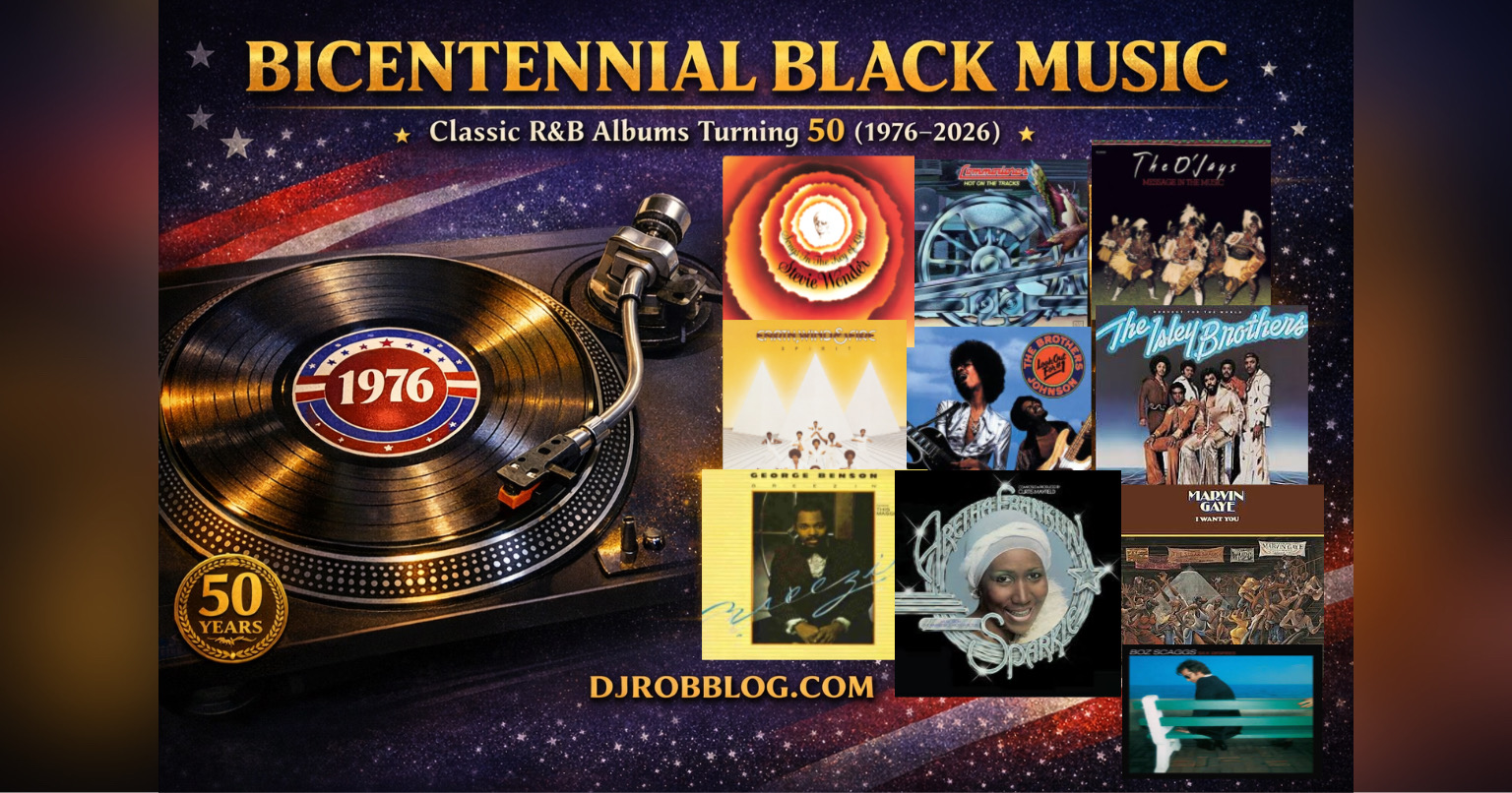
From Stevie Wonder to Marvin Gaye, these landmark albums defined a pivotal year when soul, funk, and disco reshaped Black music.
(March 20, 2026) – A lot happened in 1976. The Jackson 5 left Motown for Epic Records (while replacing Jermaine with Randy), leaving fans to wonder if they could reclaim their early-’70s glory. The infamous “Damn, damn, damn!” episode of Good Times aired. Richard Pryor pushed boundaries with the album Bicentennial Nigger. And America celebrated its 200th birthday while electing Jimmy Carter, signaling the end of the Nixon/Ford era.
Musically, the landscape was shifting just as dramatically. Disco surged into the mainstream, with Billboard launching its first dance chart that August and nine disco songs topping the Hot 100—more than any year before it. At the same time, R&B (still widely called “soul”) found itself at a creative and commercial crossroads.
The genre had dominated the early ’70s with unprecedented crossover success, fueled in part by Soul Train and a wave of hitmakers—Stevie Wonder, Marvin Gaye, Aretha Franklin, Gladys Knight & the Pips, Al Green, the Staples Singers, Barry White, the O’Jays, and others—who regularly bridged the pop and soul charts.
But by 1976, that dominance was fading. Wonder, Franklin, Gaye, White, Green, Knight & the Pips, the Staples, the Spinners, and the O’Jays had combined for 49 top 10 Hot 100 hits between 1970 and 1975. Together, they managed just seven for the remainder of the decade. Even James Brown, who scored 19 top 40 hits between 1970–74, would not return to that tier again in the ’70s.
On the surface, it looked like a decline. In reality, it was a transformation. 1976 was arguably one of the best years for R&B – from an album perspective – as several classic LPs were released that year. If the singles charts suggested uncertainty, the album format told a completely different story.
Between January and December 1976, superstars like Stevie Wonder, Earth, Wind & Fire, Marvin Gaye, the O’Jays, and the Isley Brothers, released landmark albums that were considered among their creative best. Meanwhile, relative newcomers – like the Commodores, L.T.D., Brothers Johnson, and George Benson – did the same. And while many of these albums did not produce the number of crossover smashes that R&B artists had enjoyed in the decade’s first half, they are still regarded as among Black music’s greatest albums in a decade full of them. And dominating Jet magazine’s Soul Brothers’ Top 20 list wasn’t such a bad consolation, was it?
In celebration of these super albums all turning 50 years old this year, DJROBBLOG is commemorating 1976’s cream of the crop – the classic R&B albums that made the bicentennial one of the greatest years in Black music history. Each album is presented with facts, figures, and a vignette about their history and what made them so great, plus this blogger’s suggested best tracks from each. I hope you enjoy this soulful 50th anniversary walk down memory lane. And feel free to leave comments in the “Your Thoughts” section below about your favorite R&B albums from the country’s bicentennial.
🎵Songs in the Key of Life – Stevie Wonder

Release Date: Sept. 28, 1976
Format (label): Double vinyl album w/ a bonus four-song EP (Tamla/Motown)
Why it mattered:
Chart Peak: No. 1 R&B (20 wks), No. 1 Pop, (14 wks)
Certification: Diamond (10 million, for sales of five million copies of the double-album)
What made it so great: Like other soul acts, Wonder’s singles chart success also waned in the second half of the 1970s. But, unlike the others, his was for lack of trying. Between 1970-74, Wonder placed nine new singles in the Hot 100’s top ten, spanning six different albums. From 1975-79, he released just two albums and added three top ten hits, with two of those – the No. 1 hits “I Wish” and “Sir Duke” – coming from Songs in the Key of Life. Some of Stevie’s most enduring tracks, including “As,” his disco-leaning “Another Star,” “Love’s in Need of Love Today,” and “Isn’t She Lovely” dotted SITKOL’s four sides. The album was a tour de force taking nearly two years to complete after Wonder signed a blockbuster new contract with Motown Records. But it was worth the wait as it became the first album by a Black musician to debut at No. 1 (and only the third overall behind two 1975 Elton John albums). Its success carried well into the following year as Billboard named SITKOL 1977’s second-biggest album after Fleetwood Mac’s Rumours.
Key tracks: Nearly all of them, but personal faves include “As,” “Love’s in Need of Love Today,” “Another Star,” “Joy Inside My Tears,” “Contusion,” “Sir Duke,” “Black Man,” “Ordinary Pain,” “Pastime Paradise”
Two iconic albums released the same day…
🎵Spirit – Earth, Wind & Fire

Release Date: Sept. 28, 1976
Format (label): Single vinyl album (Columbia)
Why it mattered:
Chart Peak: No. 2 R&B, No. 2 Pop
Certification: Double platinum
What made it so great: The Elements of the Universe had scored two consecutive No. 1 albums in 1975’s That’s the Way of the World and Gratitude and were aiming for a third when they released 1976’s Spirit. But releasing the album on the same day as Stevie’s Songs in the Key of Life (which had been anticipated for two years and made chart history by debuting at No. 1) proved to be bad timing. Still, Spirit’s No. 2 placement on both the pop and soul charts did not detract from its classic status as several of the album’s tracks rank among the group’s best, including the frenetically paced first single “Getaway,” its follow-up “Saturday Nite,” and third single “On Your Face.” The band’s spiritually minded, self-titled track “Earth, Wind & Fire” was nominated for a Grammy (Best Instrumental Composition, although it had vocals). The beautiful Philip Bailey ballad and title track, “Spirit,” was written by leader Maurice White and keyboardist Larry Dunn in honor of the band’s producer Charles Stepney who died during the recording of this album (May 17, 1976). This blogger considers this the band’s second best album behind 1977’s follow-up, All ‘n’ All.
Key tracks: Every track: “Getaway,” “Spirit,” “On Your Face,” “Burning Bush,” “Earth, Wind & Fire,” “Biyo,” “Saturday Nite,” “Imagination”
Then there was Jazz music’s Grammy darling…
🎵Breezin’ – George Benson

Release Date: March 19, 1976
Format (label): Single vinyl album (Warner Bros.)
Why it mattered:
Chart Peak: No. 1 R&B, No. 1 Pop, No. 1 Jazz
Certification: Triple platinum
What made it so great: Legendary guitarist Benson and producer Tommy LiPuma took six songs by six individual songwriters and combined them into this jazz-fusion masterpiece. There’s not a bad track on Breezin’. While some of the tunes make for timeless jazz, like the title track and “Affirmation,” others use more dated keyboard technology, like the still stellar “Six to Four,” a five-minute instrumental written by late fellow guitarist Phil Upchurch, who passed in November 2025 at age 84. The late Jose Feliciano wrote and first recorded “Affirmation,” the song that opens the “B” side and which Benson essentially made his own. The Ronnie Foster-penned “Lady” was the album’s closer and yet another of the many songs from the ‘70s and ‘80s bearing that title (see Styx, Supertramp, Little River Band, Kenny Rogers, etc.). Benson’s sole composition “So This Is Love?” may be the least memorable tune on the album, which is not an insult considering the caliber of the album’s other tracks. Breezin’ was nominated for five Grammys the following year, including Album of the Year, Song of the Year and Record of the Year – the latter two for “This Masquerade” – plus Best Engineered Album and Best Pop Instrumental Performance. It won the latter three awards.
Key tracks: All six tracks are must-listens, but if you must choose, “Breezin’,” “This Masquerade,” “Affirmation”
Funk’s newest ambassadors emerged, thanks to Q…
🎵Look Out for #1 – Brothers Johnson

Release Date: February 24, 1976
Format (label): Single vinyl album (A&M Records)
Why it mattered:
Chart Peak: No. 1 R&B (4 wks), No. 9 Pop
Certification: Platinum
What made it so great: Quincy Jones protégés George and Louis Johnson graduated to top-billing status on their 1976 debut album, Look Out for #1, which marked an impressive immersion in funk by the legendary producer who’d later go on to create the biggest selling album of all time. On this presciently titled album, Bro Jo took their first single “I’ll be Good to You” to the top (it also nearly topped the pop chart, peaking at No. 3). But the album’s funkier fare included follow-up “Get the Funk Out Ma Face,” which did anything but that, and the playful “Free and Single,” in which lead singer George boasts about having more than one woman at his behest. The instrumental ballad “Tomorrow” was made into a No. 1 vocal hit for Tevin Campbell 14 years later (notably, Campbell wasn’t yet born when the Bro Jo original was released). Louis provided a rare lead vocal on the mellow “Land of Ladies,” and the brothers’ cover of the Beatles’ “Come Together” might be the funkiest in existence. The late Syreeta Wright provides some sassy vocal assistance on key singles including “I’ll Be Good to You” and “Free and Single.”
Key tracks: “I’ll Be Good to You,” “Get the Funk Out Ma Face,” “Free and Single,” “Tomorrow,” “Land of Ladies,” “Come Together”
🎵Harvest for the World – Isley Brothers

Release Date: May 29, 1976
Format (label): Single vinyl album (T-Neck Records)
Why it mattered:
Chart Peak: No. 1 R&B (1 wk), No. 9 Pop
Certification: Platinum
What made it so great: If Stevie Wonder’s classic four-album period culminated with 1976’s Songs in the Key of Life, then this 1976 masterpiece from the Isleys was arguably their fourth consecutive classic album in a long line of them, following the LPs 3 + 3, Live it Up, and The Heat is On. All four albums – along with their next eight – featured the expanded version of the legendary group, including younger members Ernie Isley, Marvin Isley, and Chris Jasper. I had the pleasure of interviewing the late Jasper in 2016 and learned just how crucial the classically trained musician (and brother-in-law to Rudolph Isley) was to this group’s ‘70s and early ‘80s success. Although all six band members shared writing credits on the label, Jasper – with assistance from Ernie – wrote most of the band’s biggest hits, including this album’s stellar title track and the guitar-driven bigger hit, “Who Loves You Better.” The beautiful ballad, “(At Your Best) You Are Love,” was famously covered by the late Aaliyah on her debut album in 1994. And the pleasantly melodic “So You Wanna Stay Down” is a highly underappreciated track. The Isleys scored ten gold or platinum albums out of 12 releases during their classic album period from 1973-83. Incredible!
Key tracks: “Who Loves You Better,” “Harvest for the World (Prelude),” “Harvest for the World,” “(At Your Best) You Are Love,” “So You Wanna Stay Down,” “Let Me Down Easy,”
Marvin at his rawest…
🎵I Want You – Marvin Gaye

Release Date: March 16, 1976
Format (label): Single vinyl album (Tamla/Motown)
Why it mattered:
Chart Peak: No. 1 R&B (1 wk), No. 4 Pop
Certification: n/a (Motown was not an active member of the RIAA at the time and did not submit the album for a sales audit once they joined the organization in 1980)
What made it so great: Its sheer eroticism. Conceived mainly by former Motown songwriter/producer Leon Ware, this was Gaye at his most carnal (even more so than “Let’s Get it On” from three years earlier… far more so). Look no further for proof than on the sensuous tracks “Since I Had You” and “Feel All My Love Inside,” which both included enough female moans to give the prior year’s “Love Won’t Let Me Wait” and “Love to Love You Baby” runs for their money. Gaye surely sets the lovemaking scenes with those two tunes (and others on the album), but I Want You is most remembered for its more subtle title track, which topped the soul singles chart (No. 15 pop). “Soon I’ll Be Loving You Again” has Marvin repeatedly asserting “I’m gonna give you some head” to his “big fine woman.” Conversely, “I Wanna Be Where You Are” – a song written by Ware and previously recorded in versions by Michael Jackson and Jose Feliciano when both were signed to Motown – was reinterpreted here as a dedication to Gaye’s young children whom he shouts out in the 1:17 short track. This album may have received mixed reviews upon its release, but it ended a three-year hiatus for Motown’s prince (following Let’s Get it On), brought him more in step with the burgeoning disco movement of the time, and returned him to the top of the charts.
Side note: The album’s iconic album cover is the original “The Sugar Shack” painting by famous artist Ernie Barnes. It was popularized during the opening credits of the TV show Good Times, which ran from 1974-79 on CBS. Ironically, Gaye’s album displaced Brass Construction’s self-titled debut LP from No. 1 on the Billboard soul chart. That album contained “Movin’,” the song that was playing during the first episode of the show’s 1976-77 season when the Evans family learns of patriarch James Evans’ death (after actor John Amos had been fired from the show after the previous season), leading to Esther Rolle’s immortal “Damn, Damn, DAMN!” moment.
Key tracks: “I Want You,” “After the Dance,” “Since I Had You,” “Feel All My Love Inside,” “Come Live with Me Angel,” “Soon I’ll Be Loving You Again”
Best blue-eyed soul album of the decade?
🎵Silk Degrees – Boz Scaggs

Release Date: February 18, 1976
Format (label): Single vinyl album (Columbia)
Why it mattered:
Chart Peak: No. 6 R&B, No. 2 Pop
Certification: Quintuple Platinum
What made it so great: In a year full of blue-eyed soul hits by the likes of The Bee Gees (“You Should Be Dancin’,” “Love So Right”), KC & the Sunshine Band (“Shake Your Booty”), Wild Cherry (“Play That Funky Music”), and even Rick Dees (“Disco Duck”), Boz Scaggs clearly had the best of the bunch with Silk Degrees – a complete album filled with soulful nuggets like Scaggs’ biggest hit, “Lowdown,” and the underappreciated opener, “What Can I Say” (No. 68 R&B, No. 42 pop). Perhaps the most pop-friendly track on Silk Degrees was the fourth single released from it, “Lido Shuffle,” which missed the soul chart altogether (No. 11 pop). But the album will always be most remembered for “Lowdown,” the slickly produced banger that peaked at No. 3 pop and No. 5 soul in late 1976. “It’s Over” borrowed from Thom Bell’s school of Philly Soul hit-making. Rita Coolidge covered “We’re All Alone” and made it a top ten hit in 1978. Future members of the band Toto – David Paich, David Hungate, and Jeff Porcaro – played on this album, further lending to its classic sound quality.
Key tracks: “What Can I Say,” “Lowdown,” “Lido Shuffle,” “It’s Over,” “Georgia,” “We’re All Alone”
And the Queen returned…
🎵Sparkle – Aretha Franklin

Release Date: June 1, 1976
Format (label): Single vinyl album (Atlantic)
Why it mattered:
Chart Peak: No. 1 R&B (1 wk), No. 18 Pop
Certification: Gold
What made it so great: Curtis Mayfield. While both he and Franklin had seen greater commercial success in the first half of the ‘70s – Aretha had 14 top 40 singles from 1970-74 and only one from ‘75-79 – their partnership generated one of the best-known and most beloved soundtrack albums of the decade. On Sparkle, the Queen’s vocals were elevated to their most soulful in years, as if she were on a mission to reclaim the Best R&B Vocal Performance Grammy award, which she’d won eight years straight but lost in ‘76 to newcomer Natalie Cole. Billed as the accompanying music from the motion picture starring the late Irene Cara, Franklin’s vocals replaced all those of the movie’s singers and were at her most energetic. This may not have been Mayfield’s most memorable soundtrack work from the decade, but it returned Lady Soul to the top of the R&B charts with the album and its first single “Something He Can Feel.” The quirky second single “Jump” featured some heavy tambourine work, which gave it swag – even if it didn’t do well on the charts. Three of the recommended tracks below were remade in the ‘90s by En Vogue and Whitney Houston.
Key tracks: “Something He Can Feel,” “Hooked on Your Love,” “Look into Your Heart,” “Sparkle,” “I Get High,” “Jump”
🎵Message in the Music – O’Jays

Release Date: September 14, 1976
Format (label): Single vinyl album (Philadelphia International)
Why it mattered:
Chart Peak: No. 3 R&B, No. 20 Pop
Certification: Gold
What made it so great: The Philly International stable of producers – led by Kenny Gamble and Leon Huff – continued churning out the hits with Message in the Music. Released the same month as Stevie’s Songs in the Key of Life and EWF’s Spirit, this O’Jays classic had to compete with those blockbusters on the charts, hence its No. 3 peak on Billboard’s soul albums chart that October. But it generated two No. 1 soul singles in the quasi-title track, “Message in Our Music” and its follow-up “Darlin’ Darlin’ Baby (Sweet, Tender, Love).” Both songs featured the trademark alternating lead vocals by founders Eddie Levert and Walter Williams, as did nearly all their hits. But unlike previous O’Jays soul chart toppers, both singles failed to reach the pop top 40, highlighting the growing chasm between soul and pop radio in the decade’s second half. But that didn’t stop the Canton, Ohio group from remaining true to their soulful brand of R&B, contributing such spiritually minded songs as “A Prayer,” “Paradise,” and “Make a Joyful Noise” to Side A of this LP. In fact, the album seemed to be aimed squarely at the church, with a bit of social commentary sprinkled in. Even the most outright love song, “Desire Me,” came across as a prayer (“let your eyes be filled with joy every time you see me”), before a beat switch carries it to a jazz-influenced, full-on declaration of love. The album’s cover art – which featured African dancers and not the O’Jays – was a statement that this project was indeed about the message in the music and not the band themselves.
Key tracks: “Darlin’ Darlin’ Baby (Sweet Tender Love),” “Message in Our Music,” “Desire Me,” “Make a Joyful Noise,” “A Prayer”
Commodores on the come-up…
🎵Hot on the Tracks – Commodores

Release Date: June 1976
Format (label): Single vinyl album (Motown)
Why it mattered:
Chart Peak: No. 1 R&B (6 wks), No. 12 Pop
Certification: n/a (Motown was not an active member of the RIAA at the time and did not bother to have the album’s sales audited once they joined the organization in 1980)
What made it so great: The Commodores were still on the rise with Hot on the Tracks, which included the No. 1 soul ballad “Just to Be Close to You” and its follow-up “Fancy Dancer,” the latter an apparent funk heir to some of Ohio Players’ earlier ‘70s work. Hot on the Tracks was the fourth consecutive album by the Tuskegee band to generate a top 40 hit on the pop chart (a streak that would continue with their next six albums). The Commodores were still a more democratic group at this stage, with Lionel Richie’s role not as prominent as it would become on later albums. Hence, the closest thing to a deliberate pop crossover was “Just to Be Close to You,” the album’s only song solely written by Richie. Still, “Just” was drenched in enough soul to top that chart, while peaking at No. 7 on the Hot 100. Otherwise, this album had enough funk (with Richie’s trademark “yaow”s) and soul to endear it to Black audiences and make it one of the longest running R&B chart toppers of the year. Several of this album’s tracks would be selected as “B” sides to future singles (“Thumpin’ Music,” “Captain Quickdraw,” and “Can’t Let You Tease Me”).
Key tracks: “Fancy Dancer,” “High on Sunshine,” “Just to Be Close to You,” “Girl, I Think the World About You,” “Can’t Let You Tease Me”
Fifty years later, these albums still resonate—not because they chased trends, but because they defined them. At a time when the singles charts suggested that soul music’s dominance might be fading, these artists doubled down on creativity, musicianship, and vision—producing full-length statements that would outlive the very trends that threatened to overshadow them.
In the end, 1976 didn’t mark the decline of R&B—it marked its evolution. And these albums stand as proof that even at a crossroads, Black music didn’t lose its way… it simply found a deeper groove during the nation’s bicentennial. We were indeed one nation under that groove.
DJRob
DJRob (he/him) is a freelance music blogger from the East Coast who covers R&B, hip-hop, disco, pop, rock and country genres – plus lots of music news and current stuff! You can follow him on Bluesky at @djrobblog.bsky.social, X (formerly Twitter) at @djrobblog, on Facebook or on Meta’s Threads.
You can also register for free by selecting the menu bars above to receive notifications of future articles.
无话可说,只是看看
So dive in, have fun