


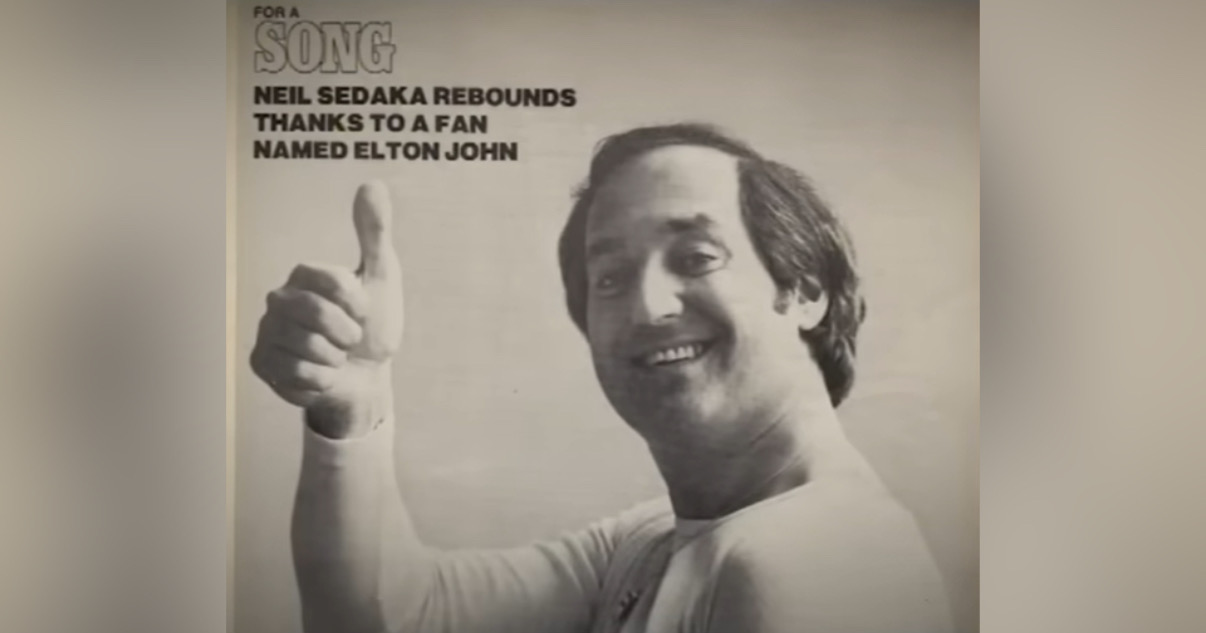
(March 2, 2026). As his family and the music world prepare to lay to rest singing and songwriting legend Neil Sedaka — who died suddenly on February 27 at age 86 — DJROBBLOG continues its tribute with a ranking of what this blogger considers his 30 greatest compositions.
This is a personal reflection on the songs that moved me most — songs written or co-written by Sedaka that, in many cases, became hits for other artists. Some soundtracked my youth; others revealed themselves later as I explored his immense, Rock and Roll Hall of Fame-caliber catalog (yes, he should have been inducted years ago).

Sedaka’s songwriting spanned more than six decades — from teen-pop classics like “Calendar Girl” to comeback anthems like “Love Will Keep Us Together,” and deeply personal works recorded by others who carried his melodies into new generations.
Perhaps — sadly, as often happens — the Rock Hall voters will recognize in death what they overlooked in life. In the meantime, I hope readers enjoy this Top 30 countdown and the commentary accompanying each entry. Please share your own favorites in the “Your Thoughts” section below.
30. “We Can Make It If We Try” (1966)
Co-written with Carole Bayer Sager, this was the last song RCA records released under Neil’s original contract, which expired in 1966 and was not renewed. The song reached No. 121 in January 1967 and was Sedaka’s last chart entry before “Laughter in the Rain” nearly eight years later.
29. “Amarillo” (1972; first recorded by Tony Christie)
Recorded originally by pop singer Tony Christie in 1972 as “(Is This the Way to) Amarillo,” this song only reached No. 121 that year. Sedaka’s cover of his own composition did better in 1977, reaching No. 44 in the wake of his historic 1975 comeback.
28. “Stupid Cupid” (1958; popularized by Connie Francis)
Sedaka and Greenfield had just signed their first publishing deal and were paired with the up-and-coming Connie Francis when they gave her this top 20 single in 1959.
27. “Sad Eyes” (1974)
No, not that one. This slow, bluesy number reflected Sedaka’s soulful influences from the early 1950s and was one of five songs originally recorded for the 1974 album Laughter in the Rain to be lifted onto Sedaka’s Back later that year.
26. “Our Last Song Together” (1973)
Neil wrote this as a parting tune from longtime songwriting partner, Howard Greenfield. As it was the last song on his comeback set, Sedaka’s Back, as well as the last charting song for the band Bo Donaldson and the Heywoods, it turned out not to be Sedaka’s and Greenfield’s last collaboration, as they would reunite later in the decade and generate hits for Captain & Tennille.
25. “For the Good of the Cause” (1974)
Filled with sass and pizazz, this jumpy upbeat number was originally included on Neil’s Polydor 1974 album, Laughter in the Rain. But that LP didn’t do anything in the U.S., so this soulful track — along with the title tune — were lifted for inclusion on his Sedaka’s Back compilation on Rocket Records later that year. We all know how that turned out.
24. “Ring, Ring” – ABBA (1973)
Most people associate ABBA’s Eurovision Contest history with “Waterloo,” the song that won them the competition in 1974, but Sedaka and Phil Cody penned the English translation of ABBA’s “Ring Ring” the year before and that song placed third in the contest, likely setting the stage for “Waterloo” to follow.
23. “Standing on the Inside” (1973)
This funky little number, which included themes exploring personal growth and overcoming isolation, was originally on Neil’s The Tra-La Days Are Over but was chosen as the lead-off track for his renaissance set, Sedaka’s Back in 1974.
22. “Endlessly” (1974)
It’s been said that Sedaka had his pick of which songs he’d previously recorded to include on the compilation Sedaka’s Back. Although this beautiful ballad from the 1974 LP Laughter in the Rain didn’t make the original cut, it was released as the B-side to the “Laughter” single and later included in a 1998 deluxe edition of Sedaka’s Back.
21. “Since You’ve Been Gone” (1959; popularized by Clyde McPhatter of the Drifters)
Several of Sedaka/Greenfield’s early compositions were farmed to big R&B acts of the day like the legendary Clyde McPhatter who rode both the soul and pop charts with this song in 1959. Lyrically, the tune embraced the same fatalistic themes Greenfield often explored with lines like “I’m gonna go walking by the railroad track. I’m just gonna let the choo-choo cross over my back. Life ain’t worth living…”
20. “The Diary” (1958)
Just months after securing their first hit with Connie Francis’ No. 14 peaking song, “Stupid Cupid,” 20-year-old Sedaka scored his own No. 14 hit with this composition inspired by Francis’ refusal to allow him to read her diary.
19. “The Way I Am” (1974)
“The Way I Am” is about self-acceptance and making no apologies for being one’s true self. Sedaka’s last appearance on an R&B chart was in 1963 before Billboard revamped it to make it look less like the Hot 100, but this was about as soulful as Sedaka ever sounded. Never released as a single by Sedaka, a version by Lovelace Watkins reached the top ten in South Africa in 1974.
18. “I Waited Too Long” (1959; popularized by LaVern Baker)
Rock and Roll Hall of Famer and soul music legend LaVern Baker took this Sedaka/Greenfield composition into the top 40 on both the pop and R&B charts in 1959. It was one of many Brill Building exports that enjoyed that status from the likes of Sedaka and contemporaries like Carole King and husband Gerry Goffin.
17. “Oh! Carol” (1959)
Continuing with the fatalistic theme of love or death, Sedaka and Greenfield penned this for the former’s real-life ex-girlfriend, Carole King, who — along with the two songwriters — were part of the famous NYC Brill Building stable of hitmakers in the late 1950s and early ’60s.
16. “Puppet Man” (1969; popularized by the 5th Dimension (’70) and Tom Jones (’71))
Both of the songs on this list from Sedaka’s 1969 album, Workin’ on a Groovy Thing, released in Australia and UK (under a different title there), were covered by the 5th Dimension: the title track and “Puppet Man,” which 5D took to No. 24 in 1970. Tom Jones’ version a year later topped out at No. 26.
15. “Little Brother” (1973)
Originally recorded for his 1973 UK album, The Tra-La Days are Over, this calypso-sounding tune was one of the better ones Sedaka lifted for his 1974 comeback compilation album, Sedaka’s Back. Its lyrics, about the tragic experiences of a small child who causes significant trouble, both for his parents and his big brother, were relatable to anyone with a pesky little brother at home.
14. “That’s When the Music Takes Me” (1972; popularized in 1975)
The third top 40 single during Sedaka’s 1975 comeback run was this Rocket Record Company hit that was reminiscent of label mate Kiki Dee’s “I Got the Music in Me,” which had reached No. 12 in late 1974 as Sedaka’s comeback was just starting. It was first included in his 1972 European album Solitaire.
13. “Solitaire” (1972; popularized by the Carpenters in 1975)
Although Richard Carpenter has said that his late sister Karen did not fancy this song, their version of it was one of six (!) songs penned by Sedaka to top the Billboard Adult Contemporary chart from 1975-76. Five of them were originally sung by Sedaka and four of those, including this one, were included on his Sedaka’s Back album.
12. “The Hungry Years” (1975)
Sedaka often referred to the years between 1964 and 1975 as his “Hungry Years,” the years when he was all but forgotten in America as a performer but continued to be a successful songwriter. This poignant ballad became one of his most requested and reinstated his partnership with Greenfield, which he’d ended in 1973 just before his historic comeback.
11. “Workin’ on a Groovy Thing” (1968; popularized by 5th Dimension in 1969)
This song’s interesting history includes versions by R&B singer Patty Drew (1968) and Sedaka himself (1969), but the best-known one was the top 20 hit by 5th Dimension, whose single release was sandwiched between the No. 1 hits “Aquarius/Let the Sunshine In” and “Wedding Bell Blues” in 1969.
10. “Breaking Up Is Hard to Do” (1962; re-popularized by Sedaka in ’76)
Mr. Sedaka’s passing on Feb. 27 came 50 years to the week that his remake of “Breaking Up Is Hard to Do” fell from its No. 8 peak, which would mark his last week in the top ten — a historic one, as “Breaking” remains the only song to appear in the top ten twice in a completely different arrangement by the same artist.
9. “Alone in New York in the Rain” (1973)
Another slice of sophistication from his fantastic and highly underrated album The Tra-La Days Are Over — and added to a 1998 deluxe reissue of 1974’s Sedaka’s Back — was this haunting tune that recalled elements of Carole King’s “It’s Too Late” and is a prime example of Sedaka’s versatility on the piano, particularly the minor-key tinkering he does at the end of each chorus.
8. “Calendar Girl” (1961)
Long before Stevie Wonder gave us a full-calendar rundown on his 1984 smash, “I Just Called to Say I Love You,” Sedaka and Greenfield penned this top five smash from 1961, in which Sedaka — unlike Wonder — mentioned each month by name in explaining how smitten he was over his love interest. Hmmm… wonder if Stevie was inspired by this tune. Oh, and check out those dance moves in the above video!
7. “Where the Boys Are” (1961; recorded by Connie Francis)
No solo female topped the Hot 100 in 1961, but Connie Francis was the biggest female singer on the planet when this title theme from the movie reached No. 4 that year. She’d become the first woman to top the Hot 100 the year before with “Everybody’s Somebody’s Fool” and then again that year with “My Heart Has a Mind of Its Own,” neither of which were penned by Sedaka/Greenfield. If not for legends like Elvis, Chubby Checker, and Marty Robbins keeping her at bay, this might have been Connie’s next No. 1.
6. “Love Will Keep Us Together” (1973; popularized by Captain & Tennille in 1975)
What could possibly be better than scoring four top 40 hits in a year and having two of them reach No. 1? Having another act cover one of your compositions and watching it become the biggest hit of that same year. That’s what “Love Will Keep Us Together” did for Sedaka in 1975. Toni Tennille was right as she declared during the song’s outro, “Sedaka is back.” The above clip is Sedaka’s performance of the song.
5. “Lonely Night (Angel Face)” (1975; popularized by Captain & Tennille in 1976)
One of my binge faves during this period of mourning, Sedaka recorded this song for his 1975 album, The Hungry Years. But it was the Captain & Tennille who scored big with it in 1976 as their third-consecutive top five hit. It reached No. 3 for the duo and sold a million copies (while reaching No. 1 on the AC chart). Could the Captain (and apparent keyboard wizard) have appeared any more enthused than in the above video?
4. “You Never Done It Like That” (1977; popularized by Captain & Tennille in ’78)
Written by the renewed partnership of Sedaka and Greenfield, the Captain & Tennille scored a top ten hit in 1978 with their cover of Sedaka’s prior year album cut, “You Never Done It Like That.” I still chuckle at the hilariously non-specific lyric, “to be specific, oooh, you never done it like that,” which Toni Tennille coos in the first verse. And it was only this week, after hearing Sedaka’s version, that I learned I’d been mishearing the bridge line, “one kiss from you, and I feel just like Columbus” as “one kiss from you, and I feel just like no other” for the past 47 years. I’ve included both versions above for your listening enjoyment.
3. “The Immigrant” (1974; popularized in 1975)
This song was said to be a tribute to songwriters Sedaka’s and Phil Cody’s parents, all of whom were immigrants, and John Lennon, who was facing deportation issues at the time of its creation. Sedaka was quoted as saying it was his only politically minded song out of more than a thousand he wrote.
2. “Bad Blood” (1975)
The fastest-climbing No. 1 song of 1975 before “Bad Blood” had been Elton John’s “Philadelphia Freedom,” which topped the chart in its sixth week on the Hot 100. “Bad Blood” did one better that October by hitting the top in only five weeks. Not to be outdone, Elton reclaimed the trophy when his “Island Girl” — in its fourth Hot 100 week — knocked “Bad Blood” out of No. 1 in November, which meant Elton had a part in the three fastest-rising No. 1 singles of 1975, as he had sang the harmonizing vocals on Sedaka’s tune, which was also on Elton’s Rocket Record Company label imprint.
1. “Laughter in the Rain” (1974)
The song that launched Neil’s American comeback in 1974 and served as my first memory of the rock and roll legend went on to reach No. 1 in Feb. 1975 and would rank as his biggest Billboard hit by virtue of its lengthy chart run. It took 16 weeks to reach No. 1 and remained on the Hot 100 longer than any of Sedaka’s other tunes (20 weeks).
Putting together this Top 30 reminded me why Sedaka’s music has always felt so personal. The charts measured their success in weeks at No. 1 (and sometimes the charts didn’t measure them at all). But life and legacy measure them in memories. And by that standard, Neil Sedaka’s compositions remain priceless.
Now it’s your turn. Rankings are meant to spark conversation, and Sedaka’s catalogue is deep enough to justify dozens of different top 30 lists. Which songs would you move higher? Which did I leave out? Share your favorites in “Your Thoughts” below — because one of the best ways to honor a songwriter of this magnitude is to keep his music alive.
R.I.P. Neil Sedaka (March 13, 1939, – February 27, 2026)

DJRob (he/him) is a freelance music blogger from the East Coast who covers R&B, hip-hop, disco, pop, rock and country genres – plus lots of music news and current stuff! You can follow him on Bluesky at @djrobblog.bsky.social, X (formerly Twitter) at @djrobblog, on Facebook or on Meta’s Threads.
You can also register for free by selecting the menu bars above to receive notifications of future articles.
I’m thinking Stepping Out could have been on the list. Yes, I am fully aware it was pretty much a copy of Bad Blood, but dang…it was fun!
True it was fun. I probably penalized it for the “Bad Blood” modeling, kinda like I did “Next Door to an Angel,” the follow-up to the original version of “Breaking Up Is Hard To Do” and a direct rip of it.