


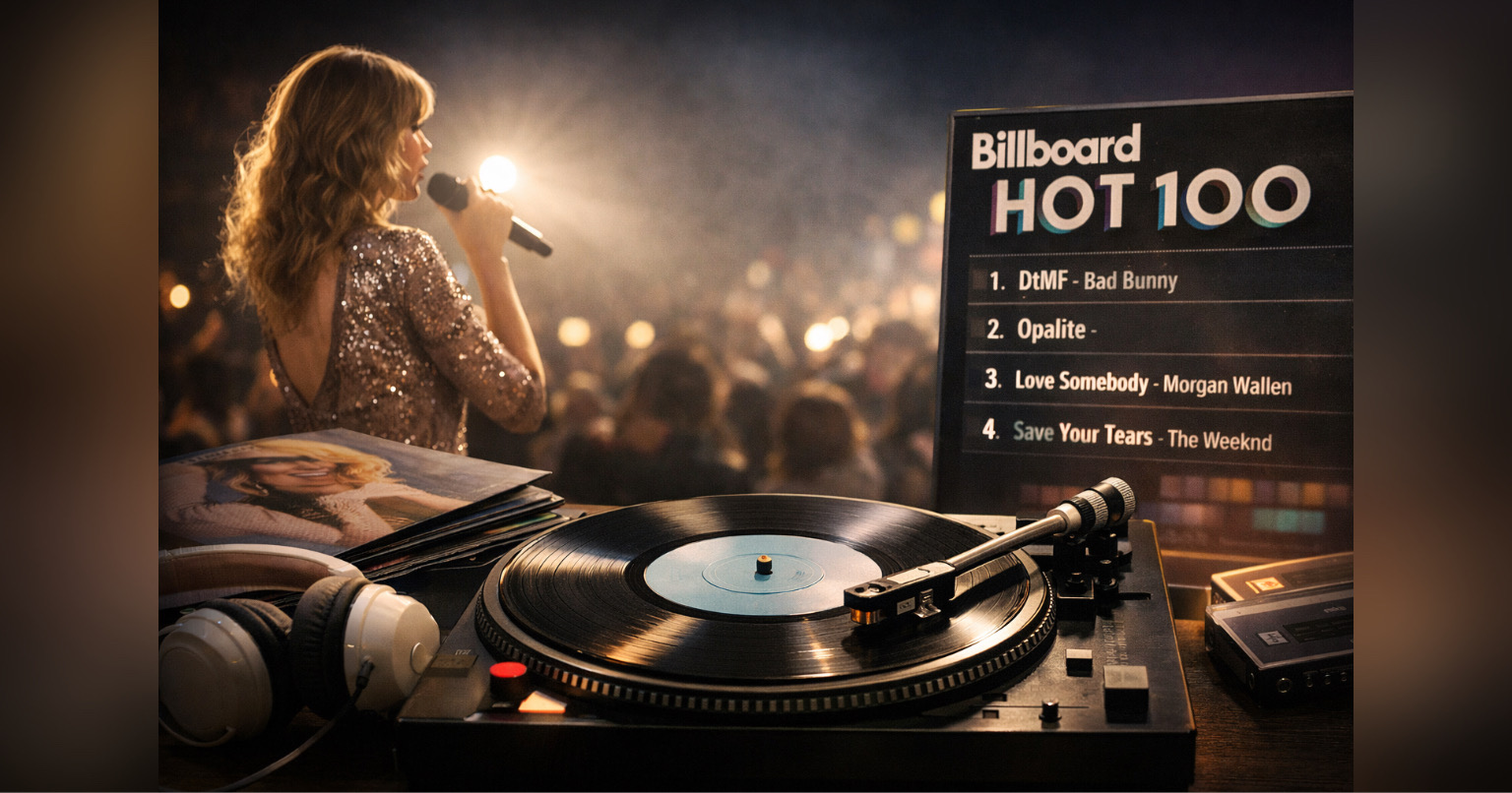
Taylor Resorts to 1980s Tactics – a Vinyl Single and Music Video – to Push “Opalite” to The Top
(February 7, 2026) – It’s tough these days to get two or more No. 1 singles from one album. It’s even tougher when the second single has already spent months in heavy radio rotation, no longer feels “new,” and lacks the jolt of a viral remix or superstar guest.
Those facts are among the issues that increase the odds Taylor Swift is facing in an aggressive bid to get “Opalite,” the now-official second single from The Life of a Showgirl to the top of the Billboard Hot 100. She’s also battling tough competition, dubious timing, and the recent history suggesting it’s not automatic that blockbuster albums yield multiple No. 1 singles.
On Friday (Feb. 6), Swift began a campaign to get “Opalite” – a Swiftie favorite since its October release – to No. 1. Apart from three or four weeks around the holiday season, “Opalite” has hovered in or near the top ten – peaking at its debut position of No. 2 and biding its time while lead official single, “The Fate of Ophelia,” continued to dominate.
The all-out push for “Opalite” includes a new music video released to Apple and Spotify streaming services, a delayed posting of the video to YouTube (deemed a lower marketing priority after the platform severed its ties as a Billboard data provider when the chart authority declined to equalize the points contributions to its charts from free and paid streaming services), and a pre-ordered limited-addition 7” vinyl 45 single to be delivered during the current chart sales tracking week. The vinyl 45 includes an acoustic version of “Opalite” on its B-side, and that version is also available on streaming services.

The marketing moves are classic Taylor, whose reputation as a chart watcher and master manipulator precedes her. No one can mobilize a global fanbase (although U.S. consumption is all that counts towards Billboard’s charts) quite like her. Swifties – even those weary of her tricky release tactics in the past (see the rollout of The Tortured Poets Department’s Anthology version) – will no doubt rally behind “Opalite” because, well it’s “Opalite.”
But will a rabid reaction by her fanbase be enough this time?
History says the odds are against her.
In the 2020s, only ten albums have pulled off a second No. 1 single – none of them by Taylor – and in all but one case, the second No. 1 single was the one more closely timed with the album’s release. That’s not a Taylor problem — it’s a decade-wide trend.
Related reading: See this exclusive listing of every album that’s generated multiple No. 1 singles in Hot 100 history!
For nine of the albums, the first No. 1 single received a significant headstart by preceding the album’s release by months and, in one case, years. Cardi B’s recent sophomore album, Am I the Drama, raised eyebrows when she included two previous standalone No. 1 hits – “WAP” and “Up” – that charted more than four years prior to the album’s release. As dubious as it may be, that decision makes Drama one of the ten albums counted here.
Two albums’ multiple No. 1s benefited from remixes that added Ariana Grande to songs by The Weeknd. More than a year after his After Hours album peaked – and after the No. 1 singles “Heartless” (2019) and “Blinding Lights” (2020) – The Weeknd teamed with Grande on a remix to “Save Your Tears,” which propelled that song to No. 1 in 2021.
Then in 2023, he dipped into that well again when Grande joined him on a remix to “Die for You” from his 2016 album Starboy, the title track of which hit No. 1 in the year of release. (For the purposes of this article, Starboy is counted for the 20s decade because that’s when its second No. 1 hit occurred.)
Then there’s the more extreme case where one superstar – Morgan Wallen – released eight singles as standalone tracks before his latest album, I’m the Problem, debuted. That gave each one a chance to chart on its own merits, and one of those, “Love Somebody,” topped the Hot 100 six months before the album (and second No. 1 single) came out.
The only album this decade to have earned two No. 1 singles without a headstart and which didn’t involve a major remix was Kendrick Lamar’s Grammy-winning GNX, which spawned the No. 1 hits “Squabble Up” and “Luther” (with SZA) – with the latter of those heavily benefiting from a Super Bowl performance, plus Lamar’s Grammy sweep for earlier hit “Not Like Us.”
If “Opalite” reverses course and hits No. 1 on the chart reflecting this week’s push, The Life of a Showgirl will become only the second album of the 2020s – after GNX – to generate two No. 1 singles in the same manner.
Dubious Timing
Then there’s that event happening Sunday (Feb. 8) involving arguably the world’s hottest superstar Bad Bunny. Like last year with Kendrick, Bunny stands to benefit heavily from the one-two punch that is this year’s Grammys and Super Bowl. His Album of the Year Grammy-winner, DeBi TiRar Mas FOTos, is expected to challenge for No. 1 on the next Billboard 200 chart and could receive an even bigger boost on the Feb. 21 chart in the wake of his Super Bowl halftime show. It’s quasi-title track, “DtMF” is expected to challenge for No. 1 on the same Hot 100 in which “Opalite” would be a top contender.
When added to the current Grammy-related pushes for Olivia Dean’s top-3 hit “Man I Need,” plus the resurgent “Ordinary” by Alex Warren and the highly popular “Choosin’ Texas” by Ella Langley, it presents an unusually daunting task for Ms. Swift to accomplish.
This raises questions about Taylor’s choice of timing: why this week? Aside from it being hard to reverse earlier ship-date commitments for the pre-ordered single – sales points for pre-ordered releases count during the week they arrive at customers’ doorsteps – it seems Taylor and Republic Records could have delayed this push by a few weeks to allow the Bad Bunny storm to subside. As popular as “Opalite” has been with Swifties, it’s hard to imagine it surviving the wave of attention non-Swifties will be devoting to this weekend’s events.
And if last year’s post-Super Bowl boost for Kendrick is any indication – his “Not Like Us” returned to the top and was immediately followed by the 13-week No. 1 run of “Luther” – it’s hard to imagine even “Opalite,” a song that has been in the public consciousness for months now, generating or sustaining enough renewed interest to topple a very Bad Bunny.
Taylor’s Fighting Her Own History
And then there’s Taylor’s own chart history. Even with 13 No. 1 singles, only one of her albums has generated multiple No. 1 hits. The 2014 set 1989 contained three: “Shake It Off,” “Blank Space,” and “Bad Blood.” Her rise to mega stardom came during an era when the multi-No. 1 hit album has been on a steady decline. In the 2020s, as previously mentioned, only ten such albums have done it so far, while 17 albums did the trick in the 2010s, and 23 did it during the 2000s. For perspective, the 1990s only saw 18, but that came during a period of adjustment as Billboard began using point-of-sale technology for its charts, and record companies shunned releasing singles to pump up album sales.
The heyday for multi-No. 1 containing albums were the 1980s, when an astonishing 36 albums achieved the feat, including multiple releases by Michael Jackson, Whitney Houston, Bon Jovi, and Phil Collins. But even that decade was a tale of two halves. From 1980-84, only ten albums generated multiple No. 1 singles, while from 1985-89, 26 albums turned the trick. Eight different albums yielded multiple No. 1 hits in 1989 alone.
Obviously, singles (and albums for that matter) were marketed differently in the 1980s than they are today. In today’s everything-everywhere-all-at-once streaming world where songs are available for mass consumption without the need for an additional radio push or video availability, it’s tough to justify suddenly crowd-sourcing a single people have been listening to ad nauseam for four months.
But stranger things have happened. Taylor’s own “Cruel Summer” topped the chart in 2023, four years after it appeared in her 2019 album, Lover, thanks to a viral social media presence following the song’s inclusion in her Eras Tour set list. The crowning remix to The Weeknd’s “Die For You” was preceded by renewed interest in the song that saw it hovering in the chart’s lower reaches six years after its initial release. And we all know about the many Stranger Things synchs that have sent decades-old songs back on the charts.
But if there’s anything working in Taylor’s favor, it’s Taylor herself and that unflappable army of Swifties. If “Opalite” fails to crest this week, it won’t be simply because Taylor miscalculated — it’ll be because the chart environment no longer behaves the way it did even five years ago. And if anyone is capable of forcing a rule-book exception, history suggests it’s still Taylor Swift.
DJRob
DJRob (he/him) is a freelance music blogger from the East Coast who covers R&B, hip-hop, disco, pop, rock and country genres – plus lots of music news and current stuff! You can follow him on Bluesky at @djrobblog.bsky.social, X (formerly Twitter) at @djrobblog, on Facebook or on Meta’s Threads.
You can also register for free by selecting the menu bars above to receive notifications of future articles.