


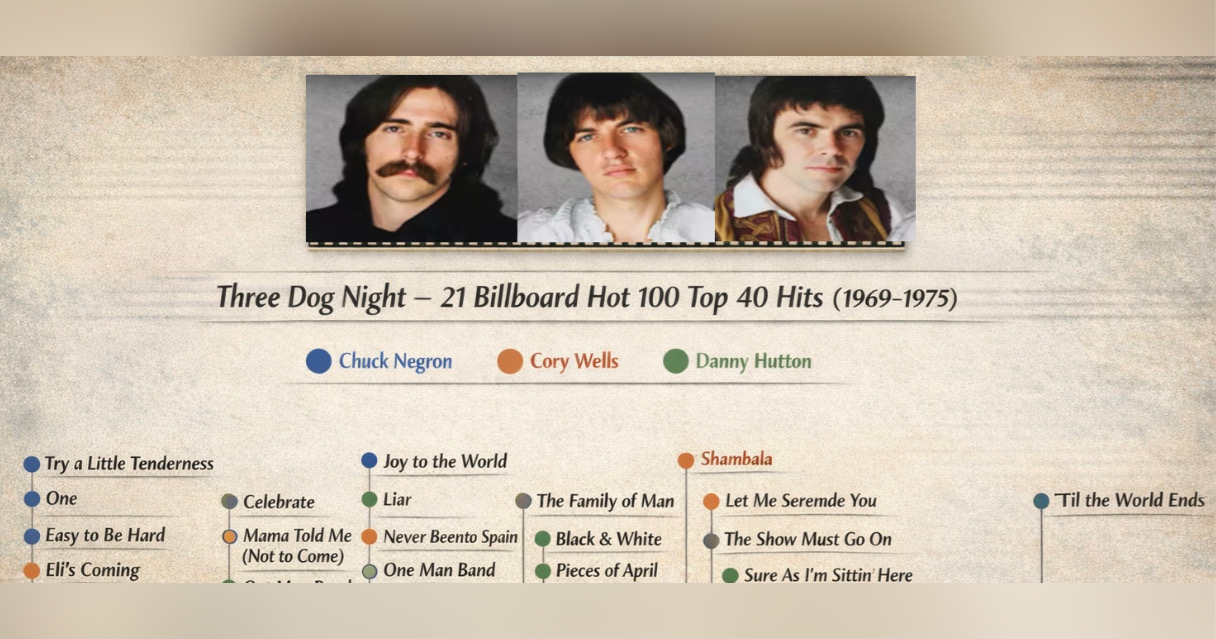
(February 5, 2026) – Few American bands made sharing the spotlight look as effortless as Three Dog Night. Between 1969 and 1975, the group placed 21 songs in the Billboard Hot 100’s top 40, an extraordinary run built not on a single frontman, but on a rotation trio of very capable lead vocalists – Chuck Negron, Cory Wells, and Danny Hutton – each bringing a distinct voice, personality, and emotional quality to the band’s hits.

With the passing of Negron on Monday (Feb. 2), it’s the right time to look back at this extraordinary group and appreciate their amazing track record. They may still be the only act to have as many as 21 Hot 100 hits with a 1.000 top 40 batting average, placing all 21 of them in that chart tier. Negron contributed solo or shared lead vocals on eleven of those hits, while the late Wells had the most (12) and Hutton had six. Those totals include the four songs on which the trio shared lead duties.
Three Dog Night, named for the coldest night in the Australian outback where cuddling with three dogs was necessary to brave the chill, joined the Temptations as only the second group to have three separate members sing lead on at least one No. 1 single. Negron had the biggest of those with 1971’s “Joy to the World,” which also ranked as Billboard’s top single of that year.
With Three Dog Night, lead vocals weren’t a footnote, they were the engine that drove each song, often carrying the tunes to higher heights than the music or lyrics might have otherwise. Can you imagine “Jeremiah was a bullfrog!” being sung any differently by Negron and still being a smash hit? Or “Mama Told Me (Not to Come)” being as big without the humor that Cory Wells injected into it? “Black and White” may have been a poor-man’s “Everyday People,” but the informative, schoolteacher-like cadence that Hutton gave it couldn’t have been more fitting given the song’s purpose.
In Three Dog Night’s case, the choice of singer often determined whether a song sounded defiant, tender, playful, or world-weary – and, just as often, whether it became a smash. Hutton’s straight approach couldn’t have carried “Mama Told Me,” Negron’s energy would have been too much for “Black and White,” and Wells might have made “Joy to the World” sound even more novelty than intended. And with neither member writing any of their chart hits – perhaps explaining why the band has been overlooked for the Rock Hall of Fame – the fact that they were so vocally invested in each tune was a true mark of their artistry and professionalism.

What follows is a wiki-style guide to all 21 of Three Dog Night’s Top 40 hits, each chronological entry documenting songwriters and producers, chart performance, lead vocal duties, label information and RIAA certification. A commentary on each song’s vocals and historical context is also included, along with an audio or video clip for each entry.
At the end of the article is DJROBBLOG’s ranking of my ten favorites – a critic’s choice from best to worst based purely on my own binge listening, bias, and long-term wear. It’s part reference guide, part personal reckoning, and above all, a tribute to a band whose greatest strength was not only interpreting other people’s songs, but knowing exactly whose voice was needed to do it.
🎵 “Try a Little Tenderness” (1969)
Peak Hot 100 Position: 29
Weeks on Chart: 12
Album: Three Dog Night (1969)
Songwriters: Jimmy Campbell/Reg Connelly/Harry Woods
Producer: Gabriel Mekler
Catalog: Dunhill/ABC 4177
Lead Vocalist(s):
• Cory Wells
Notable Vocal Notes:
• Wells performed the tune (with no backing from Hutton or Negron) in the style of the late Otis Redding as a tribute to him. Wells came by his love of soul music honestly. His boyhood love of doo-wop groups like the Del-Vikings and his formation of an interracial band prior to 3DN inspired some of the most soulful vocal expressions in the group’s catalog of hits.
• Like Redding, Wells’ uninhibited vocal builds in intensity as the song progresses, displaying his soulful chops — arguably the most soulful of the trio.
• Three Dog Night would stretch the song to more than 15 minutes during live performances in the 1980s.
Who Recorded It First?
• The Ray Noble Orchestra w/ vocals by Val Rosing (1932) (click above to hear this fox-trot ballad)
• Several other versions in the 1930s before Frank Sinatra recorded one for his 1946 debut album and again on his 1960 Nice ‘n’ Easy LP. Mel Torme, Bing Crosby and Aretha Franklin also recorded versions. Franklin’s version peaked at No. 100 in 1962.
• Otis Redding’s definitive version of “Tenderness” peaked at No. 25 pop and No. 4 soul in 1967.
🎶 “One” (1969)
Peak Hot 100 Position: 5
Weeks on Chart: 16
Album: Three Dog Night (1969)
Songwriters: Harry Nilsson
Producer: Gabriel Mekler
Catalog: Dunhill/ABC 4191
Certification: Gold (1 million)
Lead Vocalist(s):
• Chuck Negron
Notable Vocal Notes:
• Negron’s multi-octave range conveys the emotion befitting of this song’s messages of loneliness. He begins softly with the iconic opening line, “One is the loneliest number that you’ll ever do…” before building to a crescendo by the song’s finish.
Who Recorded It First?
• Harry Nilsson (on his third album, Aerial Ballet, 1968)
• The song was inspired by the telephone busy signal that Nilsson heard. Those tones (beep, beep, beep, beep…) became the opening piano notes in 3 Dog Night’s version.
🎵 “Easy to Be Hard” (1969)
Peak Hot 100 Position: 4
Weeks on Chart: 13
Album: Suitable for Framing (1969)
Songwriters: Galt MacDermot/James Rado/Gerome Ragni
Producer: Gabriel Mekler
Catalog: Dunhill/ABC 4203
Lead Vocalist(s):
• Chuck Negron
Notable Vocal Notes:
• Negron’s softly reverbed tenor gently ponders the evils of the world. He pours his emotion into each verse, alternating between the initial soft delivery and the waling cry of the two bridges where he expresses his need for a friend.
• The song famously has no choruses, just verses and a couple of bridges.
Who Recorded It First?
• Lynn Kellogg (May 1968)
• The song was from the rock musical Hair. Kellogg performed it on stage in the musical.
• “Easy to Be Hard” was later performed in the 1979 film version of Hair by Cheryl Barnes.
🎼 “Eli’s Coming” (1969)
Peak Hot 100 Position: 10
Weeks on Chart: 14
Album: Suitable for Framing (1969)
Songwriter: Laura Nyro
Producer: Gabriel Mekler
Catalog: Dunhill/ABC 4215
Lead Vocalist(s):
• Cory Wells
Notable Vocal Notes:
• Wells’ soulful delivery is applied to this warning to would-be female victims about heartbreaker Eli’s return to town.
• Wells is supported by Negron who rises to a convincing falsetto in the intro and throughout.
• This song’s urgency has rarely been duplicated in future 3DN singles.
Who Recorded It First?
• Laura Nyro (1967)
• At least three other versions were released in 1969 (Don Ellis, The Friends of Distinction, Honey Ltd.), with several more in 1970-71.
• “Eli’s Coming” joined two other Nyro-penned songs (“And When I Die” by Blood, Sweat & Tears; and “Wedding Bell Blues” by the 5thDimension) in the top ten in November/December 1969, making her the first female songwriter to have written three simultaneous top ten hits.
🎧 “Celebrate” (1970)
Peak Hot 100 Position: 15
Weeks on Chart: 9
Album: Suitable for Framing (1969)
Songwriters: Garry Bonner/Alan Gordon
Producer: Gabriel Mekler
Catalog: Dunhill/ABC 4229
Lead Vocalist(s):
• All (Hutton, Negron, Wells).
Notable Vocal Notes:
• Hutton does verse 1, Negron is verse 2, Wells is verse 3 (who also sings melody through the end refrain, while the others sing harmony).
• It is one of only two chart singles in which each lead vocalist takes turn on a verse. The other is “The Family of Man” (1972).
Who Recorded It First?
• Three Dog Night
• “Celebrate” was the first 3DN chart single that wasn’t a cover of another artist’s song.
🎤 “Mama Told Me (Not to Come)” (1970)
Peak Hot 100 Position: 1 (2 wks)
Weeks on Chart: 15
Album: It Ain’t Easy (1970)
Songwriters: Randy Newman
Producer: Richard Polodor
Catalog: Dunhill/ABC 4239
Certification: Gold (1 million)
Lead Vocalist(s):
• Cory Wells
Notable Vocal Notes:
• Wells’ hilarious phrasing carried this tune to No. 1. Coming across as a reluctant participant in the party he’s attending, one can’t help but wonder if the protagonist has partaken in some of the antics he seemed so appalled by.
• Donna Summer reportedly sang backup vocals (though she was not credited in the album’s liner notes).
• In a rare turn, all three members spend the last third of the song ad-libbing around the refrain (“that ain’t the way to have fun”).
Who Recorded It First?
• Eric Burdon and the Animals (1967)
• Randy Newman recorded a version around the same time as 3DN’s was released.
• “Mama Told Me” was the first in a string of 12 consecutive 3DN hits produced by Richard Polodor.
• “Mama Told Me” was famously the No. 1 song on the very first episode of American Top 40 with Casey Kasem in July 1970. It had just replaced the Jackson 5’s “The Love You Save.”
🎶 “Out in the Country” (1970)
Peak Hot 100 Position: 15
Weeks on Chart: 11
Album: It Ain’t Easy (1970)
Songwriters: Roger Nichols/Paul Williams
Producer: Richard Polodor
Catalog: Dunhill/ABC 4250
Lead Vocalist(s):
• All three in unison (Wells, Negron, Hutton)
Notable Vocal Notes:
• This song was sung mostly in melody (no harmony) and was their only single to use this arrangement.
• Not only was each member singing melody, but all three sang the verses in falsetto and used their tenors for the choruses. This seemed to provide a unifying force behind the song’s environmentally conscious message.
• The only harmony used is at the end of the line “and take back something worth remembering” during the first two choruses, and then in various spots during the final refrain.
Who Recorded It First?
• Three Dog Night
• Their seventh top 40 hit was their second original recording.
• “Out in the Country” ranks as this blogger’s favorite 3DN tune!
🎵 “One Man Band” (1970)
Peak Hot 100 Position: 19
Weeks on Chart: 11
Album: Naturally (1970)
Songwriters: Billy Fox/Tommy Kaye/January Tyme
Producer: Richard Polodor
Catalog: Dunhill/ABC 4262
Lead Vocalist(s):
• Hutton and Negron
Notable Vocal Notes:
• Hutton (melody) and Negron (harmony) begin the song’s verses.
• Negron takes over at the 1:58 mark while the others harmonize behind him through the song’s end.
Who Recorded It First?
• Three Dog Night
• “One Man Band” incorporates a guitar section at the 1:41 mark that is reminiscent of Guess Who’s “No Time,” which had been a hit earlier in 1970.
🎵 “Joy to the World” (1971)
Peak Hot 100 Position: 1 (6 wks)
Weeks on Chart: 17
Album: Naturally (1970)
Songwriter: Hoyt Axton
Producer: Richard Polodor
Catalog: Dunhill/ABC 4272
Certification: Gold (1 million)
Lead Vocalist(s):
• Chuck Negron
Notable Vocal Notes:
• Negron poured his all from start to finish into a song that famously began, “Jeremiah was a bullfrog.”
• All seven members of 3DN (not just the three key vocalists) joined in on the chorus at the end.
• Am I the only one who wishes they had simply elongated the word “fii-ish” with another syllable rather than pluralize it as “fishes”?
Who Recorded It First?
• Three Dog Night, although Axton recorded a cover of his own composition the same year this hit No. 1.
• Hutton and Wells initially rejected the song upon hearing Axton’s demo, but Negron felt the group needed to loosen up again (like they had on “Mama Told Me”).
• “Joy to the World” became the band’s biggest hit, while holding two Motown classics to No. 2 peaks on the Billboard Hot 100: “What’s Goin’ On” by Marvin Gaye, and “Never Can Say Goodbye” by the Jackson 5.
🎤 “Liar” (1971)
Peak Hot 100 Position: 7
Weeks on Chart: 12
Album: Naturally (1970)
Songwriter: Russ Ballard
Producer: Richard Polodor
Catalog: Dunhill/ABC 4282
Lead Vocalist(s):
• Danny Hutton
Notable Vocal Notes:
• Hutton’s first turn as solo lead on a single release, his gritty delivery recalls that of a coherent Joe Cocker.
• Hutton’s heavily distorted vocal counters the understated acoustic guitar intro.
• The music finally catches up to Hutton’s urgency with various instrumental crescendos during the chorus.
Who Recorded It First?
• Argent (1970)
• The guitar intro is reminiscent of the underlying guitar riff to Simon & Garfunkel’s “Mrs. Robinson” two years earlier.
• 3DN’s version of “Liar” is another of this blogger’s favorite tunes, although other artists have since covered it (Capability Brown, The Meters, Graham Bonnet).
🎶 “An Old Fashioned Love Song” (1971)
Peak Hot 100 Position: 4
Weeks on Chart: 11
Album: Harmony (1971)
Songwriter: Paul Williams
Producer: Richard Polodor
Catalog: Dunhill/ABC 4294
Certification: Gold (1 million)
Lead Vocalist(s):
• Chuck Negron
Notable Vocal Notes:
• Negron’s easy tenor in what was perhaps the group’s simplest of songs conveyed its uplifting vibe
• The three members achieved three-part harmony as they sang the words “three-part harmony.”
Who Recorded It First?
• Red-hot songwriter Paul Williams created a version himself around the same time that 3DN’s was recorded.
• The Carpenters, who’d recorded two of Williams’ other compositions (“We’ve Only Just Begun” and “Rainy Days and Mondays”), famously rejected “An Old Fashioned Love Song” before it was given to 3DN
• “Old Fashioned” was 3DN’s first Adult Contemporary No. 1 hit and their fourth gold-certified single.
🎧 “Never Been to Spain” (1971)
Peak Hot 100 Position: 5
Weeks on Chart: 12
Album: Harmony (1971)
Songwriter: Hoyt Axton
Producer: Richard Polodor
Catalog: Dunhill/ABC 4299
Lead Vocalist(s):
• Cory Wells
Notable Vocal Notes:
• Wells’ first charting solo vocal lead since the far more raucous “Mama Told Me” 18 months earlier.
• A more understated vocal than “Mama Told Me,” Wells continued the 3DN tradition of beginning soft before building in intensity during the song’s refrain as his bandmates harmonize.
Who Recorded It First?
• Hoyt Axton, ironically in 1971 on his album Joy to the World. Axton is also one of only two songwriters to have solely penned two 3DN hits (Dave Loggins the other).
• The lyric line “what does it matter” probably sums up what is mostly a rambling song about where the protagonist has never been as he compares places like “Heaven” to his hometown of Oklahoma (not Arizona).
• “Never Been to Spain” completed a streak of four consecutive top ten hits for 3DN in early 1972.
🎵 “The Family of Man” (1972)
Peak Hot 100 Position: 12
Weeks on Chart: 9
Album: Harmony (1971)
Songwriters: Jack Conrad/Paul Williams
Producer: Richard Polodor
Catalog: Dunhill/ABC 4306
Lead Vocalist(s):
• All (Hutton, Wells, Negron)
Notable Vocal Notes:
• Like “Celebrate” two years earlier, each member took turns leading a verse, and in the same order (first Hutton, then Negron and Wells).
• Negron’s falsetto carries the song through the fade-out, in the style of many of the day’s soul groups (Stylistics, Delfonics, the Moments, the Dells, etc.).
Who Recorded It First?
• Three Dog Night
• Williams covered his own song in a 1974 version on his album A Little Bit of Love.
• “The Family of Man” is arguably the funkiest of 3DN’s singles and is one of this blogger’s favorites.
🎼 “Black & White” (1972)
Peak Hot 100 Position: 1 (1 wk)
Weeks on Chart: 11
Album: Seven Separate Fools (1972)
Songwriters: David Arkin/Earl Robinson
Producer: Richard Polodor
Catalog: Dunhill/ABC 4317
Certification: Gold (1 million)
Lead Vocalist(s):
• Danny Hutton
Notable Vocal Notes:
• Hutton sang the lead and was joined by a children’s chorus.
• His lead gave each member claim to having sung solo on a No. 1 3DN song (Wells on “Mama Told Me”; Negron on “Joy to the World”).
Who Recorded It First?
• Pete Seeger (1956). This song about racial harmony came during the early Civil Rights movement while the country was dealing with desegregation. Seeger was accompanied by a young Black child in his original.
• 3DN’s version of “Black and White” was still timely, if not considered a bit cheesy, as the nation was still dealing with racial strife in 1972 (as it is in 2026).
🎵 “Pieces of April” (1972)
Peak Hot 100 Position: 19
Weeks on Chart: 14
Album: Seven Separate Fools (1972)
Songwriter: Dave Loggins
Producer: Richard Polodor
Catalog: Dunhill/ABC 4331
Lead Vocalist(s):
• Chuck Negron
Notable Vocal Notes:
• Negron recorded without the backing of Hutton or Wells, who’d left London – where the album was being recorded – before it was finished.
• Only “Try a Little Tenderness” – their first chart hit – had the distinction of not featuring all three singers, at least on background vocals, before “April.”
Who Recorded It First?
• Dave Loggins (1972), for his album Personal Belongings
• In what must have been some sort of cover-song purgatory back in 1972, Andy Williams covered “Pieces of April” for his album Alone Again (Naturally), the title of which had been a No. 1 hit that year for Gilbert O’Sullivan, while Johnny Mathis covered “April” for his album Me and Mrs. Jones, the title of which had been a No. 1 song for Billy Paul that year.
• “Pieces of April” ranks among 3DN’s most delicate ballads, never really reaching a crescendo.
🎤 “Shambala” (1973)
Peak Hot 100 Position: 3
Weeks on Chart: 16
Album: Cyan (1973)
Songwriter: Daniel Moore
Catalog: Dunhill/ABC 4352
Producer: Richard Polodor
Certification: Gold (1 million)
Lead Vocalist(s):
• Cory Wells
Notable Vocal Notes:
• The calm of Wells’ delivery during the verses was meant to capture the peace and serenity contained in the song’s spiritual lyrics about the mythical place called “Shambala.”
• In 3DN tradition, the song’s bridge (“How does your light shine in the halls of Shambala?”) increased the intensity from the song’s otherwise calm verses.
• That’s Negron’s ad-libs we hear going high falsetto during the second bridge.
Who Recorded It First?
• Composer Daniel Moore recorded a version before B. W. Stevenson and later 3DN’s version in 1973. Stevenson’s version charted one week before 3DN’s on the Hot 100.
• This would be the final top ten single sung by Wells.
• When it reached No. 1 in Cashbox (No. 3 in Billboard), “Shambala” continued a four-year No. 1 streak to begin the 1970s, something no other act had accomplished (although only three of those years were in Billboard).
• The B-side of “Shambala” was called “Our ‘B’ Side,” with tongue-in-cheek lines like, “we’d love to write an A-side someday, but here it is, our B-side baby.” True to the lyrics, the band’s members never wrote any of their A-sides.
🎵 “Let Me Serenade You” (1973)
Peak Hot 100 Position: 17
Weeks on Chart: 12
Album: Cyan (1973)
Songwriter: John Finley
Producer: Richard Polodor
Catalog: Dunhill/ABC 4370
Lead Vocalist(s):
• Cory Wells
Notable Vocal Notes:
• Wells begins with a soft baritone vocal before building to a crescendo during the song’s bridge and outro, once again showing off those soulful, almost gospel-like chops. His ad-libs are as soulful as many R&B singers of the day as this song was released during soul music’s crossover peak in the early ‘70s.
• The verses and choruses are hardly distinguishable but are effectively led with the title line to ensure familiarity.
Who Recorded It First?
• Rhinoceros (1968)
• Melissa Manchester covered it in 1977 for her album, Singin’…
🎤 “The Show Must Go On” (1974)
Peak Hot 100 Position: 4
Weeks on Chart: 19
Album: Hard Labor (1974)
Songwriters: David Courtney/Leo Sayer
Producer: Adam Faith/David Courtney
Catalog: Dunhill/ABC 4382
Certification: Gold (1 million)
Lead Vocalist(s):
• Chuck Negron
Notable Vocal Notes:
• Negron’s emotional delivery was equal parts pain and hilarity to match the song’s circus clown feel.
• Oddly, the title line is never sung as written. “The Show Must Go On” is rearranged to “Must let the show go on” at the end of each refrain.
• Negron holds the distinction of having sung lead on 3DN’s first (“One”) and last (“Show”) top ten hits.
Who Recorded It First?
• Leo Sayer (1973), on his debut album Silverbird
• Counting both Billboard and Cashbox charts, 3DN became the only act to open a decade’s first five years with at least one No. 1 hit during the rock era. “The Show Must Go On” (1974) followed “Shambala” (1973), “Black and White” (1972), “Joy to the World” (1971), and “Mama Told Me (Not to Come)” (1970).
• 3DN’s version of “Show” was their first single not produced by Richard Polodor since “Celebrate” in 1970. It was also their last million-seller.
🎶 “Sure As I’m Sittin’ Here” (1974)
Peak Hot 100 Position: 16
Weeks on Chart: 13
Album: Hard Labor (1974)
Songwriter: John Hiatt
Producer: Jimmy Ienner
Catalog: Dunhill/ABC 15001
Lead Vocalist(s):
• Cory Wells
Notable Vocal Notes:
• One of the band’s more upbeat tunes, Wells’ vocals suitably depict the Zen-like vibes of the lyrics, even if they lack some of the intense soul of the original by its writer Hiatt.
• According to Songfacts, the song includes the sound of a toilet flushing about three quarters of the way through, but the only thing that sounds close to that is the chicken scratch guitar at the 2:07 mark.
• The repeated lines “mmm, mmm, mmm, mmm” followed by “sure as I’m sittin’ here” and “c’mon, sit down, get down…” give some heft to the toilet theory, but nah…
Who Recorded It First?
• John Hiatt (1974), in an even more soulful version than Wells’ vocals on 3DN’s hit.
• “Sure As I’m Sittin’ Here” was 3DN’s last of 18 consecutive top 20 singles, beginning with “One” in 1969.
🎵 “Play Something Sweet (Brickyard Blues)” (1974)
Peak Hot 100 Position: 33
Weeks on Chart: 12
Album: Hard Labor (1974)
Songwriter: Allen Toussaint
Producer: Jimmy Ienner
Catalog: Dunhill/ABC 15013
Lead Vocalist(s):
• Cory Wells
Notable Vocal Notes:
• Wells packed some grit and soul into the band’s penultimate top 40 hit, and the last on which he sang lead.
• “Play Something Sweet” started at a slower tempo before inadvertently speeding towards the finish as songs often did before the use of metronomes eliminated that problem.
Who Recorded It First?
• Sylvester and the Hot Band — yes, that Sylvester of “Dance (Disco Heat)” fame (click to hear above).
• At 4:48 in running time, this was 3DN’s longest single
• Several other acts recorded “Play Something Sweet” in the year between Sylvester’s version and 3DN’s. Even Maria “Midnight at the Oasis” Muldaur released a cover in 1974 after 3DN’s charted.
🎶 “Til the World Ends” (1975)
Peak Hot 100 Position: 32
Weeks on Chart: 9
Album: Coming Down Your Way (1975)
Songwriter: Dave Loggins
Producer: Bob Monaco/Jimmy Ienner
Catalog: ABC 12114
Lead Vocalist(s):
• Chuck Negron
Notable Vocal Notes:
• Negron delivered a wistful solo on what would become the band’s last chart hit.
• This song increased Negron’s solo vocal count to seven for 3DN’s chart hits, one behind Wells who had eight, and ahead of Hutton’s two solo leads. The three vocalists shared lead on the remaining four of their top 40 hits.
Who Recorded It First?
• Three Dog Night
• By peaking at No. 32, “Til the World Ends” kept 3DN’s perfect Hot 100 streak intact with all 21 of their chart hits reaching the top 40.
• Follow-up single, “Everybody’s a Masterpiece” (1976) failed to make the Hot 100, which in hindsight was a good thing as it kept the abovementioned milestone intact.
DJROBBLOG’s Choice – Their Ten Best:
Rank. “Title” (lead vocalist)
1. “Out in the Country” (all three)
2. “Shambala” (Cory Wells)
3. “One” (Chuck Negron)
4. “Mama Told Me (Not to Come)” (Wells)
5. “Liar” (Danny Hutton)
6. “Celebrate” (all)
7. “Easy to Be Hard” (Negron)
8. “Eli’s Coming” (Wells)
9. “The Family of Man” (all)
10. “Play Something Sweet (Brickyard Blues)” (Wells)
Published in memory of the late Chuck Negron, founding member and one of the three defining voices of one of the greatest bands of the 1960s and ‘70s and in rock-and-roll history. The songs he sang or co-anchored helped define 3DN’s chart success and enduring legacy.
Which of their songs still resonate most with you today? And did seeing the lead vocal breakdown change how you think about the band’s legacy or any songs? Feel free to provide your views in the “Your Thoughts” field below.
And may Chuck Negron and Cory Wells continue to rest in rock and roll heaven.
DJRob
DJRob (he/him) is a freelance music blogger from the East Coast who covers R&B, hip-hop, disco, pop, rock and country genres – plus lots of music news and current stuff! You can follow him on Bluesky at @djrobblog.bsky.social, X (formerly Twitter) at @djrobblog, on Facebook or on Meta’s Threads.
You can also register for free by selecting the menu bars above to receive notifications of future articles.