


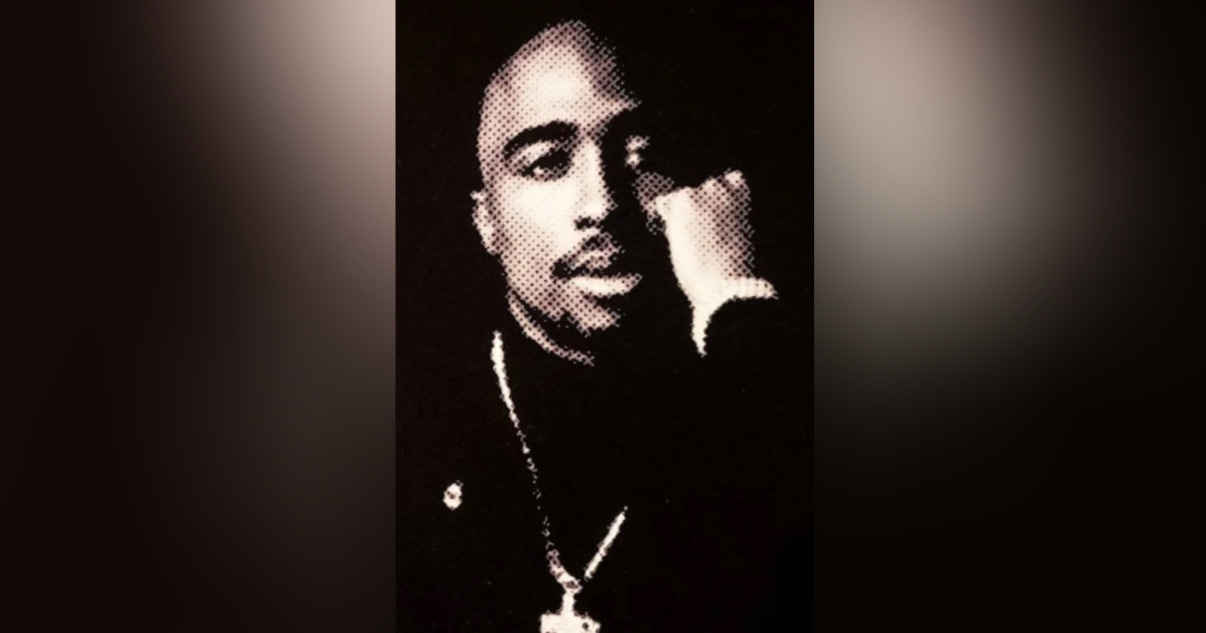
(August 31, 2026) — As I began writing this while visiting Las Vegas last week, a jury located just a few miles from me had yet to decide whether Duane “Keffe D” Davis is guilty of orchestrating the September 1996 murder of Tupac Shakur.
Now as closing arguments are being heard, it is expected that we may soon learn Davis’ fate. He may be convicted. He may be acquitted. The jury may not agree at all. Whatever the outcome, it will mark a pivotal moment in what has been hip-hop’s highest-profile murder mystery for three decades — rivaled only by that of his slain rival, Christopher Wallace, a/k/a The Notorious B.I.G.
But whatever happens in that courtroom, one verdict has already been rendered with the passage of time: the opportunity for anything resembling total justice in Tupac’s murder disappeared years ago.
As evidence, consider the fact that Tupac Shakur lived for 25 years. It has taken nearly 30 just to put someone on trial for ending his life. The reading of a verdict might actually coincide with the 30th anniversary of his shooting on September 7, 1996.
That fact alone sometimes makes the current proceedings feel less like justice and more like a retelling of historic events for Court TV audiences and fodder for adult podcasters, some of whom weren’t even alive then — with many key witnesses no longer alive now.
No Justice
For those who need a refresher, here are those events: Tupac was shot four times on the night of September 7, 1996, while riding in a BMW driven by Death Row Records head Suge Knight near the Las Vegas Strip. He died six days later, on September 13. Knight, whose head was grazed by a fifth bullet, survived. The shooting allegedly occurred as retaliation after Pac and his entourage beat up Davis’ nephew Orlando “Baby Lane” Anderson in front of the MGM hotel here following a Mike Tyson fight.
Tupac Was Murdered in a Totally Different World
To illustrate just how much time has passed and how different the world was then, consider that:
Tyson was still a world heavyweight champion at a time when many people could still name one. He regained the WBA title (to join his WBC title) after defeating Bruce Seldon that night.
Bill Clinton — the nation’s 42nd president — was still in his first term and two months away from being reelected (this was before most Americans had ever heard the name Monica Lewinsky).
Google didn’t yet exist. Neither did Facebook, YouTube, Twitter, Instagram or TikTok.
Most of us bought our music on compact discs. Streaming meant something that only water (or the fluid of your choice) did. Even peer-to-peer music file sharing — which would soon turn the record industry upside down — wasn’t a thing yet. Heck, saying something was a thing wasn’t even a thing.
“Macarena” — the Bayside Boys’ version — was the No. 1 song in America at a time when having the No. 1 song meant most Americans had likely heard it. This was just weeks after Pac’s lone No. 1 single — the double-sided “How Do U Want It” and “California Love” — topped the chart.
Cell phones existed but relatively few people carried them, and those who did mostly used them for the quaint purpose of actually calling someone. There were no smartphones recording our every movement through photos, videos, texts, apps and location data. There weren’t thousands of bystanders instinctively reaching for a camera whenever something like a drive-by happened.
And the Las Vegas Strip wasn’t blanketed by anything resembling today’s web of high-definition surveillance cameras.
That was the world in which Tupac Shakur was murdered.
Now imagine trying to reconstruct a few chaotic minutes from that world nearly 30 years later.
There are no forgotten iCloud accounts to search. No text-message threads to resurrect. No social-media posts geotagging the people involved. No collection of smartphone videos from witnesses standing nearby. Investigators and jurors instead must rely heavily on the decidedly more analog evidence that survived 1996 — things like paper hotel receipts documenting who was at the MGM, and VHS video footage of the physical attack on Davis’ nephew prosecutors say triggered it all — and on the memories of people who survived it.
Many Key Witnesses Didn’t Survive
Thirty years later, the man prosecutors say orchestrated the shooting is finally on trial.
But much of the cast of characters who could have helped establish what happened that night is no longer here.
The man long alleged to have actually fired the shots is deceased. So are the other occupants of the white Cadillac from which the shots were allegedly fired. The medical examiner who performed Tupac’s autopsy is dead.
And perhaps most poignantly, so is Tupac’s mother, Afeni Shakur, who died in 2016 after spending the final 20 years of her life without seeing anyone prosecuted for her son’s murder.
Those losses illustrate just part of the problem with trying a murder case three decades after the crime. Other issues are more fundamental to the trial itself.
Witnesses — those willing or who were forced to testify — are now being asked to remember conversations, movements, relationships and events that occurred in 1996. Think about what you were doing 30 years ago. Now imagine dozens of witnesses reportedly being asked under oath to recall precisely who said what, who stood where, who knew what and when they knew it — with another person’s freedom potentially depending upon your 30-year-old recollection. Many of us have trouble reconstructing events from even a fraction of that time.
Ironically, the one person in that courtroom who likely has the best recall about the events of September 7, 1996, is the one who’s done the most talking for two decades — the defendant himself.
And prosecutors who were proclaiming three years ago upon his arrest that justice was finally being delivered didn’t exactly have to drag the accused out of hiding.
For years, the former self-proclaimed Compton Kingpin Keffe D was right there in plain sight.
It is ironic that Davis embraced some of the very technology that didn’t exist when Shakur was murdered to give the prosecution much of the evidence it purportedly has against him now. Davis publicly discussed the events surrounding Tupac’s killing in interviews, podcasts and other media appearances. In 2019, he published a memoir, Compton Street Legend, in which he described his presence in the Cadillac and the events leading up to the shooting. If there was indeed a “street code” to abide by — one where silence means survival — Davis broke it many times over.

Unlike those true crime stories you see on TV, this case wasn’t suddenly cracked because of a miraculous DNA match, a newly discovered murder weapon or some long-hidden piece of physical evidence (that we know of). The man prosecutors now say orchestrated Tupac’s murder spent years publicly discussing the very events that ultimately helped put him on trial, presumably under the belief he had total immunity from self-incrimination.
Now Davis’ defense essentially argues that those incriminating statements were exaggerated, embellished… made for money and notoriety.
Which leaves a jury in 2026 with an extraordinary task: Decide whether to believe what Keffe D said about Keffe D years ago — or what Keffe D says about Keffe D now.
And decide it beyond a reasonable doubt.
This is why 30 years matters. How can testimony about events that old not carry some measure of uncertainty — particularly when so much of the contemporaneous evidence that might corroborate or contradict it no longer exists?
Evidence has likely disappeared if it was captured at all. It was revealed earlier during the trial that there was no official police report on the attack on Davis’ nephew that preceded the murder. The now-imprisoned Suge Knight — the only man in the car with Tupac — has refused to testify, although he continues to give “testimony” in the form of TMZ interviews. Instead of the medical examiner who actually examined the body, we get the opinions of “an expert” who has read the report decades later.
Justice doesn’t necessarily have an expiration date. But the ability to deliver it completely certainly has deteriorated with time.
But… Maybe Peace
And yet there is something undeniably significant about what is happening in Las Vegas as jurors now hear closing arguments.
For three decades, Tupac’s murder has occupied the strange center of a Venn diagram where criminal investigation, hip-hop history and American folklore overlap.
Since Day 1 there have been books, documentaries, and interviews. There’ve been accusations, conspiracy theories, finger-pointing, and enough speculation to fill thousands of hours of YouTube videos and podcasts. Countless rappers — including top names like Jay-Z and Eminem — have even made pointed references to the murder in their songs. Compton rapper The Game just last week claimed he’s known for more than a decade how it all went down.
But now, finally, storied versions of what happened in September 1996 are being subjected to something none of those other accounts ever faced:
A courtroom.
Twenty-seven witnesses were ultimately questioned — 24 called by prosecutors and three by the defense. Their claims were challenged. Evidence was scrutinized. The defense got to argue that Davis’ earlier stories were fiction from a man simply chasing clout. Prosecutors finally had a chance to prove to a jury of Davis’ peers that the only person still alive who was in the vehicle with the trigger man was the orchestrator of it all. Both parties are reiterating those cases in closing arguments as I publish this.
And twelve jurors will now get to decide whether that evidence establishes Davis’ guilt beyond a reasonable doubt.
The Case for Peace
Meanwhile, for Tupac’s surviving family members, perhaps there is some peace in gaining closure while the case was presented and tested publicly, regardless of the outcome.
Related: Some Tupac Shakur Family Members Step Out of Courtroom, Others Stay to Face Autopsy Photos
For hip-hop, perhaps there is peace in moving one of its two most infamous unsolved murders — Tupac in 1996 and The Notorious B.I.G. six months later — further from endless speculation and toward some official accountability.
Yet in death, virtually everything associated with Tupac has appreciated in value — his music, his image, his influence and, perhaps most of all, his place in American culture. His legacy has achieved a permanence that few artists, living or dead, ever attain.
Still there is something profoundly sad about the fact that Tupac Shakur has now spent more time as an icon than he ever had the chance to spend as a man. And that’s why whatever happens in this courtroom shouldn’t be confused with justice… a justice so boldly touted by Las Vegas authorities in that 2023 press briefing announcing Davis’ arrest. Three years later, Shakur’s surviving relatives have argued that justice may never come.
In the end, I side with them. No jury can return the 30 years that preceded its verdict.
No conviction can allow Afeni Shakur to see someone held accountable for her son’s death.
In the end if Davis, 63, is convicted, he will have lived more than two Tupac lifetimes as a free man since the night Shakur was killed. That’s what most of these last 30 years will have afforded him.
And because total justice won’t be found in that Las Vegas courtroom after all this time, maybe some semblance of peace will have to do.
May Tupac’s soul continue to rest in it.
DJRob
DJRob (he/him) is a freelance music blogger from the East Coast who covers R&B, hip-hop, disco, pop, rock and country genres – plus lots of music news and current stuff! You can follow him on Bluesky at @djrobblog.bsky.social, X (formerly Twitter) at @djrobblog, on Facebook or on Meta’s Threads.
You can also register for free by selecting the menu bars above to receive notifications of future articles.