


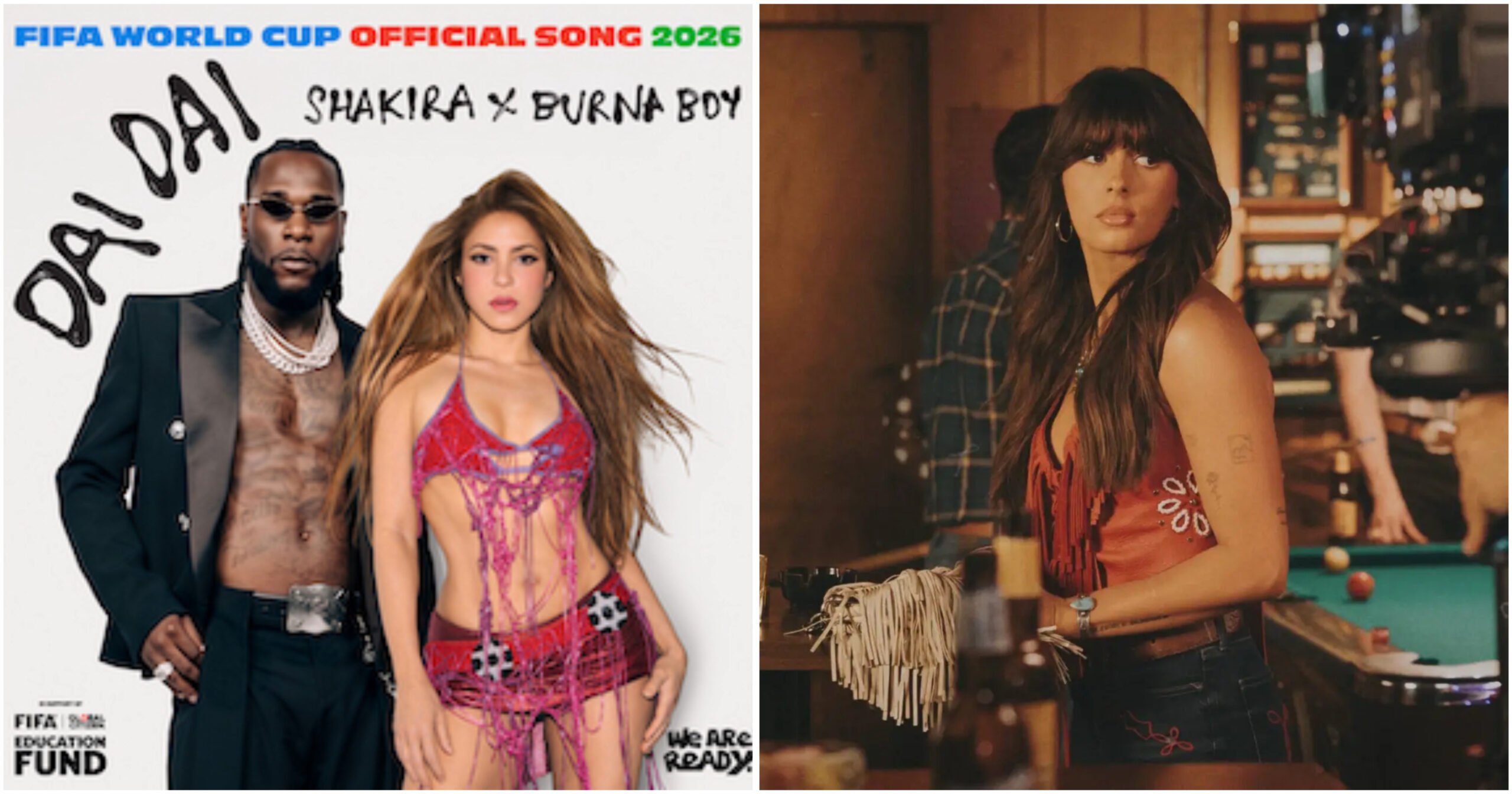
(July 22, 2026) – America may have played host to the World Cup and the global diversity that comes with it, but rarely has the difference between what the U.S. is listening to and what the rest of the world is embracing looked quite so stark. Country singer Ella Langley’s “Choosin’ Texas” is again the No. 1 song on the Billboard Hot 100, where it’s been tops on-and-off for the past nearly six months.
Meanwhile, the No. 1 song in the rest of the world – as measured by Billboard’s Global charts – is the FIFA World Cup theme song, “Dai Dai” by Shakira & Burna Boy. The pair performed the infectious tune at the opening ceremonies in Mexico several weeks ago and again during the World Cup final halftime show in East Rutherford, N.J. last Sunday (July 19).
The two songs’ performances are flipped on the opposite charts. In the U.S., “Dai Dai” is No. 42 on the chart dated July 25 (up from No. 55 the previous week), while “Choosin’ Texas” is at No. 50 on the Global Excluding U.S. chart, down from its No. 46 peak last frame. When factoring in U.S. performance, as Billboard does for its Global (including U.S.) chart, “Choosin’ Texas” sees a huge improvement to No. 3, accounting for the huge percentage of the global market owned by U.S. consumers.
Since 2020, Billboard has been measuring global performance using two charts – the Global 200 and the Global Excl. U.S. charts – which monitor streaming and sales in 90 countries (except the U.S. for the latter chart) to determine how songs are performing across the globe. It reflects performance not only in Europe, but in Latin America, Africa, Asia, Oceania and other parts of the world, potentially representing the tastes of billions of consumers. Despite America’s outsized influence on the Global 200, rarely is a song No. 1 on that chart without also being No. 1 on the Global Excl. U.S. list. To be No. 1 on either ranking essentially means having the biggest song in the world. To that end, “Dai Dai” is No. 1 on both charts this week.
The degree to which “Choosin’ Texas” and “Dai Dai” differ on the Hot 100 and Global Excl. U.S. chart illustrates an interesting gap between the songs’ U.S. reception and their international standing, a particularly noteworthy distinction given how much American music and culture has influenced other parts of the world in the past. That a country song like Langley’s is underperforming in global markets, however, isn’t so surprising when one considers that the genre is generally viewed as uniquely American. Langley doubles down on the notion by invoking American geography – the southern states of Texas and Tennessee – throughout the song’s lyrics, making it not merely a country song, but one whose identity is rooted in a specific corner of America.
“Dai Dai” on the other hand couldn’t be a better representation of the world’s diverse cultures. Shakira is Colombian, while Burna Boy represents Nigeria. The combination of Shakira’s high-energy, Latin-pop rhythms and Burna’s Afrobeats makes it a quintessential global collaboration. The song’s lyrics are themselves a multilingual call for global unity. The phrase “Dai Dai” is Italian for “come on, come on” or “go, go,” while other similar phrases are sung in English, Japanese, Spanish and French – all delivering a message of moving forward together.
The song also pays homage to football (i.e., soccer) culture – itself not as big here in the U.S. as it is internationally – with a roll call chant of past football legends and competing nations, befitting its status as the Cup’s 2026 official anthem. The World Cup itself is one of the few events that genuinely belongs to nearly every participating nation. Choosing a song that transcends borders was the most natural way that FIFA could celebrate this year. All of this makes the Cup anthem’s lackluster performance in this year’s host country even more astounding.
Billboard conducted a deep dive into “Dai Dai” and its international streaming — country by country — and found that, when adjusted for differences in population, the U.S. ranked 37th (among the 90 monitored countries) at 0.02 streams per person during the pre-Final tracking week. Norway, on the other hand, was No. 1 with 0.16 streams per person.
Billboard noted that Norway’s World Cup team remained competitive until its quarterfinals elimination against England on July 11 (reflected in this week’s charts). The remainder of the top ten markets for “Dai Dai,” in order, were Luxembourg, Netherlands, France, Spain, Switzerland, Belgium, Portugal, Sweden, and Germany. Of those ten markets, five of them were represented by teams that were still in the World Cup competition by the end of the July 9 tracking week, with four more eliminated that week or the week before.
Billboard also found that, while a country’s performance in the tournament didn’t necessarily correlate with where “Dai Dai” performed best, it was generally a factor. The song’s streaming totals have increased every week since its May 15th international release when it entered the Global 200 at No. 114. It moved to No. 1 as the tournament got underway and has continued to gain in international streaming.
Exceptions were in places like Nigeria, which didn’t qualify for this year’s World Cup but saw relatively high numbers from the beginning simply because of Burna Boy’s involvement. The U.S. streaming share is another anomaly. The American team advanced far into the tournament to the Round of 16 (eliminated July 6), yet still only ranked No. 37 in the per-person streaming numbers for “Dai Dai” among the countries monitored that week.
Given the record-high viewership of this year’s Cup final – an estimated 68.2 million people tuned in on Sunday across multiple platforms – it’s likely that “Dai Dai” will continue to move up, even in the U.S., following the historic halftime performance by Shakira and Burna Boy. But it’s interesting that, in a world where historically America drove musical culture, as it concerns the biggest song in the world today – one deliberately celebrating diversity and the game’s global reach – America would be the one catching up.
Assuming it does at all.
Or maybe we’ll just keep “Choosin’ Texas.”
DJRob
DJRob (he/him) is a freelance music blogger from the East Coast who covers R&B, hip-hop, disco, pop, rock and country genres – plus lots of music news and current stuff! You can follow him on Bluesky at @djrobblog.bsky.social, X (formerly Twitter) at @djrobblog, on Facebook or on Meta’s Threads.
You can also register for free by selecting the menu bars above to receive notifications of future articles.