


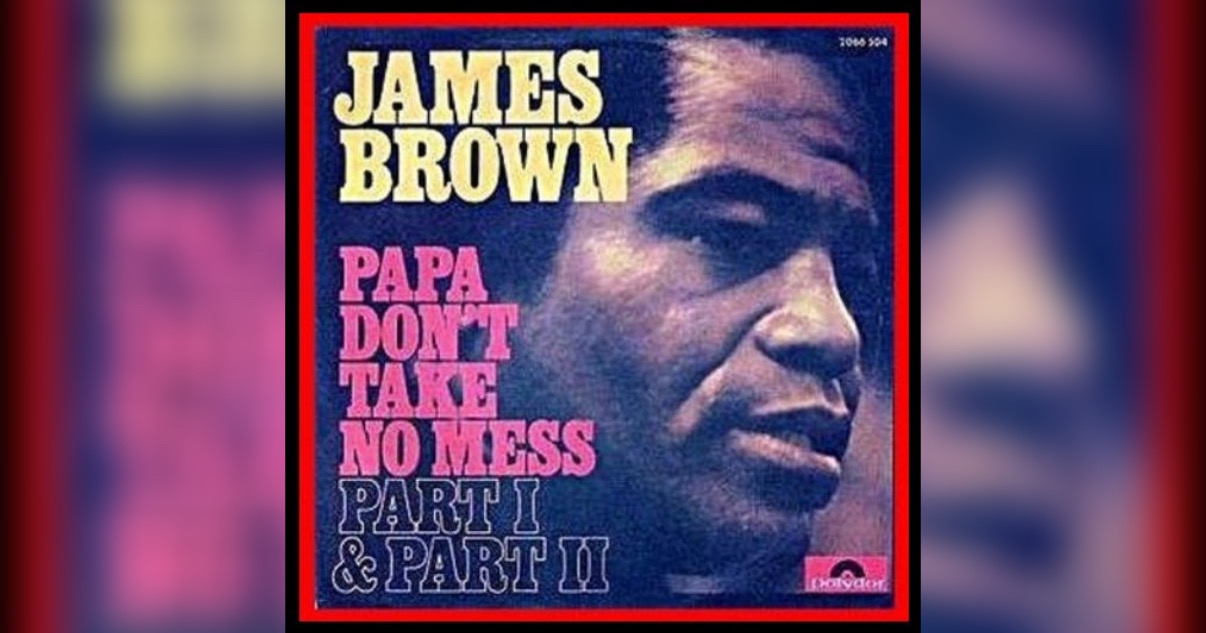
(June 21, 2026) – Long before television gave us Cliff Huxtable, and shortly after TV’s James Evans, Sr. became the iconic father of Norman Lear’s “Good Times,” James Brown delivered his own funk-laden portrait of a dad who commanded respect.
That picture came in 1974 with “Papa Don’t Take No Mess,” the sprawling, nearly 14-minute funk masterpiece that became the final No. 1 R&B/Hip-Hop hit of Brown’s extraordinary career. Though it is seldom mentioned alongside such classics as “Papa’s Got a Brand New Bag,” “I Got You (I Feel Good),” or “The Payback,” the song may be one of Brown’s most vivid pieces of storytelling – despite the fact that it’s title refrain is repeated far more times than any of the verses that describe its “Papa.”
The groove is deceptively simple. A relentless rhythm section locks into place while Brown speaks, shouts, testifies, and reminisces about a father figure who worked hard, demanded discipline, didn’t cuss, but also tolerated no foolishness. There are no elaborate chord changes, no sweeping orchestration, and no polished pop hooks. In other words, no nonsense… just like the father it so well describes.
Anyone who grew up in a Black household during the 1960s, ‘70s, or even the ‘80s likely recognize this man immediately. This man who might sip a little taste of gin, or who’d bet his last ten on game of skins, but one with a “heart of gold” who was, dare I say, in the home where we needed him.
As JB puts it in one verse, he once “saw Papa cry when he thought I would die.” Claiming something was “in his eye,” but JB knew that was a lie, finishing the verse with “loved his son!”
This was likely the father who left for work before sunrise and came home after dark. This was the father who didn’t believe every problem required a committee meeting, the father who didn’t hesitate to remind you who brought you into the world and how the rest of that line went.
Modern-day parents might wince at the notion, but within the context of 1974 America, which was integral to this blogger’s upbringing, Brown was describing a style of parenting that was common, accepted, and often viewed as necessary preparation for a world that was surely more unforgiving than he was. It’s not lost on me that “Mess” was from an album called Hell.
What makes this song so remarkable is that Brown never presents Papa as a villain (unlike a certain recent biopic that is now the highest grossing in its genre’s history). Quite the opposite. JB portrays him as a provider, protector, and moral compass… one “who will take a stand” and who will put a fight when he “knows he’s right.” The hard discipline is only one piece of a larger picture. Papa worked. Papa cared. Papa cried. Papa held the family together. Most importantly, Papa made sure his children understood the difference between right and wrong.
In that sense, “Papa Don’t Take No Mess” serves as an oral history of a generation… my generation. It captured the realities of countless Black families whose fathers navigated segregation, economic hardship, and limited opportunities while still managing to build stable homes and hopeful futures for us kids.
Interestingly, the song found new life nearly two decades later through a sample in Janet Jackson’s “That’s the Way Love Goes,” a fascinating eternal connection given Jackson’s own reported relationship with her father – one of the most discussed musical fathers in modern music history. Indeed, Joseph Jackson – as depicted in the Michael biopic – embodies some of the same traits described in “Papa Don’t Take No Mess.” And, despite the villainous depiction of Papa Joe in the movie, his strict parenting methods clearly helped shape the Jackson family’s legendary achievements while also becoming a source of controversy and pain.
Whether intentional or not, that sample created a bridge between the generation that grew up on the Jacksons – such as I had in the 1970s – and those who were being parented in the 1990s and beyond, resulting in very different conversations about fatherhood and discipline.
This Father’s Day, “Papa Don’t Take No Mess” deserves another listen – if you cannot withstand the 13:50 version I’ve binged on this morning while writing this, the much shorter single version will do. Beneath its hypnotic groove lies more than a funk jam. It is a tribute to a generation of fathers who weren’t always expressive, weren’t always gentle, and certainly weren’t perfect – but showed their love through sacrifice, protection, provision, and an unwavering determination to keep their families moving forward.
Continue to rest in power to James Brown and to the many dads of my growing up generation, including my own… who surely didn’t take no mess!
DJRob
Dedicated to my father, Charles A. Roberts (1933-2020).
DJRob (he/him) is a freelance music blogger from the East Coast who covers R&B, hip-hop, disco, pop, rock and country genres – plus lots of music news and current stuff! You can follow him on Bluesky at @djrobblog.bsky.social, X (formerly Twitter) at @djrobblog, on Facebook or on Meta’s Threads.
You can also register for free by selecting the menu bars above to receive notifications of future articles.
Amen, I can relate. What was once discipline, is now considered abuse. I am grateful for the discipline. I’ve seen so many kids get lost in this unforgiving world because discipline coupled with love and compassion was absent. And yes, my papa didn’t take no mess. Happy Father’s Day!
Thanks, ‘Lous… and same to you!