


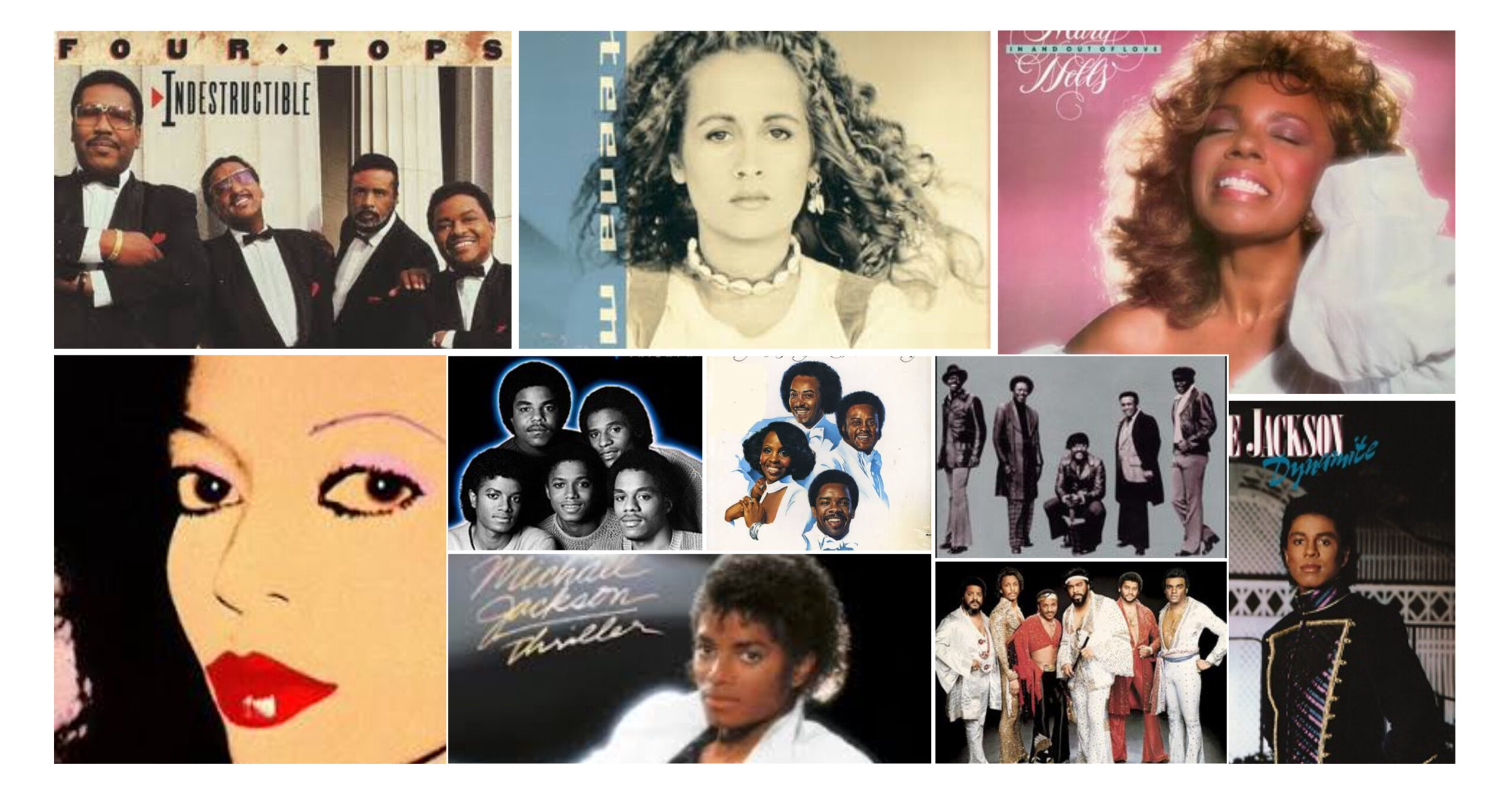
These 10 Motown Acts Fared the Best on the Hot 100 Charts After Leaving Hitsville, U.S.A..
(April 29, 2026) – Everyone knows which former Motown artist dominated the Billboard charts the most after leaving the label. That part isn’t a mystery.
But what about the rest of the leaderboard?
Who ranks second? Third? And which other Motown legends actually did better after walking away from the Motor City’s most famous record company?
While some acts essentially remained with Motown Records for their entire chart careers—like The Temptations, The Supremes, the Miracles, and Stevie Wonder—others took their talents elsewhere… and in some cases, took their success to another level.
DJROBBLOG has done the math and compiled the ten acts who were once with Berry Gordy’s label and then went on to have the most success after departing. We ranked these famed musicians in order of their chart performance after moving onto such labels as Epic, T-Neck, Buddah, RCA, and Arista.
Using a system that assigned points to every one of their Hot 100 hits in an inverted fashion based on peak position (100 points for No. 1, 99 points for No. 2… down to one point for No. 100) and then assigning bonus points for weeks at No. 1, these are the ten Motown acts that scored the biggest success after leaving the label.
Keep reading to see where legends like the Jackson 5, Gladys Knight & the Pips, and Diana Ross rank in terms of their chart success after leaving one of music’s most hallowed institutions.
(Notable misses: Marvin Gaye, Rick James, the Commodores, Rare Earth, and Boyz II Men—those acts all left Motown but didn’t have enough success with other labels to register in the below top ten.)
Rank. Artist
10. Teena Marie

Post-Motown chart points: 168
Total with Motown included: 283
post-Motown contribution to total: 59.4%
Teena Marie began her career as a protégé of label mate and one-time lover Rick James but, unlike the late Punk-Funk legend, moved on after just five years with Motown. Most diehard fans will remember Marie as the Queen of Ivory Soul after scoring big R&B chart hits with classics like “Square Biz,” “I’m A Sucker for Your Love,” and “I Need Your Lovin’.” But it wasn’t until after signing with Epic Records that she scored her first top 10 pop hit with 1984’s “Lovergirl.” Marie also scored her first No. 1 R&B hit with “Ooh La La La” in 1989, also on Epic. She died of natural causes in December 2010.
9. Mary Wells

Post-Motown chart points: 311
Total with Motown included: 1227
post-Motown contribution to total: 25.3%
When Mary Wells’ “My Guy” went to No. 1 in 1964, it became only the second song by a Black solo female to top the Hot 100 (after Little Eva’s “The Loco-Motion” two years earlier). Wells became known as the “Queen of Motown” years before Diana Ross assumed the crown. As the label’s first true superstar, her 1964 departure—right as “My Guy” hit No. 1—remains one of Motown’s most abrupt exits.
Despite later moves to multiple labels, including 20th Century Records and then to Atco, Reprise and Epic, she never matched her earlier dominance, making her post-Motown output more notable for its historical context than its chart impact. She later sued the label for back payments of royalties and reached a six-figure settlement. She died of throat cancer in 1992.
8. Jermaine Jackson

Post-Motown chart points: 430
Total with Motown included: 979
post-Motown contribution to total: 43.9%
Jermaine Jackson spent more time with Motown than any of his brothers. He famously remained with former father-in-law Berry Gordy’s label in late 1975 when his brothers split to go to Epic. Jermaine eventually left Motown for Arista, where he extended his solo success with hits like “Do What You Do,” “Dynamite,” and the R&B No. 1 “Don’t Take It Personal.”
While often overshadowed by his younger brother’s superstardom, Jermaine carved out a respectable second act that nearly doubled his Motown footprint. He was most recently credited as co-executive producer of the highly successful biopic Michael about the late King of Pop.
7. Four Tops

Post-Motown chart points: 762
Total with Motown included: 2848
post-Motown contribution to total: 26.8%
The Four Tops were the most enduring act to come out of Motown with all four of its original members remaining with the group from the beginning until Lawrence Payton’s passing in 1997. But The Tops’ on-and-off relationship with Motown had already splintered by then, with the group having signed with ABC/Dunhill in 1972 and with Casablanca and Arista after that. With ABC, Payton, lead singer Levi Stubbs, Abdul “Duke” Fakir, and Renaldo “Obie” Benson scored with classics like “Ain’t No Woman (Like the One I’ve Got)” and “Keeper of the Castle.” They recorded their last No. 1 soul hit, “When She Was My Girl,” in 1981 on Casablanca. All four of the original members are deceased but the group’s legacy continues with replacement members as a touring act.
6. Diana Ross

Post-Motown chart points: 810
Total with Motown included: 2972
post-Motown contribution to total: 27.3%
Diana Ross’ former group, The Supremes, never left Motown before their breakup in 1977. But their former leader left for RCA Records after signing a then-record deal in 1981. By then, Ross had scored six No. 1 hits as a solo artist for Motown and was the most successful female artist in chart history. The hits continued with RCA, including songs like “Why Do Fools Fall in Love,” “Mirror Mirror,” “Muscles,” “Swept Away,” and “Missing You.”
She would eventually return to Motown—a move that marked a shift from chart dominance to legacy building—as newer superstars like Madonna, Janet Jackson, and Whitney Houston began redefining pop’s hierarchy. Ross, 82, still tours today.
5. Jackson 5/Jacksons

Post-Motown chart points: 838
Total with Motown included: 2399
post-Motown contribution to total: 34.9%
When the Jackson 5 joined Epic Records in 1975, youngest brother Randy replaced Jermaine and co-wrote some of the group’s most memorable post-Motown hits, including “Shake Your Body (Down to the Ground),” “Lovely One,” “Walk Right Now,” “Destiny,” and “2300 Jackson St.” But their Motown run—featuring one of the most explosive debuts in chart history—remains the foundation of their legacy, beginning with six songs that reached either No. 1 or No. 2 on both the pop and soul charts. They’d score many more hits with Motown before pursuing more financial and creative control with Epic.
4. Gladys Knight & the Pips

Post-Motown chart points: 1119
Total with Motown included: 2353
post-Motown contribution to total: 47.6%
Gladys Knight & the Pips remains the first — and likely only — recording act to score No. 1 songs on the Billboard R&B/Hip-Hop Songs chart with six different record labels. One of those was Motown — under the “Soul” imprint. Their No. 1 hits included the first of three versions of “I Heard it Through the Grapevine” to top the soul chart (the only song in history to do that). But it was their decision to join Buddah Records in 1973 that landed them their only pop No. 1, “Midnight Train to Georgia,” and a bunch of big hits that followed. They’re also the act with the most even split of chart success while with Motown and after leaving the label, with nearly 48 percent of their chart points coming after their departure.
3. The Spinners

Post-Motown chart points: 1512
Total with Motown included: 1687
post-Motown contribution to total: 89.6%
The Spinners, in a nod to the Motor City, released songs as The Detroit Spinners in the U.K. to avoid trademark infringement with a British group who already owned the name. Back at home, with no such restrictions, they scored a few hits for their hometown label, like the Stevie Wonder-penned “It’s a Shame,” before moving to Atlantic Records and having their biggest success under the creative arm of songwriter/producer Thom Bell.
It was there they forged a Rock-and-Roll Hall of Fame career with songs like “I’ll Be Around,” “Could It Be I’m Falling in Love,” “Mighty Love,” “Then Came You,” “Games People Play,” “The Rubberband Man,” and (after parting ways with Bell) “Working My Way Back to You”/“Forgive Me Girl” and “Cupid/I’ve Loved You for a Long Time.” All of the group’s original members have deceased.
2. The Isley Brothers

Post-Motown chart points: 1633
Total with Motown included: 1805
post-Motown contribution to total: 90.5%
The Isleys, led by Ronald and featuring four of his brothers and one brother-in-law — the late Chris Jasper — had major success on their own label, T-Neck Records (named for their town of Teaneck, NJ), beginning in the late 1960s. But the group — then just a trio — had a brief stint with Motown in the mid-60s, scoring with hits like “This Old Heart of Mine.” They also had some success before joining Motown, including with early rock-and-roll classics like “Shout” and “Twist and Shout,” which the Beatles famously covered in 1964.
Ron and little brother Ernie — now the sole surviving members — continued charting into the new millennium and still tour today. But it was their phenomenal T-Neck success, including a slew of hit singles, plus gold and platinum albums nearly every year between 1973-83, that places them at No. 2 on this list and gives them the highest non-Motown contribution to their success, percentage wise.
1. Michael Jackson

Post-Motown chart points: 3668
Total with Motown included: 4287
post-Motown contribution to total: 85.6%
Was there ever any doubt who’d be Number One? The King of Pop’s 1980s output alone would have catapulted him to the top of this list. Michael Jackson has more than double the post-Motown success of the runner-up Isley Brothers (and that’s just accounting for singles chart positions).
For perhaps the first time since his untimely passing from a drug overdose in 2009, MJ has been the most buzzed-about artist on the planet this week—thanks to the phenomenal success of his biopic, which smashed opening-week box office records by earning $97 million in the U.S. ($217m worldwide). While the film’s first act focused on his rise to fame as part of the Jackson 5, the remainder was spent on his post-Motown solo career, which saw him achieve unprecedented commercial success and worldwide fame. It’s that chapter that makes him the most successful ex-Motown artist, not to mention one of the most important entertainers of all time!
In the end, leaving Motown wasn’t just a business decision—it was a gamble. For some, it meant chasing creative control. For others, it was about ownership, money, or simply survival in an evolving industry.
But as this list shows, the artists who benefited most weren’t just the ones who left—they were the ones who reinvented themselves and, in one conspicuous case, reshaped the industry altogether.
Whether it was Michael Jackson redefining global superstardom, The Isley Brothers building a self-sustained empire, or The Spinners finding their signature sound elsewhere, these acts proved that Hitsville, U.S.A. may have launched their careers…
…but it didn’t define their ceilings.
DJRob
DJRob (he/him) is a freelance music blogger from the East Coast who covers R&B, hip-hop, disco, pop, rock and country genres – plus lots of music news and current stuff! You can follow him on Bluesky at @djrobblog.bsky.social, X (formerly Twitter) at @djrobblog, on Facebook or on Meta’s Threads.
You can also register for free by selecting the menu bars above to receive notifications of future articles.
So much nostalgia, love it! Did Motown ever have negative info or horror stories like The Five Heartbeat’s Big Red Records? 🤣