


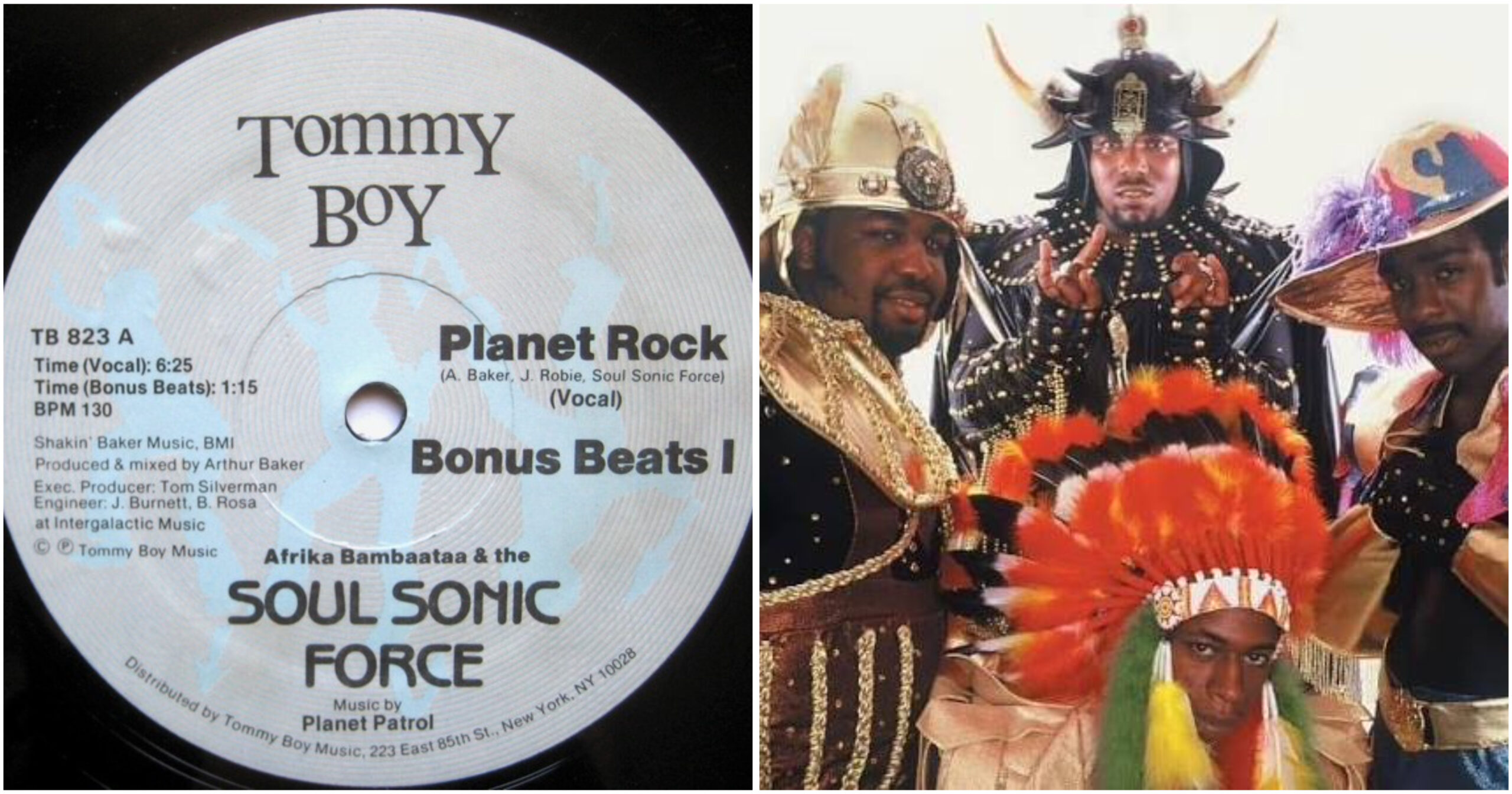
(April 10, 2026) – Afrika Bambaataa, 68, died Thursday, April 9, after a battle with prostate cancer—just days before his 69th birthday on April 17. His death immediately took me back 44 years to one of music’s greatest summers and his important role in it.
Bambaataa was considered a pioneer in hip-hop history, founding the Afrocentric group Universal Zulu Nation—an organization built to promote knowledge, wisdom, understanding, freedom, justice, equality, peace, unity, love, and respect, all while elevating the four pillars of hip-hop culture: rapping, DJing, breakdancing, and graffiti.
Many artists are said to have passed through the Zulu Nation’s orbit, including A Tribe Called Quest, Kurtis Blow, Run-DMC, and Ice-T. But it was Bambaataa—born Lance Taylor in 1957 in New York City—whose name became synonymous with the movement. And it was his groundbreaking 1982 hit that introduced both him and the Zulu Nation to the masses: “Planet Rock.”

“Planet Rock” – More Than a Hip-Hop Song.
“Planet Rock” was rap’s “One Nation Under a Groove”—a call to unity through music and dance that no prior rap record had delivered so completely. While earlier hits by the Sugar Hill Gang, Grandmaster Flash & the Furious Five, and Kurtis Blow leaned into storytelling, boasting, or battle rhymes, “Planet Rock” was an open invitation:
“Rock, rock to the Planet Rock, don’t stop!”
Simultaneously, it was a respectful nod to Mother Earth—a show of respect for the rock we all live on long before Earth Day had reached hip-hop consciousness.
It was even a disco throwback, invoking the word itself in its nostalgic second verse (“we know a place where the nights are hot…”).
And it was, at its core, a celebration—an invitation to connect, “hump and bump,” and “chase your dreams” while you were at it.
Yes, it was 1982’s funkiest jam—but it was also something more profound.
“Planet Rock” blended genres like no hip-hop song before it, fusing the European techno-pop of Kraftwerk’s “Trans-Europe Express” and “Numbers” (and even their “Computer World 2”) with soul, disco, and funk. In doing so, it helped pioneer the electro-funk hybrid—arguably the first distinctly new Black music sound of the post-disco early ’80s.
Its Roland TR-808-driven beat became foundational—not just for hip-hop, but for the freestyle dance movement later in the decade. Its DNA surfaced in tracks like Planet Patrol’s “Play at Your Own Risk” and “Cheap Thrills,” while its futuristic aesthetic carried through Bambaataa’s own follow-ups (“Looking for the Perfect Beat,” “Renegades of Funk”) and other early-’80s electro classics like Grandmaster Flash’s “Scorpio,” Jonzun Crew’s “Packjam,” and Newcleus’ “Jam on It.”
One of Hip-Hop’s First Ten Hits
At a time when rap was still in its infancy—just its third full year of commercial viability—“Planet Rock” was only the eighth rap song to reach the Billboard Hot 100 (and the sixth true hip-hop entry, excluding novelty or one-off outliers by the Afternoon Delights and Blondie).
For perspective, roughly 2,000 rap songs have charted on the Hot 100 since.
Yet in 1982, it stood tall as the year’s biggest hip-hop hit—one of only three to make the chart, alongside Grandmaster Flash’s “The Message” and Sugar Hill Gang’s “Apache.” “Planet Rock” peaked at No. 48 (Sept. 11), while the others didn’t crack the Top 50. It also tied “The Message” for the highest R&B/Hip-Hop chart peak of the year (No. 4).
Related: Hip-Hop’s First 50 Songs to Reach the Hot 100
Planet Rock Owned Dance Floors in 1982; “Go House!”
Released just before the summer between my sophomore and junior years of high school, “Planet Rock” in its full six-and-a-half-minute length was inescapable—blasting from Black radio and dominating teen club dances in my hometown in central Virginia, and abroad. No other 12” single packed the dance floor the same way (a fact underscored by its No. 3 peak on Billboard’s disco chart). When Soul Sonic Force’s main lyricist G-L-O-B-E made references to “go house” in the fourth verse, one wouldn’t be faulted, in retrospect, for believing it might be a nod—or at least an early blueprint—for house music itself. (The song interpolated the line “rock, rock to the Planet Rock, don’t stop” liberally from earlier dance classic “Body Music” by the Strikers.)
Often Disrespected: Bambaataa and Electro-Funk were Excluded From #HipHop50 Tributes
Though Bambaataa was a pioneering DJ, he wasn’t the technical producer behind “Planet Rock”—that role belonged to Arthur Baker. Nor did he write the song, which was credited to Baker, John Robie, and the members of Soul Sonic Force.
But Bambaataa’s role was no less critical.
As he described it, he served as a “co-producer”—curating the sonic influences, suggesting source material, and assembling the creative minds who would bring the track to life. In today’s terms, he was the visionary.
After “Planet Rock,” Bambaataa never returned to the Hot 100, but he continued to make an impact on the R&B/Hip-Hop chart with Soul Sonic Force and others, including “Looking for the Perfect Beat,” “Renegades of Funk,” “Unity” (with James Brown), and “Bambaataa’s Theme.”
He also appeared in the early hip-hop film Beat Street, alongside pioneers like DJ Kool Herc, Grandmaster Melle Mel, and Doug E. Fresh.
Doomed by Controversy
In later years, however, Bambaataa’s legacy became complicated.
Multiple allegations of child molestation emerged in the 21st century tied to his time as a youth leader in the Zulu Nation. While he denied the claims, he lost a civil trial in May 2025 related to alleged abuse from the 1990s. The Zulu Nation had already formally distanced itself from him in 2016, issuing apologies to alleged victims.
He was never criminally convicted.
Still, it is a difficult and sobering late chapter for a man whose name was once synonymous with unity, culture, and one of the most transformative records in hip-hop history.
For many younger fans who’ve lived hip-hop and electro-pop all their lives, the impact of “Planet Rock” may be hard to fully grasp.
But for those of us who lived it?
When we heard “you gotta rock it, don’t stop… keep tickin’ and tockin’, work it all around the clock…”
—we did exactly that… all night long. Or at least as late as we could back then.
Rest in peace, Afrika Bambaataa.
And for readers facing challenges beyond the music—whether it’s abuse, health or personal trauma—take care of yourselves. Speak up, get screened, and, most importantly, get help.
DJRob
DJRob (he/him) is a freelance music blogger from the East Coast who covers R&B, hip-hop, disco, pop, rock and country genres – plus lots of music news and current stuff! You can follow him on Bluesky at @djrobblog.bsky.social, X (formerly Twitter) at @djrobblog, on Facebook or on Meta’s Threads.
You can also register for free by selecting the menu bars above to receive notifications of future articles.