


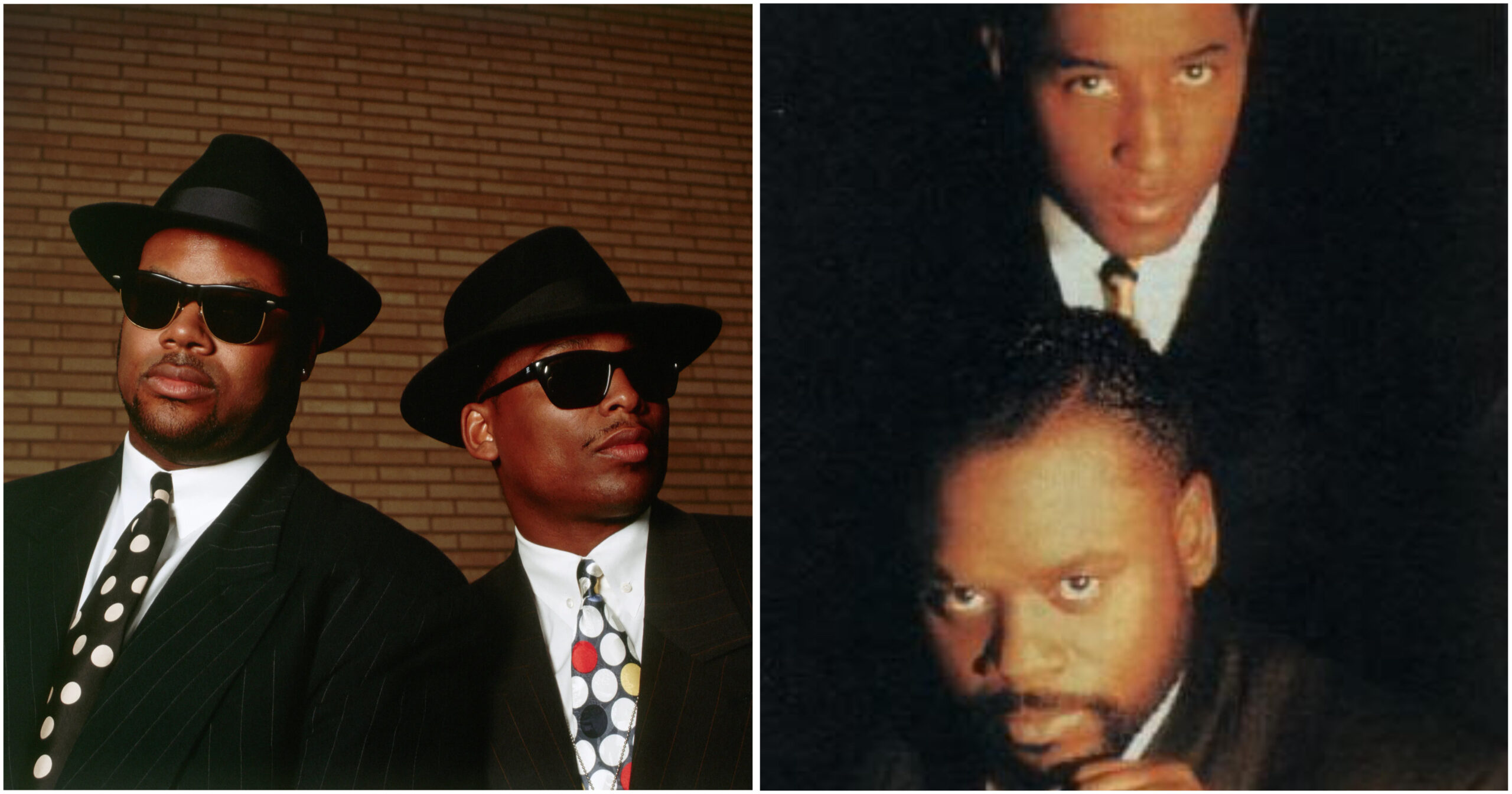
(February 27, 2026) – In the mid-1980s, as hip-hop surged into its golden age and New Jack Swing began reshaping radio, two songwriting and production teams emerged as the defining architects of modern R&B.
In Minneapolis, former members of The Time — Jimmy Jam and Terry Lewis — were crafting sleek, synth-driven soundscapes built on melodic precision and rhythmic sophistication.
In Los Angeles, Antonio “L.A.” Reid and Kenneth “Babyface” Edmonds were creating something warmer, more intimate — melding drum-machine urgency with gospel-rooted melody and romantic storytelling.
They weren’t enemies. They were competitors in the purest sense: each duo unwittingly pushing the other to new creative and commercial heights.
Between 1984 and 2006, the two partnerships — sometimes with the assistance of others — combined to produce 48 No. 1 hits on Billboard’s Hot R&B/Hip-Hop Songs chart, shaping the sound of artists ranging from Janet Jackson and Usher to Whitney Houston and Boyz II Men. What’s more, this No. 1 tally was nearly split even, with Jam & Lewis securing 25 No. 1 R&B hits while L.A. & Face produced 23. And get this: if Toni Braxton’s record label execs had followed conventional wisdom and released her No. 1 R&B radio hit, “Seven Whole Days,” as a commercially available single in 1993, it too might have topped the R&B/Hip-Hop Songs chart, giving Reid and Edmonds a 24th No. 1 joint hit. Those label execs, by the way? Well, they were none other than Reid and Edmonds themselves who founded LaFace Records to which Braxton was signed at the time.
Indeed, the Jam & Lewis vs. L.A. and Face chart rivalry was one for the ages — playing out on cassette decks, radio rotations, and Billboard charts — not in wars of words on the internet or anywhere else.
And for over two decades, R&B listeners were the winners!
Jam & Lewis Strike First: The Minneapolis Blueprint (1984-1986)
Jimmy Jam and Terry Lewis fired the opening shots. After scoring a No. 2 R&B smash with the S.O.S. Band’s “Just Be Good To Me” — produced in recording sessions that resulted in Prince infamously firing them from The Time in 1983 — Jam & Lewis earned their first No. 1 in 1984 with Cheryl Lynn’s “Encore,” introducing a futuristic R&B sound that blended a programmed funk groove with emerging synth-based production.
Their true breakthrough came two years later with Janet Jackson’s Control era in 1986, which redefined female autonomy in pop and R&B. That album yielded five No. 1 R&B chart singles — with the lone exception being the No. 1 pop hit “When I Think of You,” the first for Jam & Lewis and Jackson.
By 1987, The Time’s ex-pats had created a sonic blueprint others would either seek or follow.
Reid & Babyface Answer Back: The New Jack Swing Explosion (1987-1992)
With hip-hop’s golden age in full tilt and New Jack Swing dominating the airwaves, L.A. Reid & Babyface — fresh out of the group they co-founded, The Deele — began stacking No. 1 hits at a staggering pace as a production tandem.
From early 1987 — when they returned The Whispers to No. 1 with “Rock Steady” — through late 1992, when Bobby Brown’s “Humpin’ Around” topped the chart, L.A. & Babyface produced an astonishing 23 No. 1 R&B singles for 13 different artists.
Their sound was distinct — longer synth chords, less reliance on syncopated drum programming than Jam & Lewis, and a unique song structure that almost always included a pre-chorus to setup the ultimate hook. And they had a gift for transforming young artists into superstars, building big song catalogs for Bobby Brown, TLC, After 7, Johnny Gill, Karyn White, and Boyz II Men — among others.
During the Reid/Edmonds six-year hot streak, rivals Jam & Lewis produced 15 No. 1 hits—an extraordinary total that still left them briefly trailing their West Coast rivals.
The rivalry had officially begun.
Precision vs. Passion: Two Different Blueprints for R&B Dominance
What made the rivalry between Jimmy Jam & Terry Lewis and L.A. Reid & Babyface so compelling wasn’t just the volume of hits — it was how differently those hits sounded.
Jam & Lewis approached production like architects. Emerging from Prince’s Minneapolis orbit, they favored sleek synthesizer textures, disciplined drum programming, and carefully layered arrangements that allowed space and rhythm to do as much storytelling as the lyrics themselves. Their productions for Janet Jackson — particularly Control and Rhythm Nation 1814 — felt mechanical and human at the same time: emotionally restrained on the surface, yet pulsing with urgency underneath.
Even their grand ballads, like New Edition’s “Can You Stand the Rain?” and Janet’s “I Get Lonely,” conveyed heartbreak through atmosphere as much as vocal performance.
Reid & Babyface, by contrast, built their records around emotional immediacy. Babyface’s gospel roots shaped chord progressions that felt warm, intimate, and deeply personal, while Reid’s rhythmic instincts ensured the tracks never lost their groove. Their productions didn’t hover around the singer — they embraced them.
Whether it was Bobby Brown’s kinetic swagger on “Every Little Step,” Karyn White’s vulnerability on “Superwoman,” or Boyz II Men’s aching devotion on “End of the Road,” their records placed the voice — and the feeling — squarely at center stage.
If Jam & Lewis perfected the sound of emotional control, Reid & Babyface perfected emotional release.
Together, they gave late-20th-century R&B its full emotional spectrum.
After the Split: Babyface Carries the Torch While Jam & Lewis Endure
By 1993, just as their dominance reached its peak, the Reid & Babyface partnership quietly came to an end. Reid shifted his focus toward executive leadership — first at LaFace Records and later at Arista — where he would help guide the careers of artists like TLC, Usher, and OutKast from the boardroom rather than behind the mixing console.
Babyface, however, never left the studio.
If anything, his influence deepened. Between 1993 and 2000, he produced or co-produced nine additional No. 1 R&B hits, many of them defining ballads of the decade. Tevin Campbell’s “Can We Talk” introduced one of the era’s most enduring slow jams, while Boyz II Men’s “I’ll Make Love to You” and Whitney Houston’s “Exhale (Shoop Shoop)” became cultural touchstones that transcended the R&B chart and dominated the Hot 100 as well. His productions during this period slowed the tempo of mainstream R&B, ushering in an era where vulnerability — not swagger — still reigned as the genre’s dominant emotional currency.
Meanwhile, Jam & Lewis proved equally adaptable. Rather than being confined to their 1980s and early ’90s peak, they extended their relevance into the next generation, producing Janet Jackson’s Velvet Rope and All for You albums, Mariah Carey’s “Thank God I Found You” (with boy band 98 Degrees), and Usher’s turn-of-the-century hits like “U Remind Me.” Nearly two decades after their first No. 1, the boys from Minneapolis were still shaping the sound of contemporary radio.
By the early 2000s, the rivalry was less about direct competition and more about parallel legacies — two production dynasties whose fingerprints remained on nearly every major R&B star of the era. Their combined totals of 56 No. 1 R&B smashes (including Babyface’s nine apart from Reid), plus dozens more near-misses in the top five, were unequaled by any other two production tandems combined.
DJROBBLOG is celebrating their legacies during Black History Month by recapping all of their No. 1 R&B/Hip-Hop chart productions from Cheryl Lynn’s “Encore” to Jackson’s “Call on Me” (with Nelly). Below are those lists: first songs produced by Jam & Lewis, then Reid & Face, in chronological order. Note: Daryl Simmons was a regular collaborator on the songs by Reid and Edmonds. Given his regular partnership with them, those songs are duly noted.
Also, these lists are for production credits only. Songs written by the two tandems but produced by someone else (like Jam & Lewis’ “Jerk Out” by The Time, produced by Prince; or Babyface’s “Sweet November” by Troop, produced by Steve Russell) are not included. And finally, No. 1 Hot 100 songs that did not top the R&B/Hip-Hop Songs chart (like Human League’s “Human”; Janet’s “When I Think of You,” Boyz II Men’s “On Bended Knee,” or Madonna’s “Take a Bow”) are also not listed here. This is a pure R&B/Hip-Hop No. 1 history moment.
Jimmy Jam & Terry Lewis:
🎵1. “Encore” – Cheryl Lynn (1984)
🎧2. “What Have You Done for Me Lately” – Janet Jackson (1986)
🎶3. “Nasty” – Janet Jackson (1986)
🎼4. “Control” – Janet Jackson (1987)
🎤5. “Let’s Wait Awhile” – Janet Jackson (1987)
🥁6. “Diamonds” – Herb Alpert ft. Janet Jackson (1987)
🎹7. “Fake” – Alexander O’Neal (1987)
🎺8. “Fishnet” – Morris Day (1988)
🪇9. “Everything I Miss at Home” – Cherrelle (1988)
🪘10. “Can You Stand the Rain?” – New Edition (1989)
🪇11. “Miss You Much” – Janet Jackson (1989)
🎼12. “Rhythm Nation” – Janet Jackson (1990)
🎸13. “Escapade” – Janet Jackson (1990)
🪕14. “Rub You the Right Way” – Johnny Gill (1990)
🎧15. “Sensitivity” – Ralph Tresvant (1990)
🎷16. “Wrap My Body Tight” – Johnny Gill (1991)
17. “Romantic” – Karyn White (1991)
🎵18. “The Best Things in Life Are Free” – Luther Vandross & Janet Jackson w/ BBD and Ralph Tresvant (1992)
🎺19. “That’s the Way Love Goes” – Janet Jackson (1993)
🎼20. “Any Time, Any Place” – Janet Jackson (1994)
🎶21. “I Get Lonely” – Janet Jackson (1998)
🎤22. “Thank God I Found You” – Mariah Carey ft. Joe & 98 Degrees (2000)
🎼23. “All for You” – Janet Jackson (2001)
🎶24. “U Remind Me” – Usher (2001)
🎹25. “Call on Me” – Janet Jackson & Nelly (2006)

L.A. Reid & Babyface (songs on which Daryl Simmons was given co-production credited are denoted by *):
🎵1. “Rock Steady” – The Whispers (1987)
🎼2. “Girlfriend” – Pebbles (1988)
🎺3. “Roses are Red” – Mac Band (1988)
🎤4. “Don’t Be Cruel” – Bobby Brown (1988)
🎶5. “The Way You Love Me” – Karyn White (1988)
🎹6. “Dial My Heart” – The Boys (1988)
🪕7. “Superwoman”* – Karyn White (1989)
🎸8. “Lucky Charm” – The Boys (1989)
🎧9. “Every Little Step” – Bobby Brown (1989)
🎼10. “Love Saw It” – Karyn White (w/ Babyface) (1989)
🎺11. “On Our Own” – Bobby Brown (1989)
🎶12. “It’s No Crime” – Babyface (1989)
🎹13. “Tender Lover” – Babyface (1989)
🪕14. “Ready or Not” – After 7 (1990)
🎷15. “My, My, My” – Johnny Gill (1990)
🎧16. “Can’t Stop” – After 7 (1990)
🎵17. “Giving You the Benefit” – Pebbles (1990)
🎤18. “I’m Your Baby Tonight” – Whitney Houston (1990)
🎹19. “Love Makes Things Happen” – Pebbles & Babyface (1991)
🎼20. “Exclusivity” – Damien Dame (1991)
🪇21. “Baby-Baby-Baby”* – TLC (1992)
🎵22. “End of the Road” – Boyz II Men (1992)
23. “Humpin’ Around”* – Bobby Brown (1992)

Babyface (Post-Reid):
🎤1. “Can We Talk” – Tevin Campbell (1993); produced with Daryl Simmons
🎼2. “Seven Whole Days” – Toni Braxton (1994; No. 1 Airplay only); produced with L.A. Reid & Daryl Simmons
🎶3. “I’ll Make Love to You” – Boyz II Men (1994)
🎵4. “Exhale (Shoop Shoop) – Whitney Houston (1995)
🎧5. “Not Gon’ Cry” – Mary J. Blige (1996)
🎺6. “You’re Makin’ Me High” – Toni Braxton (1996); produced with Bryce Wilson of Groove Theory
🪕7. “Last Night” – Az Yet (1996); produced with Mervyn Warren of Take 6
8. “A Song for Mama” – Boyz II Men (1997)
🎶9. “Never Gonna Let You Go” – Faith Evans (1999); produced with Damon Thomas

The Near-Misses
And for those wondering, there were some notable near-misses — songs that peaked at No. 2 on the R&B/Hip-Hop Songs chart by both tandems. Here they are:
- “Just Be Good to Me” – S.O.S. Band (Jam & Lewis)
- “Saturday Love” – Cherrelle ft. Alexander O’Neal (Jam & Lewis)
- “The Finest” – S.O.S. Band (Jam & Lewis)
- “Never Knew Love Like This” – Alexander O’Neal ft. Cherrelle (Jam & Lewis)
- “If It Isn’t Love” – New Edition (Jam & Lewis)
- “Roni” – Bobby Brown (L.A. Reid & Babyface)
- “Whip Appeal” – Babyface (L.A. Reid & Babyface)
- “Alright” – Janet Jackson (Jam & Lewis)
- “Come Back to Me” – Janet Jackson (Jam & Lewis)
- “Fairweather Friend” – Johnny Gill (L.A. Reid & Babyface)
- “Do What I Gotta Do” – Ralph Tresvant (Jam & Lewis)
- “I’m Ready” – Tevin Campbell (Babyface; Daryl Simmons)
- “On Bended Knee” – Boyz II Men (Jam & Lewis)
- “Scream” – Michael Jackson & Janet Jackson (Jam & Lewis)
- “Sittin’ Up in My Room” – Brandy (Babyface)
- “Love Is All We Need” – Mary J. Blige (Jam & Lewis)
- “We’re Not Making Love No More” – Dru Hill (Babyface; Daryl Simmons)
- “4 Seasons of Loneliness” – Boyz II Men (Jam & Lewis)
- “Chante’s Got a Man” – Chante Moore (Jam & Lewis, with Big Jim)
Long before the rise of producer-driven branding in the hip-hop era — before fans recognized the sonic fingerprints of Timbaland, The Neptunes, or Darkchild — Jam & Lewis and L.A. & Face had already shown what was possible when producers became architects. Their rivalry didn’t divide R&B. It elevated it.
Every drum hit, every synth swell, every aching Babyface ballad and every razor-sharp Jam & Lewis groove pushed the other forward. Their rivalry wasn’t fueled by diss tracks or public feuds — it played out quietly, one No. 1 hit at a time, through Janet’s anthems, Bobby’s swagger, Whitney’s vocal triumphs, and Boyz II Men’s heartbreakers.
In just six short years, Reid & Babyface built a lead that seemed untouchable; over the next decade and beyond, Jam & Lewis proved longevity could be just as powerful as momentum. The final No. 1 hit tally — 25 to 23 (or 24 if you count that airplay-only No. 1) — reads less like a victory or loss and more like a perfect symmetry.
Because in the end, the real winner wasn’t either duo. It was R&B itself, forever changed by the sound of two friendly competitors pushing each other — and the music — higher.


DJRob
DJRob (he/him) is a freelance music blogger from the East Coast who covers R&B, hip-hop, disco, pop, rock and country genres – plus lots of music news and current stuff! You can follow him on Bluesky at @djrobblog.bsky.social, X (formerly Twitter) at @djrobblog, on Facebook or on Meta’s Threads.
You can also register for free by selecting the menu bars above to receive notifications of future articles.
Memo to Janet Jackson:
If anyone can benefit from a surprise album drop, it’s you. Get Jimmy Jam and Terry on the phone. Just start to brainstorm. Reflect on where your life/career placed you in 1985 vs today. Work with that. Work quickly. Try to find a sound that doesn’t lean too hard on ’86 or ’26. A blend if that’s possible.
Drop your best stuff this fall. Don’t promise a tour. Just give us one or two of those bangers that will pass the torch from “Control” and “Rhythm Nation”. No special guests. Just the three of you.
Amen to whoever submitted this great comment! I agree wholeheartedly!