


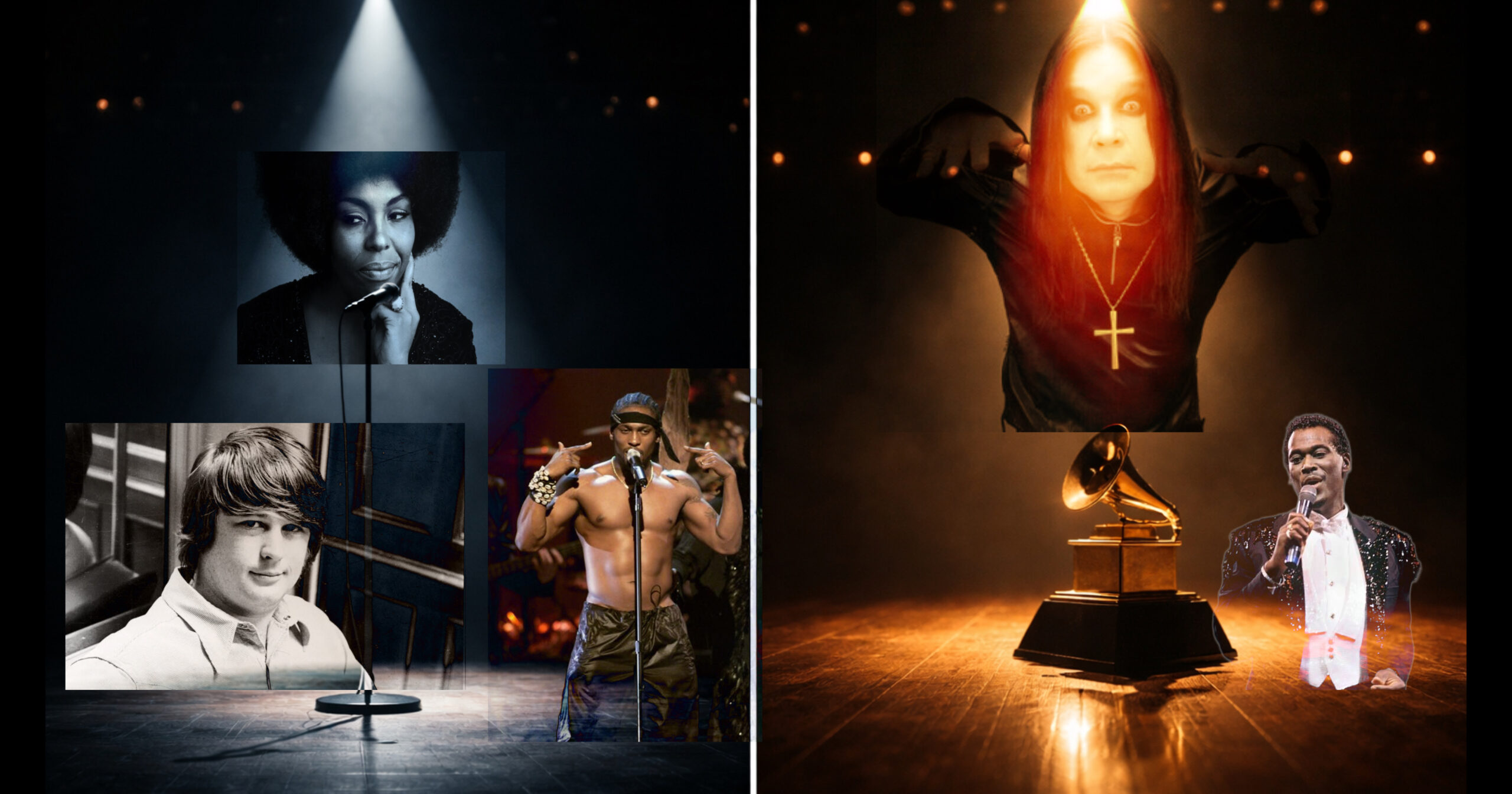
(February 2, 2026) – The most powerful moments of the 2026 Grammys – held in Los Angeles on Sunday (Feb. 1) – didn’t come from the many great performances of artists like Justin Bieber, Sabrina Carpenter, Lady Gaga, Tyler, the Creator, and Clipse.
They were not embodied in the many anti-ICE, anti-Trump sentiments expressed by host Trevor Noah, winners and presenters alike.
They came from absence.
Not the performative kind – the boycotts (or opt-outs) by people like Drake, Lil Wayne, Morgan Wallen, and the suddenly omnipresent Nicki Minaj – but the permanent kind. The kind that leaves a chair empty forever. The kind that forces a room to listen more intently. The kind that inspired one of the most memorable “In Memoriam” segments in recent show history.
This year’s ceremony will be remembered for Bad Bunny’s historic Album of the Year victory and for Kendrick Lamar’s crowning as the most decorated Grammy winner in hip-hop history. But it was shaped more by those who were no longer here to celebrate with us than it was by those who chose not to attend and whose absences have become the familiar annual Grammy sideshow. While Minaj’s absence was made conspicuous by Noah’s early jab about her current alliance with Donald Trump and the MAGA crowd, which elicited laughter and applause from seemingly the entire audience, the night’s emotional core rested squarely in its tributes to artists whose deaths in the past twelve months altered the musical landscape as we once knew it.
Rather than compressing decades of influence into a single song, the 2026 Grammys made an unusual — and wise —choice.
Recognizing that it would be nearly impossible to do justice in a four-minute song segment to the entirety of names like Sly Stone, Angie Stone, Mark Volman (of the Turtles), or The Grateful Dead’s Bob Weir and Donna Jean Godchaux, the 2026 Grammys broke the celebration into sections. These were not low-check memorials, but acknowledgments of legacies we may never see again.

The most quietly devastating absence – to this writer at least – was that of Brian Wilson, the former Beach Boy and eternal genius whose passing marked the loss of one American music’s greatest architects. There was no attempt to “update” his genius or dress it in spectacle (for Wilson didn’t live that way and certainly wouldn’t have wanted it that way posthumously). Instead, the show honored him first and last… and with restraint. Before the annual song-tribute to the other fallen artists began, Bruce Springsteen issued a pre-recorded heartfelt statement about what Wilson meant to him and the world, as a montage of Wilson’s music and images played throughout.
And later, as the show’s closing credits rolled, an inspired choice that spoke volumes – the Beach Boys’ “God Only Knows” – soundtracked a montage of historic Grammy moments with past hosts, winners and presenters making time-honored statements about the music and the spectacle that underscored the show’s past glory. The song choice alone was enough to evoke tears – at least in my living room – while reminding viewers why Wilson’s work endures more than six decades later.
But it was what came in between the homages to Wilson that elevated this “In Memoriam” past others. What began as a subtly performed tribute in the tradition of past ceremonies by Reba McEntire (performing the reworked song “Trailblazer” in partial tribute to her fallen step-son and Kelly Clarkson’s ex Brandon Blackstock) in her first-ever appearance on the Grammy stage suddenly transformed into a raucous altar-call to fallen rock god Ozzy Osbourne by Slash (of Guns N’ Roses) and former Ozzy duet partner Post Malone, who slayed — without Auto-Tune — on the Black Sabbath classic “War Pigs.”
It was enough to leave Osbourne’s family members – widow Sharon and their two children who were in attendance – in tears.
While other honored names like Ace Frehley (of KISS), Mick Ralphs (of Mott the Hoople and Bad Company), Rick Derringer, Chris Jasper (of the Isley Brothers), and many others flashed across the big screen behind the rocking tribute, Osbourne was deservedly the focus – at least of that five-minute segment — one that could only be topped by what came next.
That was when Ms. Lauryn Hill – the Grammy darling of 27 years prior who hadn’t made an appearance or an album since – curated what was likely the show’s most soulful and most reverent tribute of the century. Hill, who acted less like a reluctant icon and more like a steward of legacy, presided over what was a stellar dual tribute to two of 2025’s fallen soul icons: D’Angelo and Roberta Flack.
Hill began with a stirring rendition of “Nothing Even Matters” – the ballad from her lone solo LP The Miseducation of Lauryn Hill on which D’Angelo dueted and, as she indicated Sunday, the two never performed live together. She was then joined by a cast of R&B stars, including Bilal whose rendition of “Untitled (How Does it Feel)” was nearly as bone-chilling as D’Angelo’s original. Others, including the newly minted Grammy winner Leon Thomas, plus Jon Batiste, soon joined in a medley that included D’Angelo classics like “Brown Sugar” and “Lady” from his 1995 debut album.
The focus then segued to Roberta Flack as Hill began with the late singer’s first No. 1 “The First Time Ever I Saw Your Face” and culminated with her second, the classic “Killing Me Softly (With His Song),” which the Fugees transformed into their own masterpiece some 23 years after Flack’s original. Between those two, fellow icon Chaka Khan joined John Legend in a rendition of “Where Is the Love” – a 1972 duet Flack and the late Donny Hathaway took to the top ten – while others contributed renderings of Flack’s other ‘70s chart toppers “Feel Like Making Love” and “The Closer I Get to You.”
But it was “Killing Me Softly” – easily the night’s most anticipated performance given the shared song experience that was Hill’s and Flack’s, plus the reunion of Hill with fellow ex-Fugee Wyclef Jean – that generated the most hype as the entire audience never left its feet.
Still, that climactic moment somehow managed to be upstaged by yet another late artist’s absence.
As Cher – the soon-to-be 80-year-old but ageless diva who stunned in a black lace-and-leather outfit that not even the nipple-ring clasped dress worn by Chappell Roan could top – graced the stage to accept her Lifetime Achievement Award, she seemingly forgot that she was also there to present the night’s winner for Record of the Year. Once reminded by host Trevor, Cher introduced the pre-recorded reading of the nominees and then forgot that the winner’s name was in the envelope she was holding. Once she realized it, she announced the winner as “Luther Vandross.”
Vandross, deceased for 20 years, was the inspiration for the winning record, “Luther” by Kendrick Lamar & SZA, which Cher quickly corrected as Lamar, SZA and the song’s various producers took to the stage to accept the honor. As if to absolve Cher of her faux pas, Lamar respectfully and humbly acknowledged Vandross as the song’s inspiration in his acceptance speech and dedicated the award to the late “Here and Now” singer’s memory. Even in spirit, Vandross was sprinkling his magic dust over a live ceremony where mistakes could be equally made viral and forgivable.
It was against that backdrop that the show’s other absences told a different story. Artists like Nicki Minaj, Drake, and Morgan Wallen – whether through protest, grievance, or self-imposed exile – were nowhere to be found (although Minaj certainly made it clear she – like Donald Trump – was observing the show based on her social media posts afterwards). Their nonappearance was acknowledged, occasionally lampooned by host Noah, and then, notably, moved past.
And that may have been the most revealing contrast of the night. The Grammys didn’t revolve around who felt snubbed or who declined to submit their work. Instead, the ceremony was uplifted by the night’s amazing performances and the tributes to those whose voices were silenced but will forever be heard. Without the weight of ego, outrage, or excessive (albeit there were some) culture-war theatrics, this Grammys show found clarity in its central focus: music and legacy.
In honoring the dead with dignity rather than spectacle, the Grammys remembered what the ceremony was once built to do.
Yes, Bad Bunny’s historic win may have been the headline — but the loudest statements came from the artists who weren’t there at all.
DJRob
DJRob (he/him) is a freelance music blogger from the East Coast who covers R&B, hip-hop, disco, pop, rock and country genres – plus lots of music news and current stuff! You can follow him on Bluesky at @djrobblog.bsky.social, X (formerly Twitter) at @djrobblog, on Facebook or on Meta’s Threads.
You can also register for free by selecting the menu bars above to receive notifications of future articles.
It was also both cool and eerie that I Feel Like Making Love had been recorded by both Roberta Flack and D’Angelo!
Great insight!