


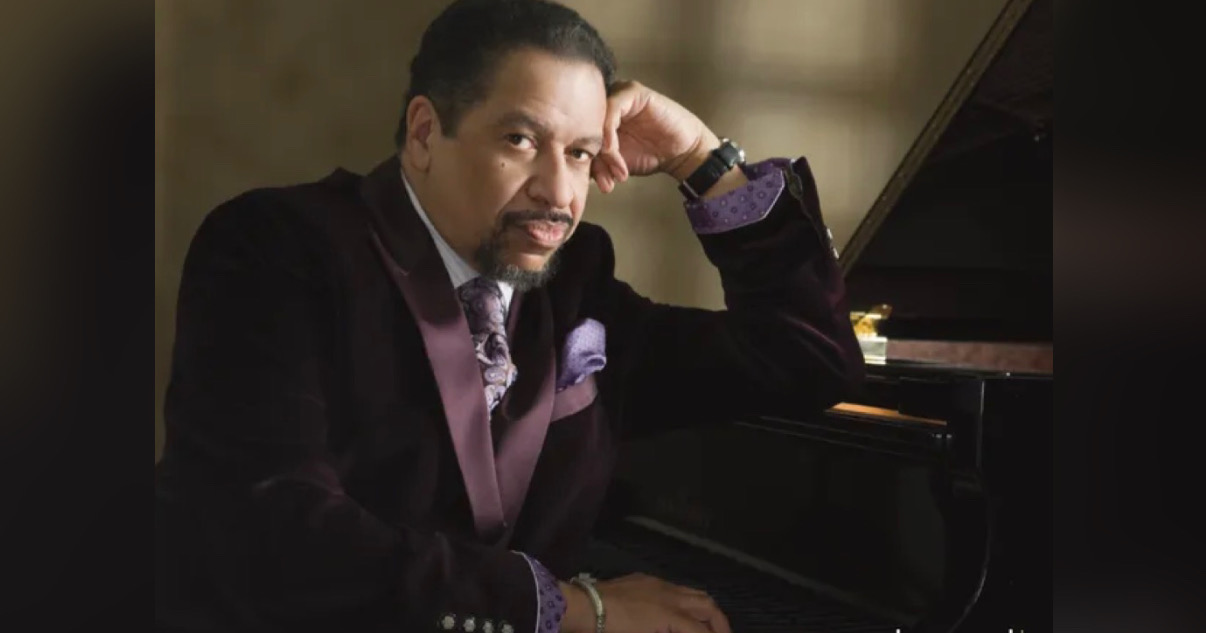
Why Richard Smallwood’s Legacy Matters Beyond ‘I Love the Lord’
(January 1, 2026) – An icon of one of the most profoundly Black music genres has been lost.
Richard Smallwood — a former child prodigy and towering figure in gospel music whose influence reached far beyond church walls — passed away in Sandy Spring, Maryland on Wednesday, Dec. 30, due to kidney failure. He was 77.
While Smallwood may not have been a household name outside gospel circles, within the Black community — and especially among church folk — he was nothing short of legendary.
His signature song was 1996’s “Total Praise,” with its unforgettable refrain, “You are the source of my strength.” Personal favorites included “Anthem of Praise,” drawn from Psalms 150 and 34, and the enduring “Center of My Joy.”
Smallwood also contributed to Mervyn Warren’s Handel’s Messiah: A Soulful Celebration, a multi-artist gospel landmark that won the Grammy for Best Contemporary Soul Gospel Album in 1992.
But his most widely recognized composition was “I Love the Lord,” famously covered by Whitney Houston for the 1996 film The Preacher’s Wife. That soundtrack remains the best-selling gospel album of all time — a staggering achievement that introduced Smallwood’s work to millions who may never have otherwise encountered gospel music in its purest form.
It was that Whitney Houston sync that made Smallwood something of an enigma — an artist whose influence did not depend on crossover validation. His success neither resulted from nor required the mainstream stamp of approval that so many Black artists — Houston included — needed to reach mass audiences.
Yet Smallwood’s name resonated deeply where it mattered most: within our community. His compositions featured soaring, intricate choral arrangements capable of rattling rafters, while his orchestral sensibilities elevated gospel without diluting its soul. His was easily among the most significant musical losses we experienced in 2025.
Smallwood, who’d been performing in (and forming) choirs since his childhood, began professionally releasing albums in the 1970s. But his breakthrough as a top gospel composer, singer, and musician (mostly piano, organ and synthesizer) happened in 1982 with the self-titled Richard Smallwood Singers album and then in 1984 with the follow-up Psalms. The latter set became his group’s first to top Billboard’s then-new Top Gospel Albums (known as Top Spiritual Albums at the time). The chart, which Billboard only published monthly at first, had been alternating space with its Christian pop chart — known then as Top Inspirational Albums – with both lists reflecting the largely disparate styles of music – largely divided along color lines – that were intended to serve the same evangelical purpose.
When Psalms first crowned Top Spiritual Albums in August 1984, the merits of Black crossover to broader audiences was being heavily debated. The focus was the then-unprecedented mainstream success of secular acts like Lionel Richie, Michael Jackson, and Prince — whose Purple Rain soundtrack ascended to the top of the all-genre Billboard 200 the same week Smallwood’s Psalms climbed to the top of the gospel chart. Industry insiders were asking whether Black artists were going too far in their attempts to appease wider (read “whiter”) audiences. More significantly, were the most successful of Black musicians going through “identity crises” and “losing their Blackness” in the process?
An article in an October 1984 issue of Billboard tackled this issue head-on, with the late producer/composer James Mtume, whose “Juicy Fruit” sold a million copies the year before without crossing over, lamenting “we’re getting so involved and so concerned with crossover that we’re losing our face.” He continued, “it’s sad because we have very few things left to support our identity anymore.”
Among those few things were Smallwood and gospel music in general, which hadn’t been the debate’s focus and had remained steeped in its Black roots. When Smallwood reached the top of the gospel charts, he was among fellow icons like Sandra Crouch (whose album Psalms replaced at No. 1), her twin brother Andre, and the legendary Shirley Caesar, as well as many other gospel greats of the day. Billboard’s companion ranking for Christian pop music – Top Inspirational Albums – was where white counterparts like Amy Grant, Michael W. Smith, and Sandy Patti dwelled. Aside from an occasional Andre Crouch siting in that chart’s lower ranks, the divide in musical praise was a case of rarely the two shall meet. In other words, this brand of soul-steeped gospel was uniquely and intentionally ours and was going to remain so.
Smallwood, who in a span of more than three decades charted 17 albums on Top Gospel Albums, including four No. 1s (Psalms plus three albums with the group Vision), eventually saw moderate success on Top Christian Albums. The albums Textures and Testimony – both with the Richard Smallwood Singers – reached the top 30 of the Christian charts (and top 10 Gospel) in 1987 and 1992, respectively. One of his live albums with Vision – Persuaded: Live in D.C. – did the same in 2001.
But those albums, like most in the gospel orbit, remained true to their cultural roots – roots that arose from centuries of enslaved Blacks who’d been brought to America and stripped of their language, customs and heritage. Out of the assemblage of culture that remained emerged the forms of Black American music that became blues, jazz, R&B and, of course, gospel — forms from which Smallwood never strayed.
The late gospel great eventually worked with secular artists like Chaka Khan, Boyz II Men, Stevie Wonder, and Destiny’s Child – all superstars whose pop and occasional gospel crossover success is noteworthy.
Ironically, it may be the cover of “I Love the Lord” by one of the most crossover-conscious artists of all time that secures Smallwood’s place in popular memory.
But to us, he was always far more than that — a guardian of tradition, a musical architect of praise, and proof that cultural integrity could thrive without compromise. He knew that Black gospel flows from our hearts and through every vein of our bodies. It represents both light and life.
RIP Richard Lee Smallwood (1948-2025).
DJRob
DJRob (he/him) is a freelance music blogger from the East Coast who covers R&B, hip-hop, disco, pop, rock and country genres – plus lots of music news and current stuff! You can follow him on Bluesky at @djrobblog.bsky.social, X (formerly Twitter) at @djrobblog, on Facebook or on Meta’s Threads.
You can also register for free by selecting the menu bars above to receive notifications of future articles.